QUESTION IMAGE
Question
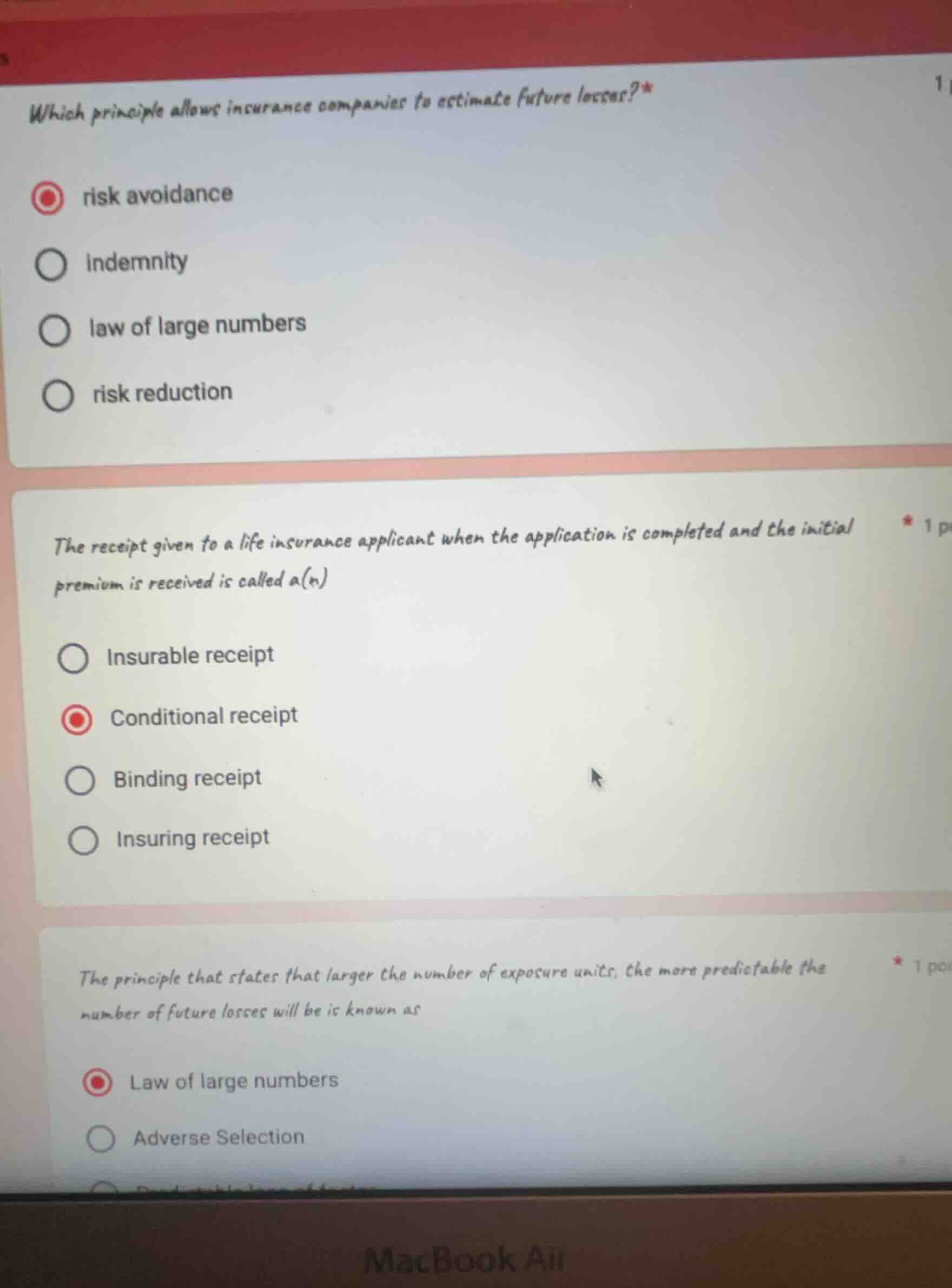
which principle allows insurance companies to estimate future losses?*
- risk avoidance
- indemnity
- law of large numbers
- risk reduction
the receipt given to a life insurance applicant when the application is completed and the initial premium is received is called a(n)
- insurable receipt
- conditional receipt
- binding receipt
- insuring receipt
the principle that states that larger the number of exposure units, the more predictable the number of future losses will be is known as
- law of large numbers
- adverse selection
Brief Explanations
- For the first question: Risk avoidance is avoiding a risky activity; indemnity is compensating for losses; risk reduction lessens loss severity. Only the law of large numbers uses large data sets to estimate future losses, which is how insurers operate.
- For the second question: An insurable receipt is not a standard term; a binding receipt provides immediate coverage; an insuring receipt is not the correct standard term. A conditional receipt covers the applicant only if they meet underwriting requirements after application and initial premium payment.
- For the third question: Adverse selection refers to high-risk individuals seeking insurance more. The law of large numbers directly states that more exposure units make future losses more predictable.

Snap & solve any problem in the app
Get step-by-step solutions on Sovi AI
Photo-based solutions with guided steps
Explore more problems and detailed explanations
- law of large numbers
- Conditional receipt
- Law of large numbers