QUESTION IMAGE
Question
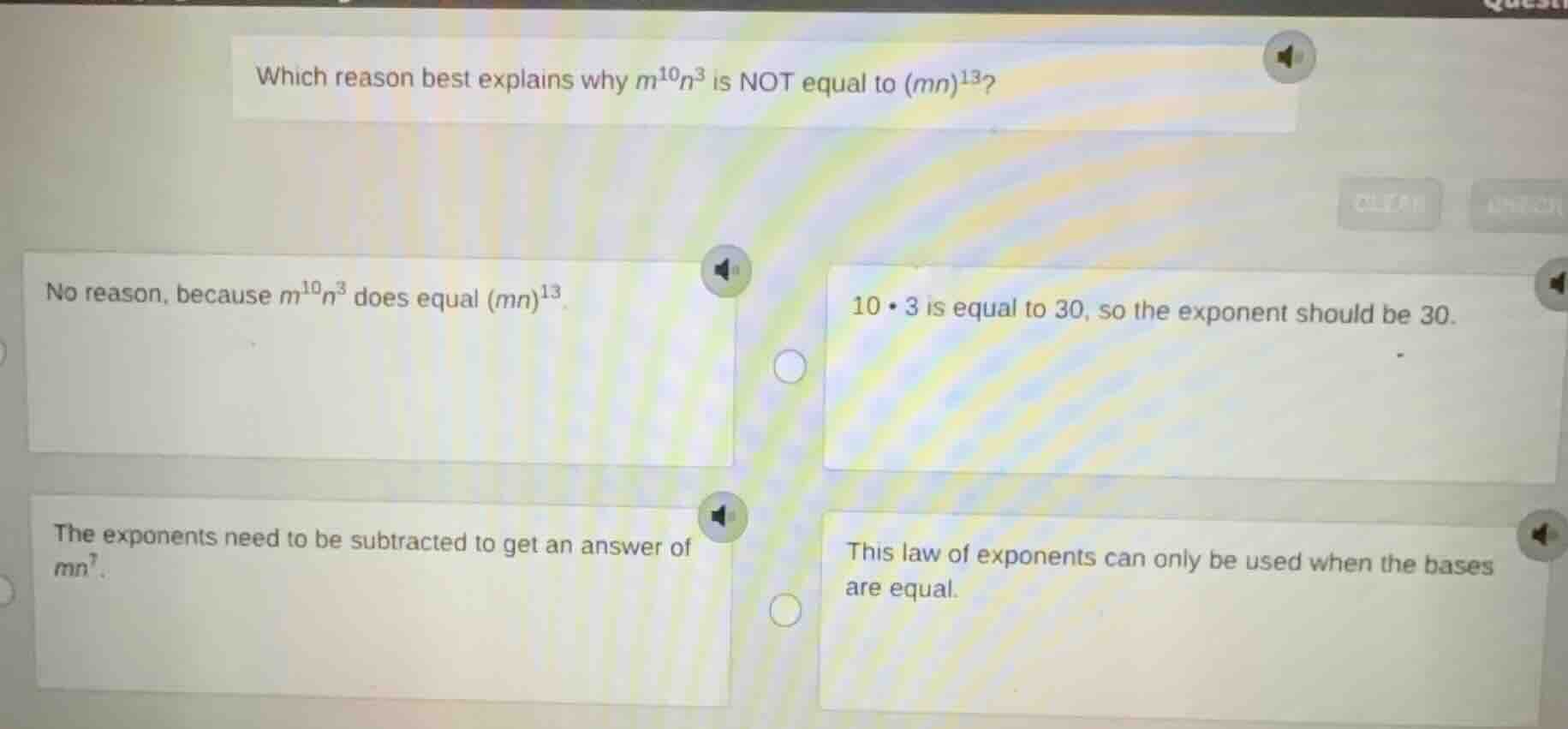
which reason best explains why $m^{10}n^{3}$ is not equal to $(mn)^{13}$?
no reason, because $m^{10}n^{3}$ does equal $(mn)^{13}$.
$10 \cdot 3$ is equal to 30, so the exponent should be 30.
the exponents need to be subtracted to get an answer of $mn^{7}$.
this law of exponents can only be used when the bases are equal.
To determine why \( m^{10}n^{3} \) is not equal to \( (mn)^{13} \), we analyze the exponent rules. The power - of - a - product rule \((ab)^n=a^n b^n\) applies when we raise a product to a power. For the rule \((mn)^k = m^k n^k\) to be used to combine \( m^{10}n^{3} \) into a single power of a product, the exponents of \( m \) and \( n \) must be the same (because the bases \( m \) and \( n \) are different, and the power - of - a - product rule requires applying the same exponent to each base in the product).
- The first option is wrong because \( m^{10}n^{3}
eq(mn)^{13}\).
- The second option is wrong because we do not multiply the exponents in \( m^{10}n^{3}\) to get a new exponent (the operation here is not related to multiplying the exponents of different bases).
- The third option is wrong because we do not subtract the exponents in this context (subtracting exponents is for division of like bases, e.g., \( \frac{a^m}{a^n}=a^{m - n}\), which is not the case here).
- The fourth option is correct. The law of exponents (power - of - a - product) that would combine \( m^a n^b\) into \((mn)^k\) requires \( a = b=k\) (since \((mn)^k=m^k n^k\)), so this law can only be used when the bases have the same exponent (or when we are raising a product to a power, and we apply the same exponent to each base in the product). Since the exponents of \( m \) and \( n \) in \( m^{10}n^{3}\) are different, we can't use the power - of - a - product rule to write it as \((mn)^{13}\) (because \( 10
eq3
eq13\) in a way that would satisfy the rule).

Snap & solve any problem in the app
Get step-by-step solutions on Sovi AI
Photo-based solutions with guided steps
Explore more problems and detailed explanations
This law of exponents can only be used when the bases are equal.