QUESTION IMAGE
Question
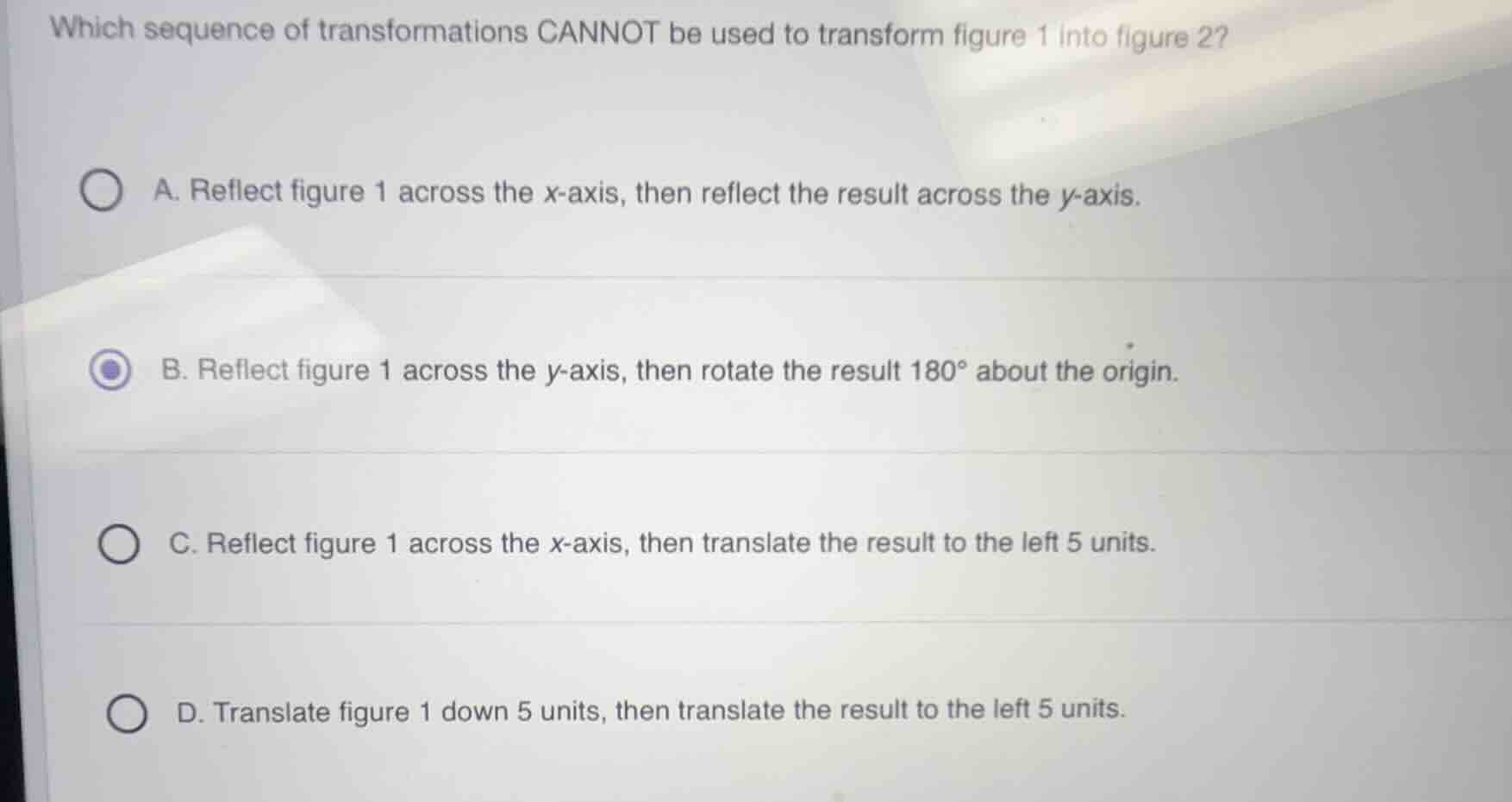
which sequence of transformations cannot be used to transform figure 1 into figure 2? a. reflect figure 1 across the x-axis, then reflect the result across the y-axis. b. reflect figure 1 across the y-axis, then rotate the result 180° about the origin. c. reflect figure 1 across the x-axis, then translate the result to the left 5 units. d. translate figure 1 down 5 units, then translate the result to the left 5 units.
Brief Explanations
To determine which transformation sequence fails, analyze each option:
- Option A: Reflecting over \(x\)-axis then \(y\)-axis is equivalent to a \(180^\circ\) rotation (or other valid mappings) and can transform figure 1 to 2.
- Option B: Reflecting over \(y\)-axis, then rotating \(180^\circ\) about the origin. A \(y\)-axis reflection followed by \(180^\circ\) rotation does not align figure 1 to 2 (e.g., test with a vertex: reflect \((x,y)\) over \(y\)-axis to \((-x,y)\), then rotate \(180^\circ\) to \((x,-y)\), which does not match the target transformation).
- Option C: Reflect over \(x\)-axis (flips vertically) then translate left 5 units—this can align the figures.
- Option D: Translate down 5 then left 5—this is a valid translation sequence for the transformation.

Snap & solve any problem in the app
Get step-by-step solutions on Sovi AI
Photo-based solutions with guided steps
Explore more problems and detailed explanations
B. Reflect figure 1 across the \(y\)-axis, then rotate the result \(180^\circ\) about the origin.