QUESTION IMAGE
Question
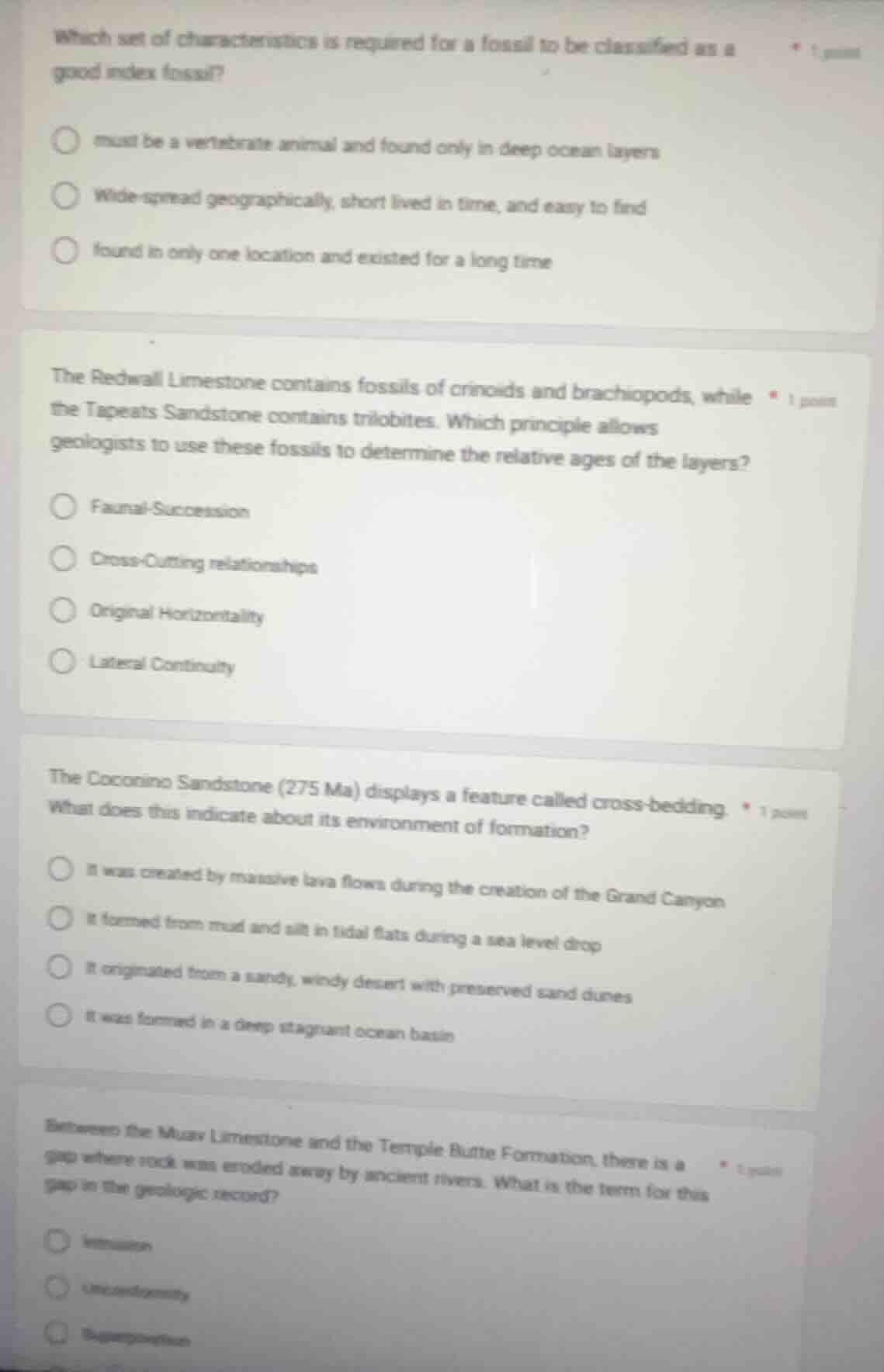
which set of characteristics is required for a fossil to be classified as a good index fossil? must be a vertebrate animal and found only in deep ocean layers wide - spread geographically, short lived in time, and easy to find found in only one location and existed for a long time the redwall limestone contains fossils of crinoids and brachiopods, while the tapeats sandstone contains trilobites. which principle allows geologists to use these fossils to determine the relative ages of the layers? faunal succession cross - cutting relationships original horizontality lateral continuity the coconino sandstone (275 ma) displays a feature called cross - bedding. what does this indicate about its environment of formation? it was created by massive lava flows during the creation of the grand canyon it formed from mud and silt in tidal flats during a sea level drop it originated from a sandy, windy desert with preserved sand dunes it was formed in a deep stagnant ocean basin between the muav limestone and the temple butte formation, there is a gap where rock was eroded away by ancient rivers. what is the term for this gap in the geologic record? intrusion unconformity superposition
First Question (Index Fossil Characteristics)
An index fossil needs to be widespread (so it can be used across areas), short - lived (to mark a specific time period), and easy to identify/find. The first option is wrong as it doesn't need to be a vertebrate or only in deep ocean layers. The third option is wrong because being in one location and long - lived doesn't help with dating across areas and time.
The principle of Faunal Succession says that fossil assemblages change over time in a predictable order. So geologists can use the different fossils (crinoids, brachiopods, trilobites) in different rock layers to determine relative ages. Cross - Cutting Relationships is about rock features cutting through others, Original Horizontality is about sedimentary layers being horizontal initially, and Lateral Continuity is about sedimentary layers extending laterally. These don't relate to using fossils for age determination.
Cross - bedding is a feature formed by wind - blown sand dunes. Lava flows form different rock structures, tidal flats form different sedimentary structures, and deep ocean basins don't form cross - bedding from sand dunes. So the environment was a sandy, windy desert with sand dunes.

Snap & solve any problem in the app
Get step-by-step solutions on Sovi AI
Photo-based solutions with guided steps
Explore more problems and detailed explanations
B. Wide - spread geographically, short lived in time, and easy to find