QUESTION IMAGE
Question
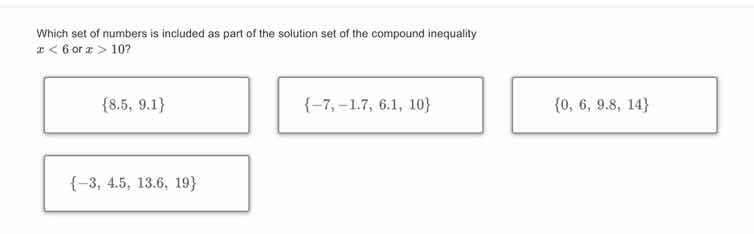
which set of numbers is included as part of the solution set of the compound inequality
$x < 6$ or $x > 10$
{8.5, 9.1}
{-7, -1.7, 6.1, 10}
{0, 6, 9.8, 14}
{-3, 4.5, 13.6, 19}
Step1: Analyze the compound inequality
The compound inequality is \(x < 6\) or \(x>10\). We need to check each set of numbers to see which one has all elements satisfying either \(x < 6\) or \(x>10\).
Step2: Check the first set \(\{8.5, 9.1\}\)
For \(8.5\): \(6<8.5<10\), so it does not satisfy \(x < 6\) or \(x>10\).
For \(9.1\): \(6<9.1<10\), so it does not satisfy \(x < 6\) or \(x>10\). So this set is not part of the solution.
Step3: Check the second set \(\{-7, -1.7, 6.1, 10\}\)
For \(-7\): \(-7 < 6\), satisfies.
For \(-1.7\): \(-1.7 < 6\), satisfies.
For \(6.1\): \(6<6.1<10\), does not satisfy.
For \(10\): \(10\) is not greater than \(10\) (the inequality is \(x > 10\), not \(x\geq10\)), so does not satisfy. So this set is not part of the solution.
Step4: Check the third set \(\{0, 6, 9.8, 14\}\)
For \(0\): \(0 < 6\), satisfies.
For \(6\): \(6\) is not less than \(6\) (inequality is \(x < 6\), not \(x\leq6\)), so does not satisfy.
For \(9.8\): \(6<9.8<10\), does not satisfy.
For \(14\): \(14>10\), satisfies. But since there are elements that don't satisfy, this set is not part of the solution.
Step5: Check the fourth set \(\{-3, 4.5, 13.6, 19\}\)
For \(-3\): \(-3 < 6\), satisfies.
For \(4.5\): \(4.5 < 6\), satisfies.
For \(13.6\): \(13.6>10\), satisfies.
For \(19\): \(19>10\), satisfies. All elements satisfy either \(x < 6\) or \(x>10\).

Snap & solve any problem in the app
Get step-by-step solutions on Sovi AI
Photo-based solutions with guided steps
Explore more problems and detailed explanations
\(\{-3, 4.5, 13.6, 19\}\)