QUESTION IMAGE
Question
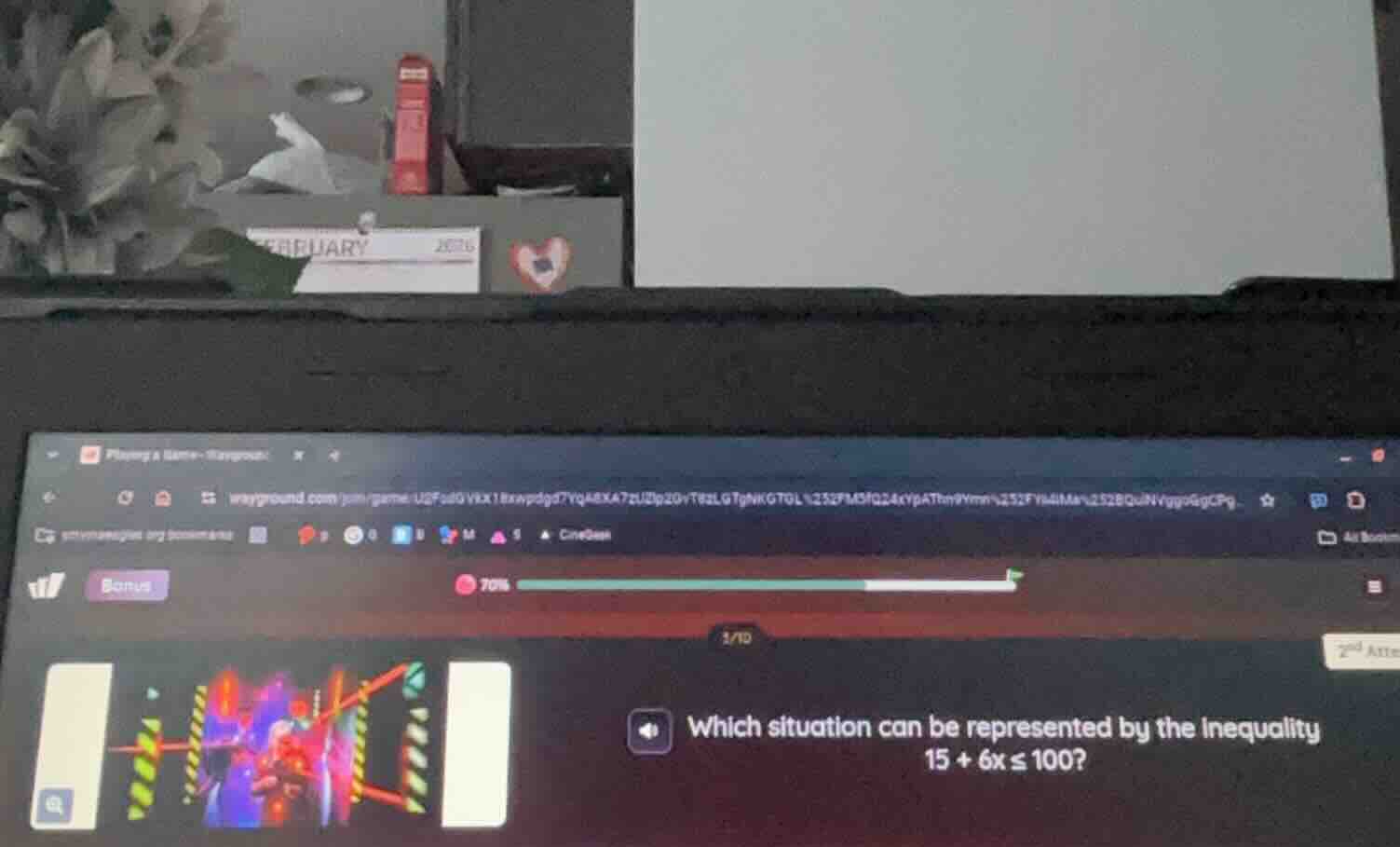
which situation can be represented by the inequality 15 + 6x ≤ 100?
To solve the problem of determining which situation is represented by the inequality \(15 + 6x \leq 100\), we analyze the inequality:
Step 1: Understand the inequality components
The inequality \(15 + 6x \leq 100\) has a fixed initial value of \(15\) and a variable term \(6x\) (where \(x\) is the number of items with a cost of \(6\) each), and the total is at most \(100\).
Step 2: Interpret possible scenarios
For example, if we consider a situation where:
- You have an initial amount of \(15\) dollars.
- Each item you buy costs \(6\) dollars.
- The total amount you spend (initial + cost of \(x\) items) must be less than or equal to \(100\) dollars.
Mathematically, this is represented as \(15 + 6x \leq 100\), where \(x\) is the number of items you can buy.
Step 3: Solve for \(x\) (optional, to check feasibility)
Subtract \(15\) from both sides:
\[
6x \leq 100 - 15
\]
\[
6x \leq 85
\]
Divide both sides by \(6\):
\[
x \leq \frac{85}{6} \approx 14.17
\]
So \(x\) (the number of items) must be a non - negative integer less than or equal to \(14\).
A possible situation is:[LLM SSE On Failure]

Snap & solve any problem in the app
Get step-by-step solutions on Sovi AI
Photo-based solutions with guided steps
Explore more problems and detailed explanations
To solve the problem of determining which situation is represented by the inequality \(15 + 6x \leq 100\), we analyze the inequality:
Step 1: Understand the inequality components
The inequality \(15 + 6x \leq 100\) has a fixed initial value of \(15\) and a variable term \(6x\) (where \(x\) is the number of items with a cost of \(6\) each), and the total is at most \(100\).
Step 2: Interpret possible scenarios
For example, if we consider a situation where:
- You have an initial amount of \(15\) dollars.
- Each item you buy costs \(6\) dollars.
- The total amount you spend (initial + cost of \(x\) items) must be less than or equal to \(100\) dollars.
Mathematically, this is represented as \(15 + 6x \leq 100\), where \(x\) is the number of items you can buy.
Step 3: Solve for \(x\) (optional, to check feasibility)
Subtract \(15\) from both sides:
\[
6x \leq 100 - 15
\]
\[
6x \leq 85
\]
Divide both sides by \(6\):
\[
x \leq \frac{85}{6} \approx 14.17
\]
So \(x\) (the number of items) must be a non - negative integer less than or equal to \(14\).
A possible situation is:[LLM SSE On Failure]