QUESTION IMAGE
Question
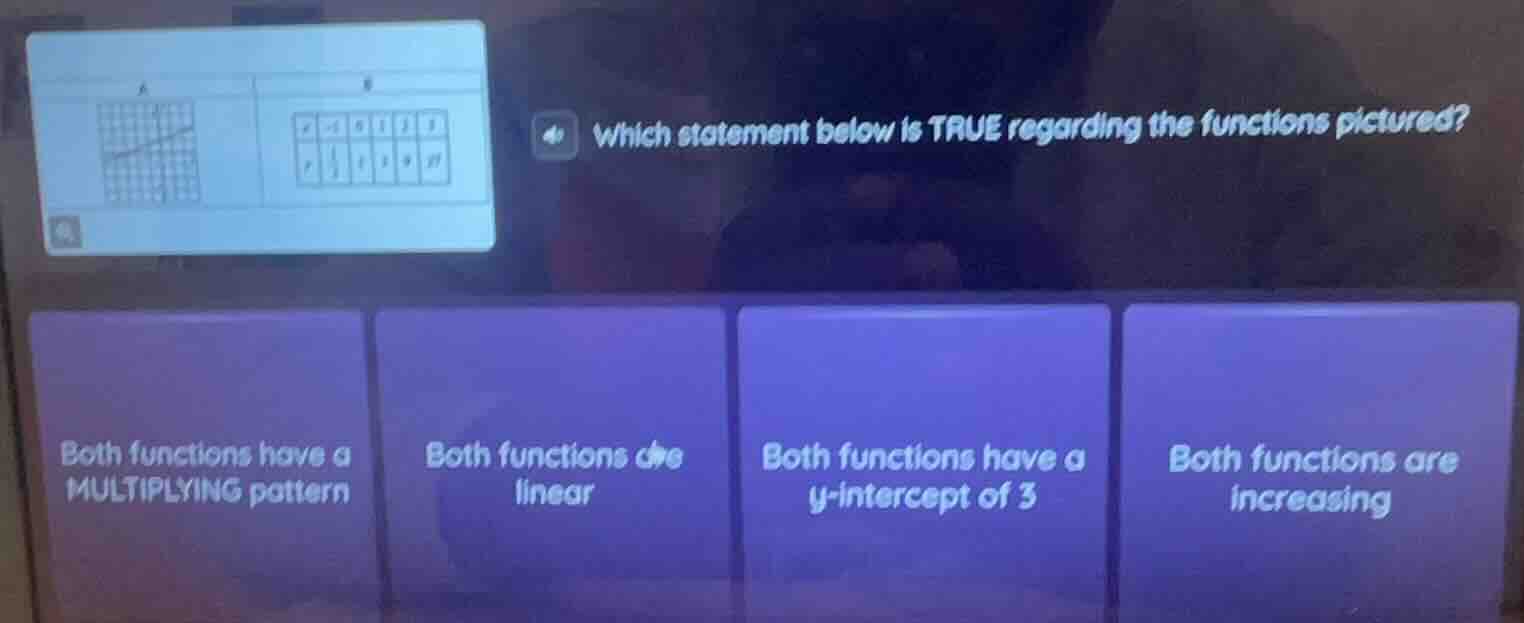
which statement below is true regarding the functions pictured? both functions have a multiplying pattern; both functions are linear; both functions have a y-intercept of 3; both functions are increasing
Step1: Analyze Table Function
The table has x-values: 0,1,2,3,4,5 and y-values: 3,5,7,9,11,13. Calculate the rate of change: $\frac{5-3}{1-0}=2$, $\frac{7-5}{2-1}=2$. This is a constant rate, so it's linear, with equation $y=2x+3$. It is increasing, has a y-intercept of 3, and an additive pattern.
Step2: Analyze Graph Function
The graph is a straight line (linear). It rises from left to right, so it is increasing. To check y-intercept: when $x=0$, the line crosses at $y=3$. The rate of change is positive (additive, not multiplying).
Step3: Evaluate Each Option
- "Both functions have a MULTIPLYING pattern": False, both have additive (constant slope) patterns.
- "Both functions are linear": True, but let's check others.
- "Both functions have a y-intercept of 3": True, but check the last option.
- "Both functions are increasing": True? Wait, re-verify: table y increases as x increases, graph rises. But wait, let's confirm all:
Wait, linear functions with positive slope are increasing. But let's check which is all true. Wait, the table is $y=2x+3$, graph is a line with positive slope, y-intercept 3. Now, check each option:
- Multiplying pattern: No, it's additive (each x increases by 1, y increases by 2). So false.
- Both are linear: Yes, table is linear (constant rate), graph is straight line (linear).
- Both have y-intercept 3: Table has y=3 when x=0, graph crosses y-axis at 3: yes.
- Both are increasing: Table y goes up as x goes up, graph rises: yes. Wait, but let's check again. Wait, maybe I misread the graph? No, the graph is a rising line. But wait, let's check which statements are true. Wait, but let's check if all are true? No, wait the first option is false. Now, let's confirm:
Wait, the table: x=0,y=3; x=1,y=5: difference +2. So linear, increasing, y-intercept 3. Graph: straight line, starts at (0,3), goes up: linear, increasing, y-intercept 3.
Wait, but the options: let's check each:
- "Both functions have a MULTIPLYING pattern": False, it's additive.
- "Both functions are linear": True
- "Both functions have a y-intercept of 3": True
- "Both functions are increasing": True
Wait, but maybe the graph is not starting at 3? Wait no, the table has x=0,y=3, which is y-intercept. The graph's line passes through (0,3) as per the grid. Wait, but maybe the question has only one true answer? Wait, no, let's recheck. Wait, maybe I made a mistake. Wait, the table: when x=0, y=3; x=1,y=5: slope 2, so $y=2x+3$. The graph: let's see, the grid: the line goes from (0,3) to (2,7), which is slope $\frac{7-3}{2-0}=2$, so same as table? No, but regardless, it's linear, increasing, y-intercept 3.
Wait, but the options: maybe all except first are true? But no, let's check the question again. Wait, maybe the graph is not linear? No, it's a straight line. Wait, maybe the "multiplying pattern" is exponential? No, this is linear, so additive.
Wait, but let's check each option again:
- Multiplying pattern: False, because y increases by a constant addend, not a multiplier.
- Both are linear: True, table has constant rate of change, graph is straight line.
- Both have y-intercept 3: True, table has y=3 at x=0, graph crosses y-axis at 3.
- Both are increasing: True, as x increases, y increases for both.
Wait, but maybe the question has multiple correct? But let's check the original problem. Wait, maybe I misread the table. The table: x values 0,1,2,3,4,5; y values 3,5,7,9,11,13. Yes, that's correct. The graph is a straight line going up, starting at (0,3).
Wait, but let's confirm which are true. All options except the first are tru…

Snap & solve any problem in the app
Get step-by-step solutions on Sovi AI
Photo-based solutions with guided steps
Explore more problems and detailed explanations
B. Both functions are linear
C. Both functions have a y-intercept of 3
D. Both functions are increasing