QUESTION IMAGE
Question
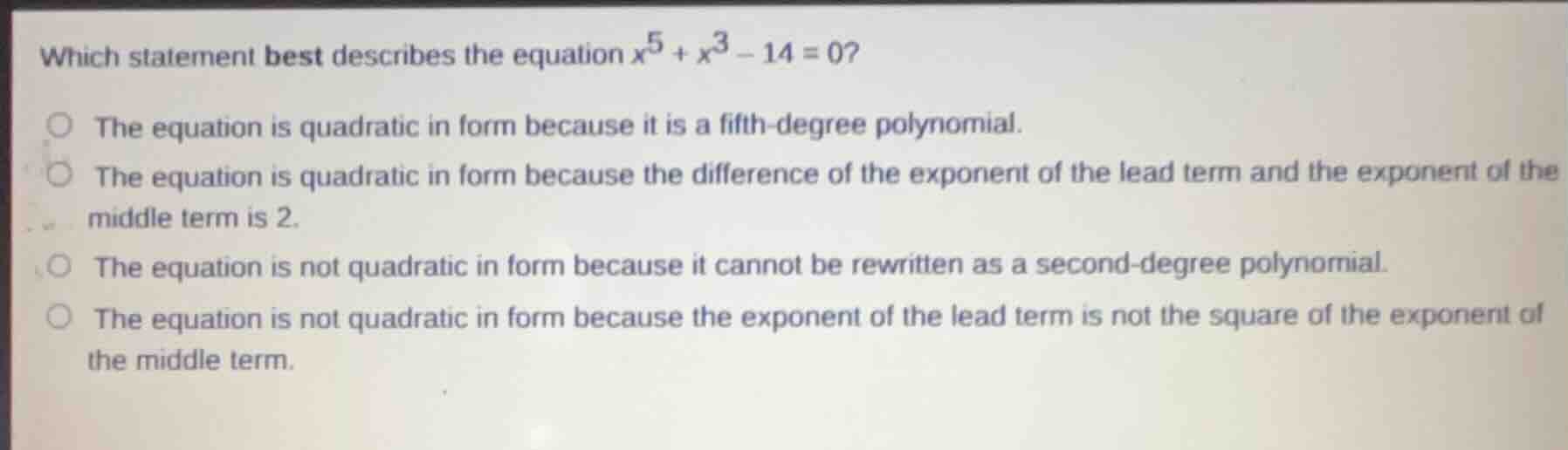
which statement best describes the equation $x^5 + x^3 - 14 = 0$?
the equation is quadratic in form because it is a fifth-degree polynomial.
the equation is quadratic in form because the difference of the exponent of the lead term and the exponent of the middle term is 2.
the equation is not quadratic in form because it cannot be rewritten as a second-degree polynomial.
the equation is not quadratic in form because the exponent of the lead term is not the square of the exponent of the middle term.
A quadratic in form equation can be rewritten as a second-degree polynomial using a substitution. For $x^5 + x^3 - 14 = 0$, let $u = x^n$: if we try $u = x^3$, the first term becomes $x^5 = x^2 \cdot x^3 = u \cdot x^2$, which cannot be expressed as a term of $u$ alone. If we try $u = x^2$, the first term is $x^5 = x \cdot x^4 = x \cdot u^2$, and the middle term is $x^3 = x \cdot u$, still leaving an $x$ term. This means the equation cannot be rewritten as a pure second-degree polynomial in a single variable, so it is not quadratic in form. We also eliminate incorrect options: a fifth-degree polynomial does not make it quadratic in form, the difference of exponents being 2 is not the correct criterion, and the lead exponent does not need to be the square of the middle exponent for quadratic form.

Snap & solve any problem in the app
Get step-by-step solutions on Sovi AI
Photo-based solutions with guided steps
Explore more problems and detailed explanations
C. The equation is not quadratic in form because it cannot be rewritten as a second-degree polynomial.