QUESTION IMAGE
Question
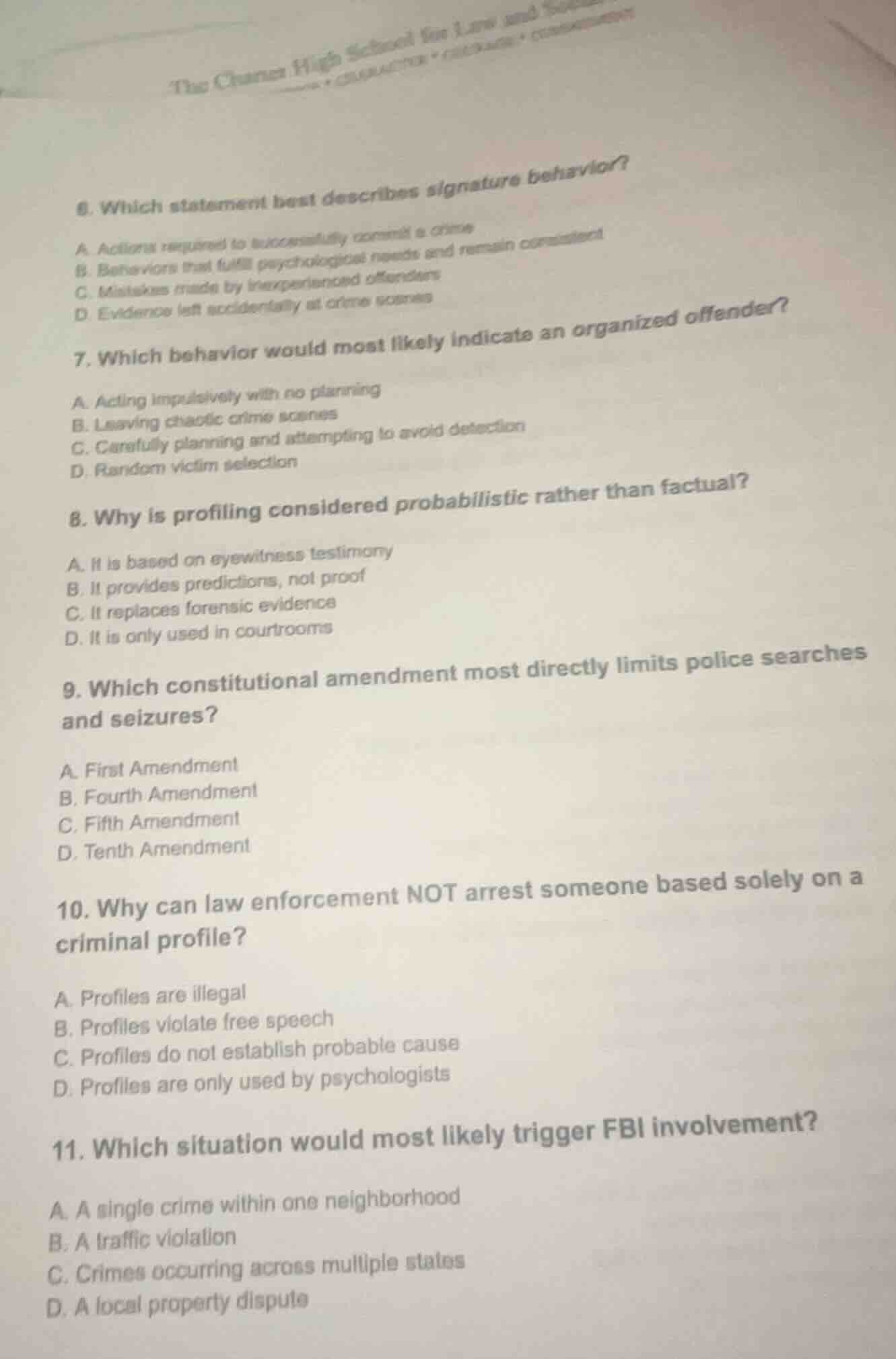
- which statement best describes signature behavior?
a. actions required to successfully commit a crime
b. behaviors that fulfill psychological needs and remain consistent
c. mistakes made by inexperienced offenders
d. evidence left accidentally at crime scenes
- which behavior would most likely indicate an organized offender?
a. acting impulsively with no planning
b. leaving chaotic crime scenes
c. carefully planning and attempting to avoid detection
d. random victim selection
- why is profiling considered probabilistic rather than factual?
a. it is based on eyewitness testimony
b. it provides predictions, not proof
c. it replaces forensic evidence
d. it is only used in courtrooms
- which constitutional amendment most directly limits police searches and seizures?
a. first amendment
b. fourth amendment
c. fifth amendment
d. tenth amendment
- why can law enforcement not arrest someone based solely on a criminal profile?
a. profiles are illegal
b. profiles violate free speech
c. profiles do not establish probable cause
d. profiles are only used by psychologists
- which situation would most likely trigger fbi involvement?
a. a single crime within one neighborhood
b. a traffic violation
c. crimes occurring across multiple states
d. a local property dispute
- Signature behavior refers to consistent actions by an offender that satisfy their psychological needs, not just the practical steps to commit a crime.
- Organized offenders plan crimes carefully and take steps to avoid being caught, unlike disorganized offenders who act impulsively.
- Criminal profiling uses patterns and trends to make predictions about offenders, not definitive, proven facts, so it is probabilistic.
- The Fourth Amendment to the U.S. Constitution protects against unreasonable searches and seizures, directly limiting police actions in this area.
- Probable cause (objective evidence linking someone to a crime) is required for an arrest; profiles only provide general likelihoods, not this concrete evidence.
- The FBI has jurisdiction over crimes that cross state lines, as they fall under federal authority, while local crimes are handled by local law enforcement.

Snap & solve any problem in the app
Get step-by-step solutions on Sovi AI
Photo-based solutions with guided steps
Explore more problems and detailed explanations
- B. Behaviors that fulfill psychological needs and remain consistent
- C. Carefully planning and attempting to avoid detection
- B. It provides predictions, not proof
- B. Fourth Amendment
- C. Profiles do not establish probable cause
- C. Crimes occurring across multiple states