QUESTION IMAGE
Question
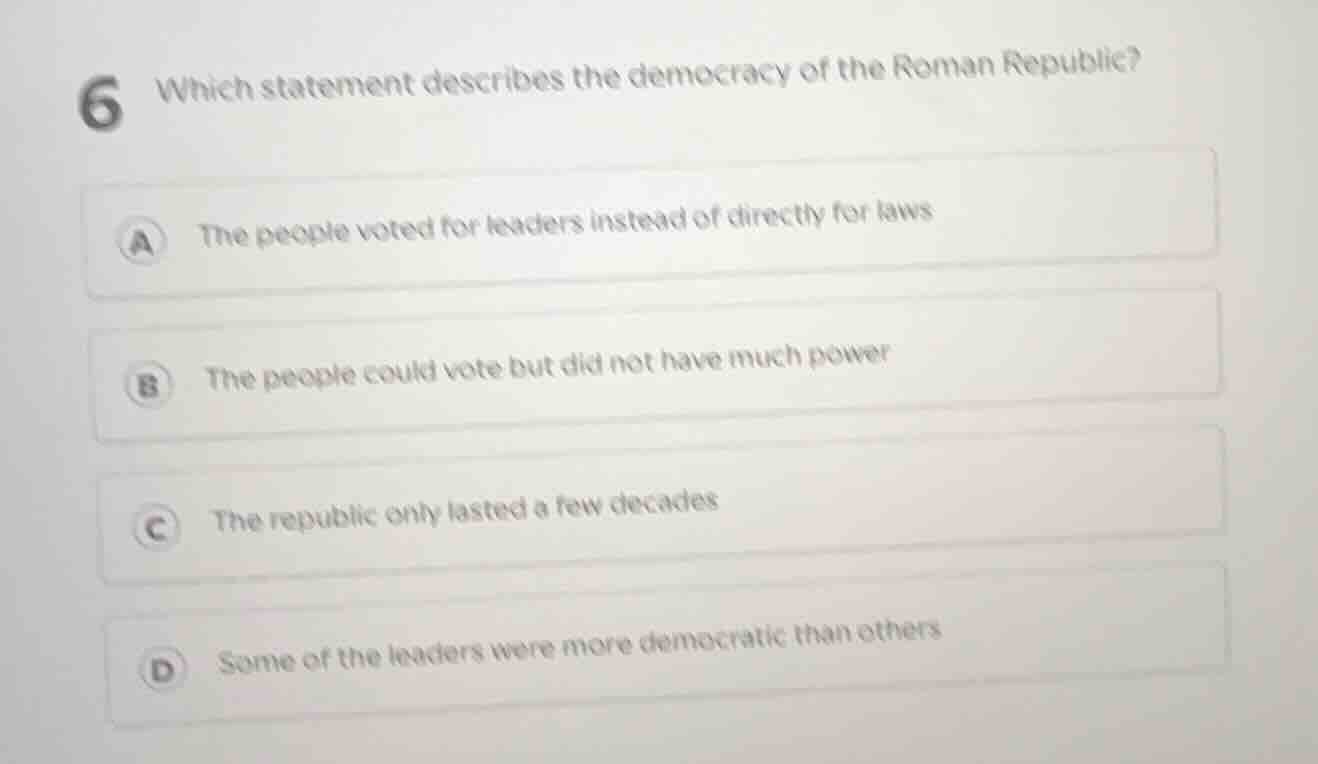
6 which statement describes the democracy of the roman republic? a the people voted for leaders instead of directly for laws b the people could vote but did not have much power c the republic only lasted a few decades d some of the leaders were more democratic than others
To determine the correct statement about the democracy of the Roman Republic:
- Option A: In the Roman Republic, the people elected representatives (leaders) who then made laws, rather than voting directly on laws. This is a key feature of their republican democracy.
- Option B: While there were class - based power dynamics, the statement "did not have much power" is an oversimplification. The plebeians, through their representatives (tribunes) and voting in assemblies, had significant influence over time.
- Option C: The Roman Republic lasted for several centuries (from 509 BC to 27 BC), so this is incorrect.
- Option D: The question is about the system of democracy, not the individual democratic nature of leaders. This option is not relevant to describing the democratic system of the Roman Republic.
- Option A: In the Roman Republic, citizens elected representatives (leaders such as consuls, senators) who were responsible for law - making. Citizens did not vote directly on laws but chose the leaders who would create and pass laws. This accurately describes the representative nature of Roman Republic's democracy.
- Option B: The Roman citizens, especially over time as the plebeians gained more rights, had significant power. They could vote in assemblies (like the Centuriate Assembly, Tribal Assembly) and their votes influenced political decisions. So the claim that they "did not have much power" is incorrect.
- Option C: The Roman Republic existed from 509 BC to 27 BC, lasting for centuries, not a few decades.
- Option D: The question is about the democratic system, not the varying democratic tendencies of individual leaders. This option is not relevant to describing the system of democracy in the Roman Republic.

Snap & solve any problem in the app
Get step-by-step solutions on Sovi AI
Photo-based solutions with guided steps
Explore more problems and detailed explanations
B. The people could vote but did not have much power (Note: There is a correction here. The correct answer should be A. The people voted for leaders instead of directly for laws. The initial analysis of option B was wrong. In the Roman Republic, the people (citizens) voted for representatives (leaders like senators, consuls, etc.) who would then make laws. The plebeians also had the right to vote in the plebeian assembly. The idea that they "did not have much power" is incorrect. The correct reasoning for option A: In the Roman Republic, it was a representative democracy where citizens elected leaders (e.g., consuls, senators) and these leaders were responsible for law - making. Citizens did not vote directly on laws but elected those who would create and pass laws. So the correct answer is A. The people voted for leaders instead of directly for laws)
Correcting the final answer based on accurate historical knowledge: