QUESTION IMAGE
Question
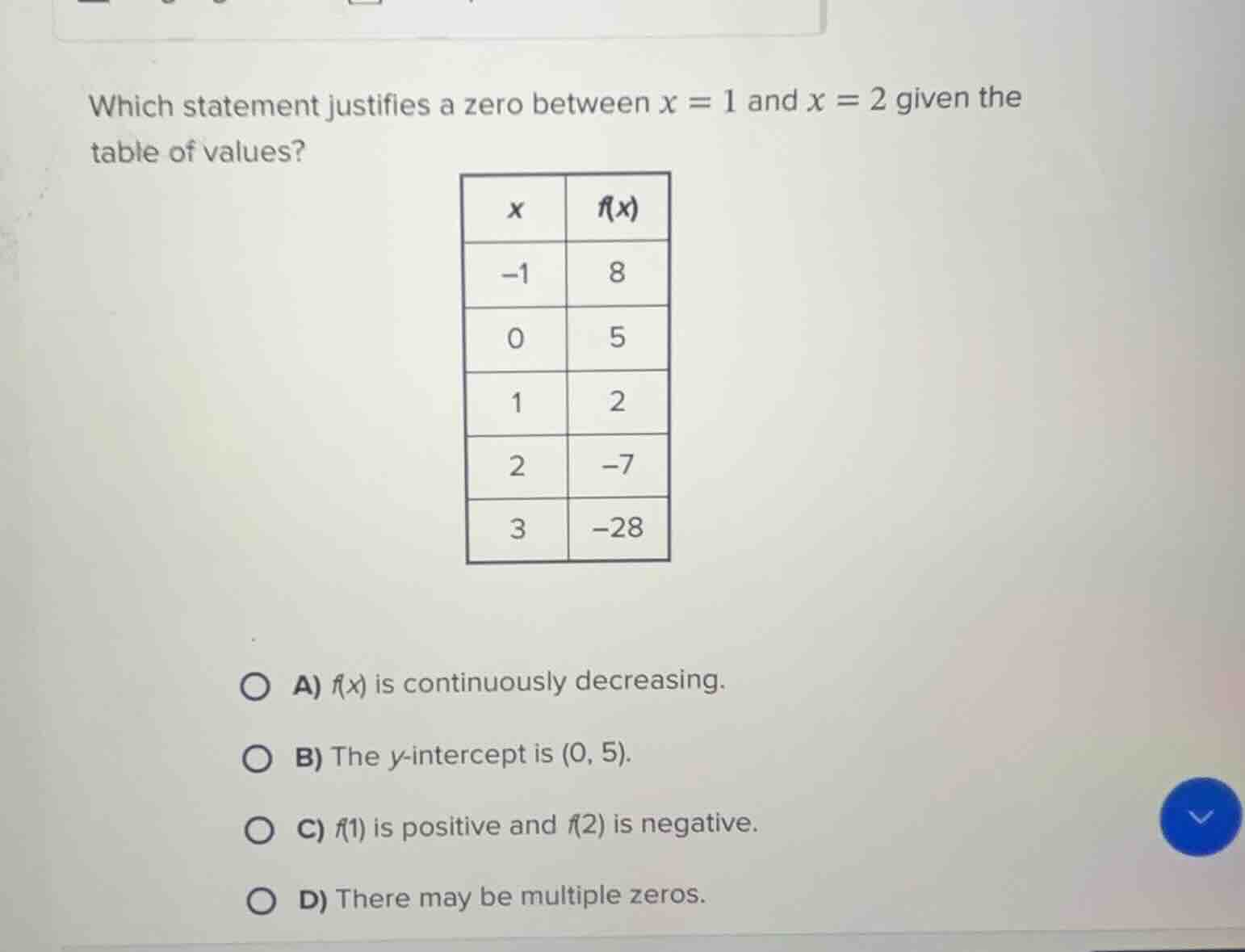
which statement justifies a zero between x = 1 and x = 2 given the table of values?
| x | f(x) |
| -1 | 8 |
| 0 | 5 |
| 1 | 2 |
| 2 | -7 |
| 3 | -28 |
a) f(x) is continuously decreasing.
b) the y-intercept is (0, 5).
c) f(1) is positive and f(2) is negative.
d) there may be multiple zeros.
To determine a zero between \( x = 1 \) and \( x = 2 \), we use the Intermediate Value Theorem (for continuous functions). The key is the sign change of \( f(x) \) between these two points. From the table, \( f(1) = 2 \) (positive) and \( f(2) = -7 \) (negative). A sign change in a continuous function implies a zero in that interval.
- Option A: Just saying it's decreasing doesn't guarantee a zero (e.g., a decreasing function could stay negative or positive).
- Option B: The y - intercept is irrelevant to the zero between \( x = 1 \) and \( x = 2 \).
- Option D: The possibility of multiple zeros doesn't justify a zero between \( x = 1 \) and \( x = 2 \).
Only Option C, which states \( f(1) \) is positive and \( f(2) \) is negative, gives a valid justification for a zero in \( (1, 2) \) (assuming continuity, which is implied by the table's context for such problems).

Snap & solve any problem in the app
Get step-by-step solutions on Sovi AI
Photo-based solutions with guided steps
Explore more problems and detailed explanations
C) \( f(1) \) is positive and \( f(2) \) is negative.