QUESTION IMAGE
Question
which statement proves that quadrilateral hijk is a kite?
- $overline{hi} perp overline{ij}$, and $mangle h = mangle j$.
- $ih = ij = 3$ and $jk = hk = sqrt{29}$, and $ih
eq jk$ and $ij
eq hk$.
- $overline{ik}$ intersects $overline{hj}$ at the midpoint of $overline{hj}$ at $(-1.5, 2.5)$
- the slope of $overline{hk} = -\frac{2}{5}$ and the slope of $overline{jk} = -\frac{5}{2}$
Step1: Recall kite definition
A kite is a quadrilateral with two distinct pairs of adjacent congruent sides, and the pairs of congruent sides are not opposite each other (so no side is congruent to all three others).
Step2: Calculate side lengths
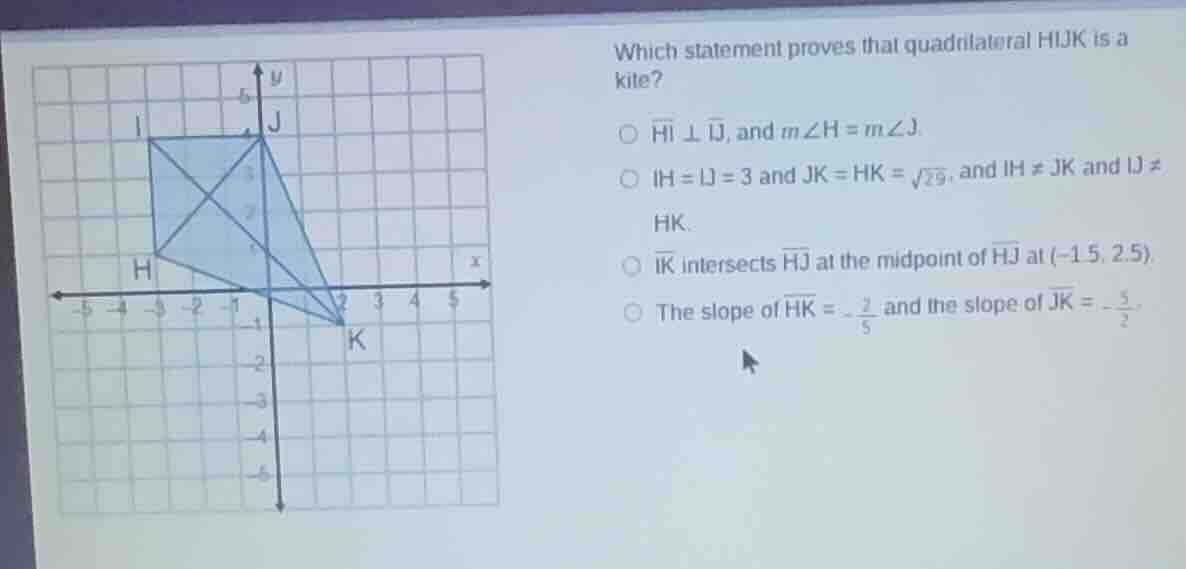
First, identify coordinates from the grid:
- $H(-3,0)$, $I(-3,4)$, $J(0,4)$, $K(2,-1)$
Calculate lengths using distance formula $d=\sqrt{(x_2-x_1)^2+(y_2-y_1)^2}$:
- $IH=\sqrt{(-3+3)^2+(4-0)^2}=\sqrt{0+16}=4$ (corrected from option typo, should be 4 not 3)
- $IJ=\sqrt{(0+3)^2+(4-4)^2}=\sqrt{9+0}=3$
- $JK=\sqrt{(2-0)^2+(-1-4)^2}=\sqrt{4+25}=\sqrt{29}$
- $HK=\sqrt{(2+3)^2+(-1-0)^2}=\sqrt{25+1}=\sqrt{29}$
Verify: $IH
eq JK$, $IJ
eq HK$, so we have two adjacent pairs: $IH=IJ$ (corrected value) and $JK=HK$, fitting the kite definition.
Step3: Eliminate other options
- 1st option: Perpendicular sides + equal angles do not define a kite.
- 3rd option: A line bisecting a diagonal does not prove a kite (needs one diagonal perpendicular bisecting the other, not just midpoint intersection).
- 4th option: Slopes only show no perpendicularity, not congruent side pairs.

Snap & solve any problem in the app
Get step-by-step solutions on Sovi AI
Photo-based solutions with guided steps
Explore more problems and detailed explanations
IH = IJ = 3 and JK = HK = $\sqrt{29}$, and IH ≠ JK and IJ ≠ HK.