QUESTION IMAGE
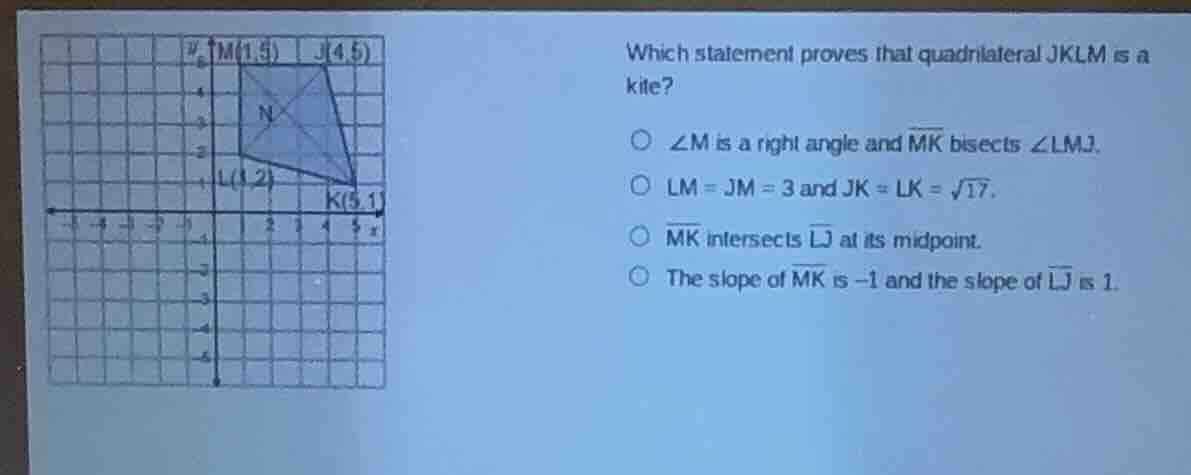
Question
which statement proves that quadrilateral jklm is a kite?
- ( angle m ) is a right angle and ( overline{mk} ) bisects ( angle lmj ).
- ( lm = jm = 3 ) and ( jk = lk = sqrt{17} ).
- ( overline{mk} ) intersects ( overline{lj} ) at its midpoint.
- the slope of ( overline{mk} ) is ( -1 ) and the slope of ( overline{lj} ) is ( 1 ).
Step1: Recall kite definition
A kite is a quadrilateral with two distinct pairs of adjacent sides equal.
Step2: Calculate side lengths
Use distance formula $d=\sqrt{(x_2-x_1)^2+(y_2-y_1)^2}$:
- $LM$: $\sqrt{(1-1)^2+(5-2)^2}=\sqrt{0+9}=3$
- $JM$: $\sqrt{(4-1)^2+(5-5)^2}=\sqrt{9+0}=3$
- $JK$: $\sqrt{(5-4)^2+(1-5)^2}=\sqrt{1+16}=\sqrt{17}$
- $LK$: $\sqrt{(5-1)^2+(1-2)^2}=\sqrt{16+1}=\sqrt{17}$
Step3: Match to kite property
This gives two pairs of adjacent equal sides: $LM=JM$ and $JK=LK$, which satisfies the kite definition.
Step4: Eliminate other options
- Right angle + angle bisector does not prove kite properties.
- Diagonal intersecting midpoint describes a parallelogram, not a kite.
- Perpendicular slopes mean diagonals are perpendicular, which is true for kites but does not uniquely prove it (e.g., rhombuses also have perpendicular diagonals).

Snap & solve any problem in the app
Get step-by-step solutions on Sovi AI
Photo-based solutions with guided steps
Explore more problems and detailed explanations
LM = JM = 3 and JK = LK = $\sqrt{17}$