QUESTION IMAGE
Question
which statement is true about the diagram?
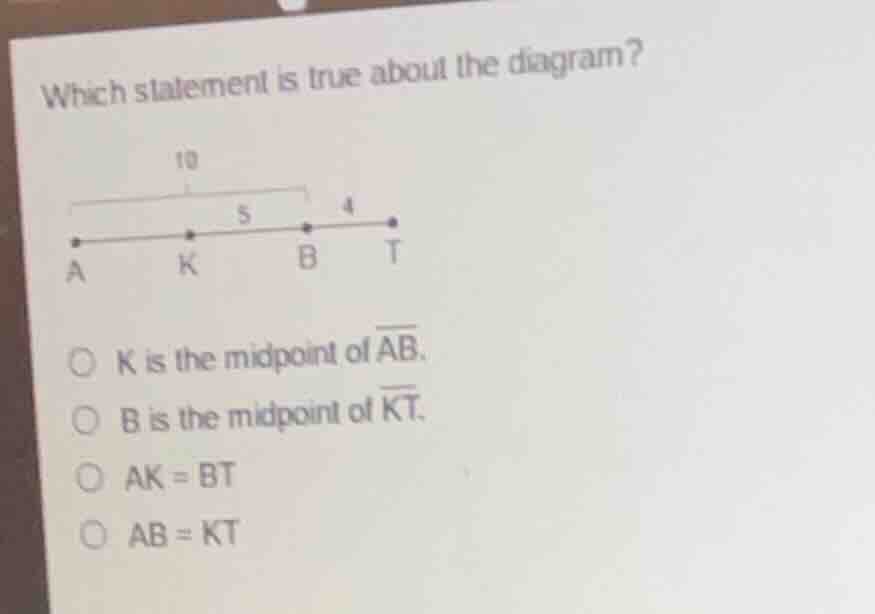
10
s
4
a k b t
k is the midpoint of \overline{ab}.
b is the midpoint of \overline{kt}.
ak = bt
ab = kt
Step1: Analyze the length of AB
From the diagram, \( AB = 10 \). Let's assume \( AK = x \), then \( KB = 10 - x \). And \( BT = 4 \), so \( KT = KB + BT = (10 - x)+ 4=14 - x \).
Step2: Check each option
- Option 1: For \( K \) to be the midpoint of \( \overline{AB} \), \( AK = KB \), but we don't know if \( x=10 - x \) (i.e., \( x = 5 \)) from the given info, so we can't confirm this.
- Option 2: For \( B \) to be the midpoint of \( \overline{KT} \), \( KB=BT \). \( BT = 4 \), \( KB = 10 - x \), we don't know if \( 10 - x=4 \) (i.e., \( x = 6 \)) from the given info, so we can't confirm this.
- Option 3: Let's find \( AK \) and \( BT \). We know \( AB = 10 \), let's assume the length from \( A \) to \( K \) and \( K \) to \( B \). Wait, actually, let's think about the total. Wait, maybe a better way: Let's assume the length of \( AK \): since \( AB = 10 \), if we look at \( KT \), \( KT=KB + BT \). But let's see the last option first. Wait, no, let's check \( AK = BT \). Wait, \( AB = 10 \), let's suppose \( AK = y \), then \( KB=10 - y \), \( KT = 10 - y+ 4=14 - y \). But for \( AK = BT \), \( y = 4 \), then \( KB = 6 \), \( KT=6 + 4 = 10 \), \( AB = 10 \), wait no, wait the fourth option is \( AB = KT \). Wait, no, let's re - check. Wait, \( AB = 10 \), \( KT=KB + BT \). If \( AK = 4 \), then \( KB = 6 \), \( KT=6 + 4 = 10 \), so \( AB = KT = 10 \)? Wait, no, the fourth option is \( AB = KT \). Wait, maybe I made a mistake. Wait, let's check each option again.
Wait, the diagram: \( A---K---B---T \), \( AB = 10 \), \( BT = 4 \). Let's assume \( AK = 4 \), then \( KB = 10 - 4=6 \), \( KT = 6 + 4 = 10 \). Then:
- Option 1: \( K \) is midpoint of \( AB \)? \( AK = 4 \), \( KB = 6 \), not equal, so no.
- Option 2: \( B \) is midpoint of \( KT \)? \( KB = 6 \), \( BT = 4 \), not equal, so no.
- Option 3: \( AK = BT \)? \( AK = 4 \), \( BT = 4 \), so yes? Wait, no, wait if \( AK = 4 \), then \( KB = 6 \), \( KT = 10 \), \( AB = 10 \). Wait, but maybe the correct way is: Let's see the length of \( AB = 10 \), \( KT=KB + BT \). If we assume that \( AK = BT \), let's say \( AK = x \), \( BT = x \), then \( KB=10 - x \), \( KT=(10 - x)+x = 10 \), so \( KT = 10 \), \( AB = 10 \), but the fourth option is \( AB = KT \). Wait, no, maybe I messed up. Wait, the fourth option is \( AB = KT \). Wait, \( AB = 10 \), \( KT=KB + BT \). If \( AK = 4 \), \( KB = 6 \), \( KT = 6 + 4 = 10 \), so \( AB = KT = 10 \). But also, \( AK = BT = 4 \). Wait, but let's check the options again.
Wait, the options are:
- \( K \) is the midpoint of \( \overline{AB} \): \( AK\) and \( KB\) should be equal. But \( AB = 10 \), if \( K \) is midpoint, \( AK = KB = 5 \), but we don't know that from the diagram (the diagram only marks \( AB = 10 \) and \( BT = 4 \)), so we can't say this is true.
- \( B \) is the midpoint of \( \overline{KT} \): \( KB\) and \( BT\) should be equal. \( BT = 4 \), \( KB=10 - AK \), we don't know if \( 10 - AK = 4 \), so we can't say this is true.
- \( AK = BT \): Let's assume \( AK = x \), \( BT = 4 \). If \( x = 4 \), then \( AK = BT \). And if \( AK = 4 \), \( KB = 10 - 4 = 6 \), \( KT=6 + 4 = 10 \), \( AB = 10 \). But also, let's check the fourth option \( AB = KT \), \( AB = 10 \), \( KT = 10 \), so both option 3 and 4? Wait, no, maybe I made a mistake. Wait, the diagram: \( AB = 10 \), \( BT = 4 \). Let's calculate \( KT \): \( KT=KB + BT \), and \( AB = AK + KB = 10 \). If we assume that \( AK = BT = 4 \), then \( KB = 10 - 4 = 6 \), \( KT=6 + 4 = 10 \), so \( AB = KT = 10 \) and \( AK = BT = 4 \). But wait, the options:…

Snap & solve any problem in the app
Get step-by-step solutions on Sovi AI
Photo-based solutions with guided steps
Explore more problems and detailed explanations
C. \( AK = BT \)