QUESTION IMAGE
Question
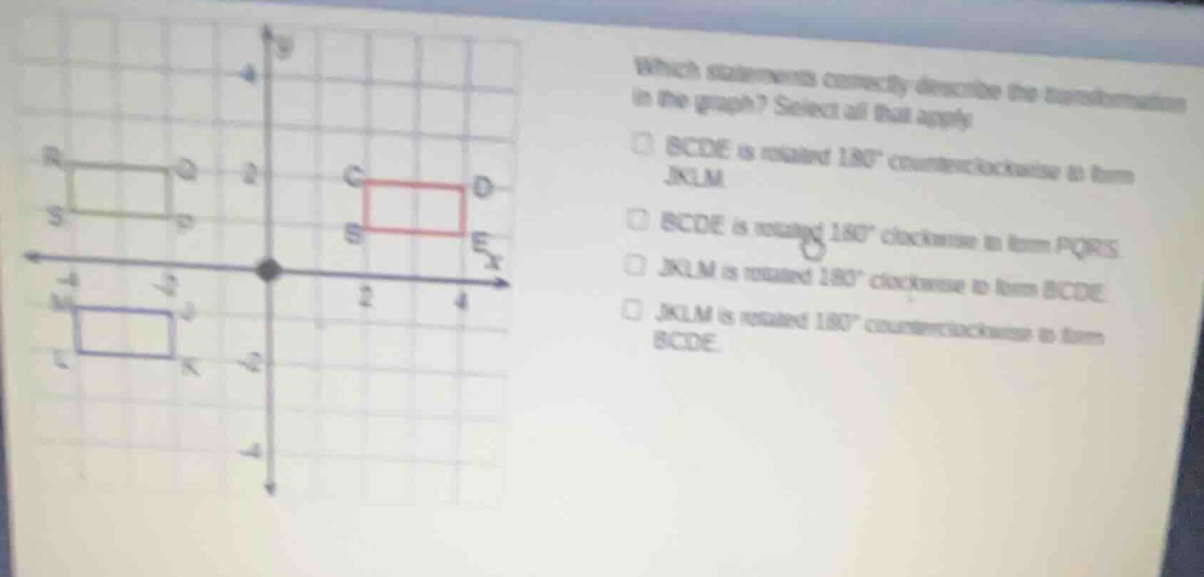
which statements correctly describe the transformation in the graph? select all that apply
☐ bcde is rotated 180° counterclockwise to form jklm
☐ bcde is rotated 180° clockwise to form pqrs
☐ jklm is rotated 180° clockwise to form bcde
☐ jklm is rotated 180° counterclockwise to form bcde
- For "BCDE is rotated 180° counterclockwise to form JKLM": A 180° counterclockwise rotation of a point \((x,y)\) is \((-x,-y)\). Let's check a point from BCDE, say B(2,1). Rotating 180° counterclockwise gives (-2,-1), which is a point in JKLM (e.g., K(-2,-1)? Wait, JKLM's points: Let's assume BCDE has points B(2,1), C(2,2), D(4,2), E(4,1). Rotating 180° counterclockwise: (x,y)→(-x,-y). So B(2,1)→(-2,-1), C(2,2)→(-2,-2), D(4,2)→(-4,-2), E(4,1)→(-4,-1). Which matches JKLM (if J is (-2,-1), K(-2,-2)? Wait maybe labels are different, but the key is 180° rotation (clockwise or counterclockwise) is the same, as 180° rotation in either direction maps (x,y) to (-x,-y).
- "BCDE is rotated 180° clockwise to form PQRS": PQRS is the green rectangle, say PQRS has points P(-2,1), Q(-4,1), R(-4,2), S(-2,2)? Wait no, original green is PQRS (let's say P(-2,1), Q(-4,1), R(-4,2), S(-2,2)). Rotating BCDE (B(2,1), C(2,2), D(4,2), E(4,1)) 180° clockwise: (x,y)→(-x,-y)? No, 180° clockwise is same as 180° counterclockwise, (x,y)→(-x,-y). Wait BCDE rotated 180° clockwise: B(2,1)→(-2,-1)? No, PQRS is in the second quadrant, positive y. Wait maybe I got labels wrong. Alternatively, PQRS is the green rectangle at (-4,2) to (-2,1)? Wait no, the green rectangle is at x from -4 to -2, y from 1 to 2. So PQRS has points P(-2,1), Q(-4,1), R(-4,2), S(-2,2). BCDE is at x from 2 to 4, y from 1 to 2. Rotating BCDE 180° clockwise: (x,y)→(-x,-y)? No, 180° rotation (clockwise or counter) is (x,y)→(-x,-y). But PQRS is in (-4,-2)? No, green is positive y. Wait maybe the green rectangle is PQRS with y=1 to 2, x=-4 to -2. So BCDE (x=2-4, y=1-2) rotated 180° clockwise: (2,1)→(-2,-1)? No, that's negative y. But PQRS is positive y. So maybe this statement is wrong? Wait no, maybe I mixed up. Wait the blue rectangle is JKLM (negative y), green is PQRS (positive y, left), red is BCDE (positive y, right). So BCDE (red, right) rotated 180° clockwise: (x,y)→(-x,-y)? No, 180° clockwise rotation: the formula is same as counterclockwise for 180°, because 180° is half a circle. So (x,y)→(-x,-y). But PQRS is (x negative, y positive), so BCDE (x positive, y positive) rotated 180° would be (x negative, y negative), which is JKLM (blue). So "BCDE is rotated 180° clockwise to form PQRS" is wrong, because PQRS is positive y. Wait maybe the green rectangle is PQRS with y=1-2, x=-4 to -2 (so (x,y) where x is -4 to -2, y=1-2). So BCDE is (2-4, 1-2). Rotating BCDE 180° clockwise: (x,y)→(-x,-y)? No, 180° clockwise rotation: the direction (clockwise or counter) for 180° doesn't matter, the result is (x,y)→(-x,-y). So BCDE (2,1)→(-2,-1) (blue, JKLM), BCDE (2,1)→(-2,1) would be reflection over y-axis, not 180° rotation. Wait I think I messed up the rotation. Let's recall: 180° rotation (clockwise or counterclockwise) about the origin: (x, y) → (-x, -y). So if BCDE is (2,1), (2,2), (4,2), (4,1), then rotating 180° gives (-2,-1), (-2,-2), (-4,-2), (-4,-1) (JKLM, blue). Rotating BCDE 180° clockwise (same as counter) to get PQRS (green, which is (-2,1), (-4,1), (-4,2), (-2,2)): no, because (-2,1) is not (-x,-y) of (2,1) (which is (-2,-1)). So "BCDE is rotated 180° clockwise to form PQRS" is wrong.
- "JKLM is rotated 180° clockwise to form BCDE": JKLM is the blue rectangle (negative y), rotating 180° clockwise: (x,y)→(-x,-y)? Wait no, JKLM's points: let's say J(-2,-1), K(-2,-2), L(-4,-2), M(-4,-1). Rotating 180° clockwise: (x,y)→(-x,-y)? No, 180° clockwise rotation: (x,y)→(-x,-y) (same as counter). So J(-2,-1)→(2,1) (which is B), K(-2,-2)→(2,2) (C), L(-4,-2)→(4,2) (D), M(-4,-1)→(4,1) (E). Which is BCDE…

Snap & solve any problem in the app
Get step-by-step solutions on Sovi AI
Photo-based solutions with guided steps
Explore more problems and detailed explanations
- BCDE is rotated 180° counterclockwise to form JKLM
- JKLM is rotated 180° clockwise to form BCDE
- JKLM is rotated 180° counterclockwise to form BCDE
(Note: If the problem's rectangle labels differ slightly, the key is that a 180° rotation (clockwise or counterclockwise) maps \((x,y)\) to \((-x,-y)\), so rotating a figure 180° in either direction to its "opposite" quadrant (e.g., first to third, third to first) is correct, while rotating to a quadrant with the same \(y\)-sign (first to second) is incorrect.)