QUESTION IMAGE
Question
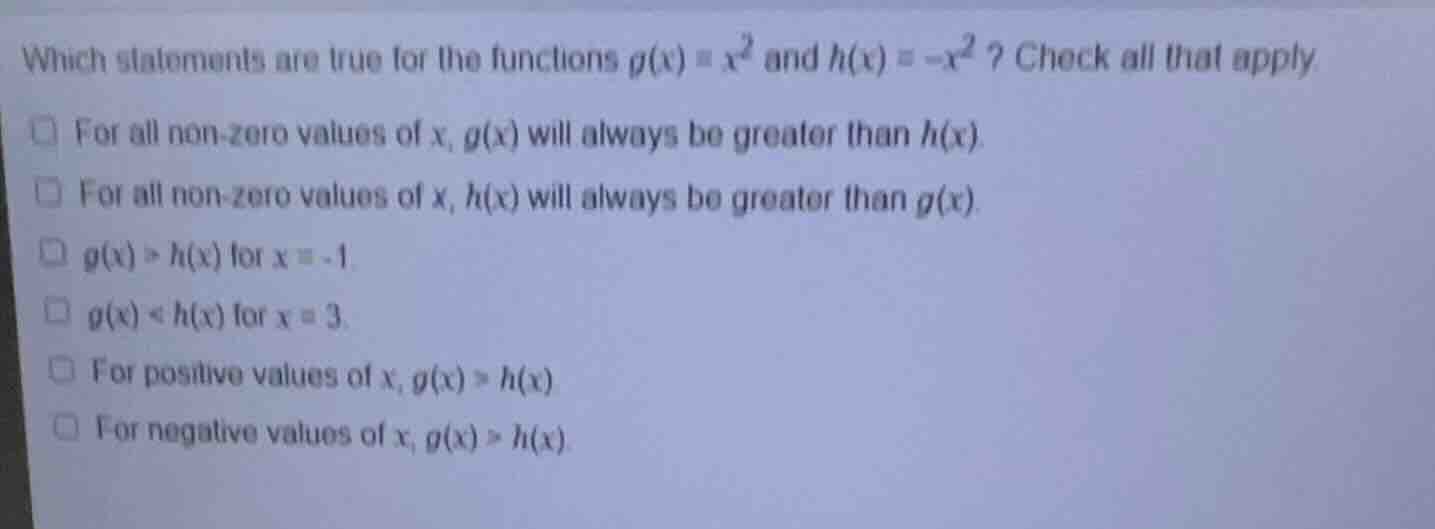
which statements are true for the functions ( g(x) = x^2 ) and ( h(x) = -x^2 )? check all that apply.
- for all non - zero values of ( x ), ( g(x) ) will always be greater than ( h(x) ).
- for all non - zero values of ( x ), ( h(x) ) will always be greater than ( g(x) ).
- ( g(x) > h(x) ) for ( x = - 1 ).
- ( g(x) < h(x) ) for ( x = 3 ).
- for positive values of ( x ), ( g(x) > h(x) )
- for negative values of ( x ), ( g(x) > h(x) ).
Step1: Analyze non-zero x, compare g(x), h(x)
For any non-zero $x$, $x^2 > 0$, so $g(x)=x^2>0$, $h(x)=-x^2<0$. Thus $g(x)>h(x)$.
Step2: Test x=-1, compute values
$g(-1)=(-1)^2=1$, $h(-1)=-(-1)^2=-1$. $1 > -1$, so $g(x)>h(x)$.
Step3: Test x=3, compute values
$g(3)=3^2=9$, $h(3)=-3^2=-9$. $9 > -9$, so $g(x)
less h(x)$.
Step4: Analyze positive x, compare values
For positive $x$, $x^2>0$, so $g(x)=x^2>0$, $h(x)=-x^2<0$, so $g(x)>h(x)$.
Step5: Analyze negative x, compare values
For negative $x$, $x^2>0$, so $g(x)=x^2>0$, $h(x)=-x^2<0$, so $g(x)>h(x)$.

Snap & solve any problem in the app
Get step-by-step solutions on Sovi AI
Photo-based solutions with guided steps
Explore more problems and detailed explanations
- For all non-zero values of x, $g(x)$ will always be greater than $h(x)$.
- $g(x) > h(x)$ for $x = -1$.
- For positive values of x, $g(x) > h(x)$.
- For negative values of x, $g(x) > h(x)$.