QUESTION IMAGE
Question
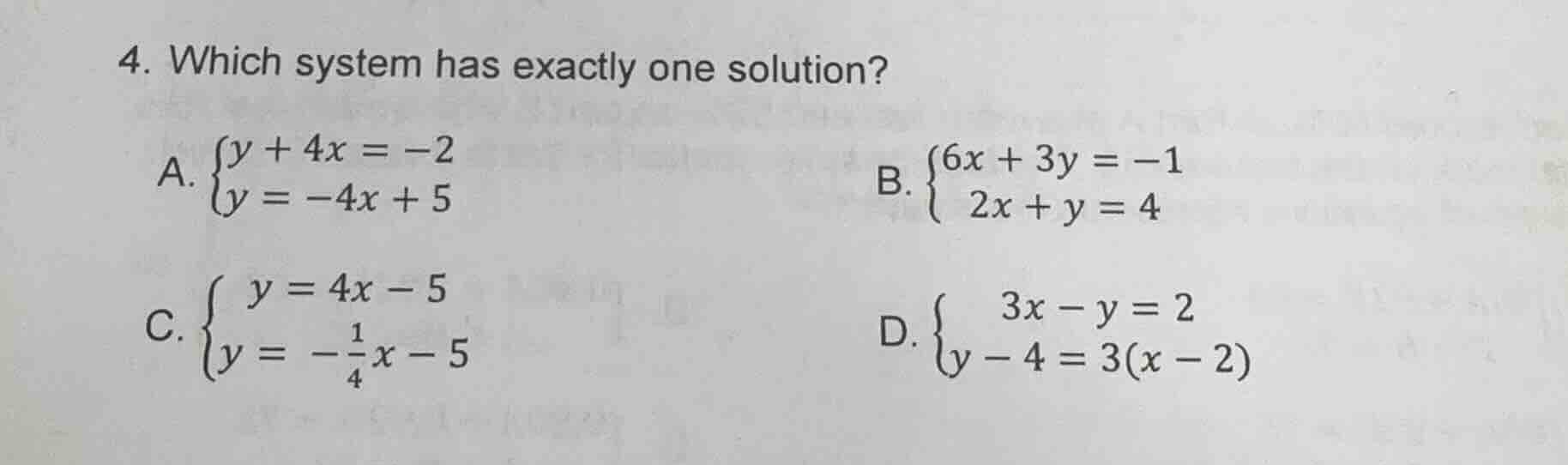
- which system has exactly one solution?
a. \\(\
\\)
b. \\(\
\\)
c. \\(\
\\)
d. \\(\
\\)
Step1: Rewrite to slope-intercept form
For system A:
First equation: $y = -4x -2$
Second equation: $y = -4x +5$
Slopes are equal ($-4$), y-intercepts different.
Step2: Rewrite to slope-intercept form
For system B:
First equation: $3y = -6x -1 \implies y = -2x -\frac{1}{3}$
Second equation: $y = -2x +4$
Slopes are equal ($-2$), y-intercepts different.
Step3: Rewrite to slope-intercept form
For system C:
First equation: $y = 4x -5$ (slope $4$)
Second equation: $y = -\frac{1}{4}x -5$ (slope $-\frac{1}{4}$)
Slopes are not equal.
Step4: Rewrite to slope-intercept form
For system D:
First equation: $y = 3x -2$
Second equation: $y = 3x -6 +4 \implies y = 3x -2$
Slopes and y-intercepts are equal.
Step5: Determine unique solution
A linear system has exactly one solution if slopes are different (lines intersect once). Only system C has non-equal slopes.

Snap & solve any problem in the app
Get step-by-step solutions on Sovi AI
Photo-based solutions with guided steps
Explore more problems and detailed explanations
C.