QUESTION IMAGE
Question
which table represents y as a function of x?
x 3 4 3 2 3
y 0 1 2 1 3
x 8 7 6 5 4
y -1 2 -1 2 -1
x 4 5 4 3 2
y -6 -5 -4 -3 -2
x 1 2 3 2 1
y 1 2 3 4 5
2 multiple choice 4 points
which relation is also a function?
x² + y² = 36
9x² + 4y² = 36
x² - y² = 36
y = 4x²
3 multiple choice 4 points
which relation is a function?
{(4,0),(4,1),(4,2),(4,3)}
{(-1,3),(-2,6),(0,0),(-2,-2)}
{(-2,-2),(0,0),(1,1),(2,2)}
{(7,4),(8,8),(10,8),(10,10)}
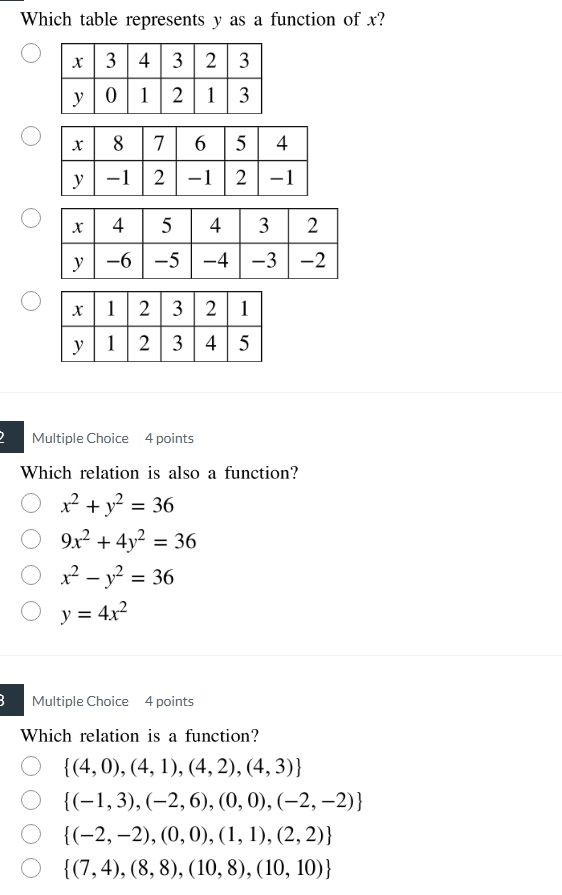
Question 1: Which table represents \( y \) as a function of \( x \)?
A function requires that each input \( x \) has exactly one output \( y \). We check each table:
- First table: \( x = 3 \) appears multiple times (with different \( y \)-values: 0, 2, 3). Not a function.
- Second table: Each \( x \) (8, 7, 6, 5, 4) has a unique \( y \)-value (or repeated \( y \)-values for different \( x \), which is allowed). For example, \( x = 8 \) gives \( y = -1 \), \( x = 7 \) gives \( y = 2 \), etc. Each \( x \) has one \( y \).
- Third table: \( x = 4 \) appears twice (with \( y = -6 \) and \( y = -4 \)). Not a function.
- Fourth table: \( x = 1 \) and \( x = 2 \) appear twice (different \( y \)-values). Not a function.
Question 2: Which relation is also a function?
A relation is a function if for each \( x \), there is exactly one \( y \). We analyze each option:
- \( x^2 + y^2 = 36 \): This is a circle. For most \( x \)-values, there are two \( y \)-values (above and below the \( x \)-axis). Not a function.
- \( 9x^2 + 4y^2 = 36 \): This is an ellipse. For most \( x \)-values, there are two \( y \)-values. Not a function.
- \( x^2 - y^2 = 36 \): This is a hyperbola. For some \( x \)-values, there are two \( y \)-values. Not a function.
- \( y = 4x^2 \): For any \( x \), plugging in gives exactly one \( y \)-value. This is a parabola opening upward, and it passes the vertical line test. So it is a function.
Question 3: Which relation is a function?
A function has no repeated \( x \)-values with different \( y \)-values. We check each set of ordered pairs:
- \( \{(4,0), (4,1), (4,2), (4,3)\} \): \( x = 4 \) is repeated with different \( y \)-values. Not a function.
- \( \{(-1,3), (-2,6), (0,0), (-2,-2)\} \): \( x = -2 \) is repeated with different \( y \)-values. Not a function.
- \( \{(-2,-2), (0,0), (1,1), (2,2)\} \): All \( x \)-values (-2, 0, 1, 2) are unique. Each \( x \) has one \( y \). This is a function.
- \( \{(7,4), (8,8), (10,8), (10,10)\} \): \( x = 10 \) is repeated with different \( y \)-values. Not a function.

Snap & solve any problem in the app
Get step-by-step solutions on Sovi AI
Photo-based solutions with guided steps
Explore more problems and detailed explanations
s:
- The table representing \( y \) as a function of \( x \) is the second table (with \( x \): 8, 7, 6, 5, 4 and \( y \): -1, 2, -1, 2, -1).
- The relation that is a function is \( \boldsymbol{y = 4x^2} \).
- The relation that is a function is \( \boldsymbol{\{(-2,-2), (0,0), (1,1), (2,2)\}} \).