QUESTION IMAGE
Question
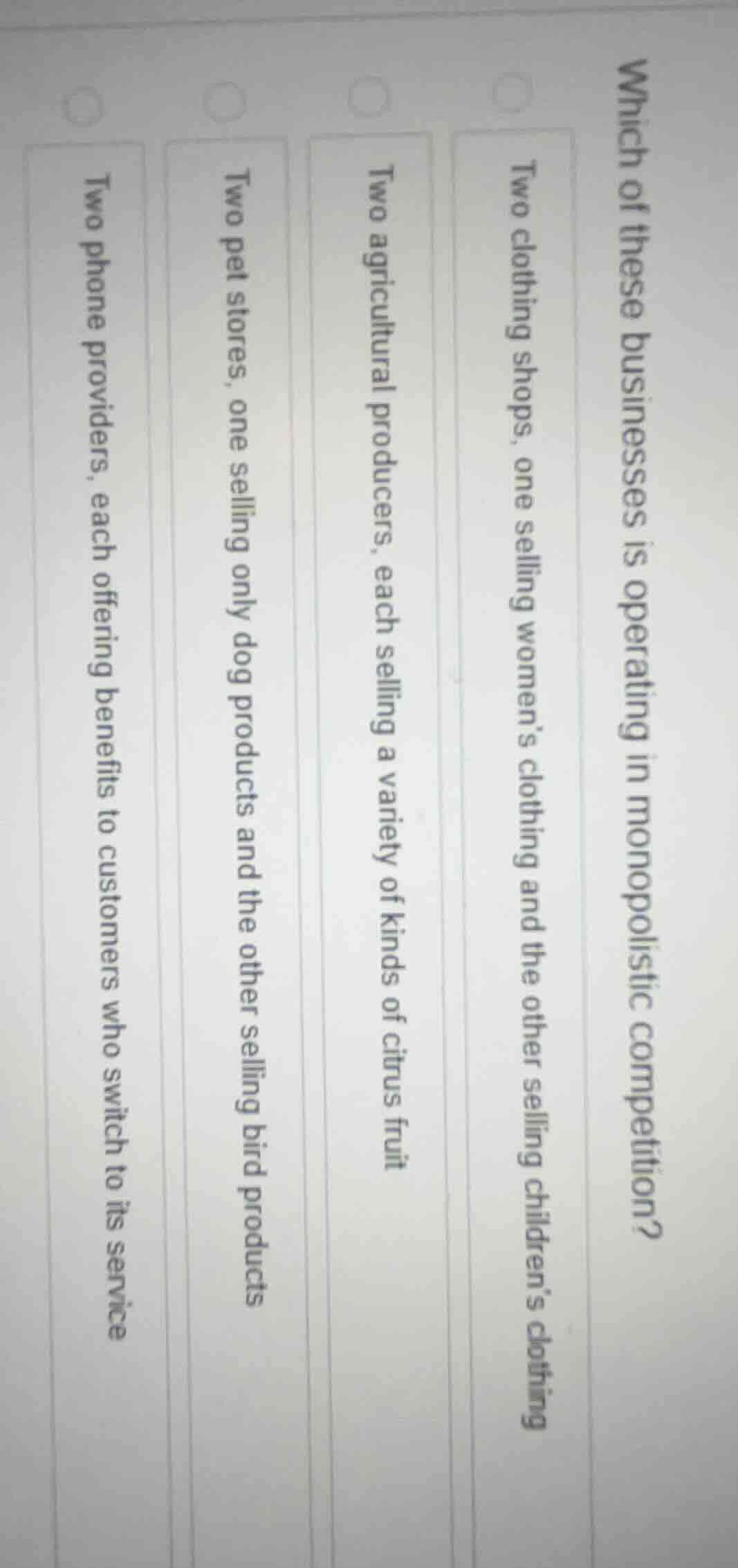
which of these businesses is operating in monopolistic competition? two clothing shops, one selling women’s clothing and the other selling children’s clothing two agricultural producers, each selling a variety of kinds of citrus fruit two pet stores, one selling only dog products and the other selling bird products two phone providers, each offering benefits to customers who switch to its service
To determine which business operates in monopolistic competition, we analyze each option:
- Two clothing shops (women’s and children’s clothing): These sell differentiated products (different target markets, styles), with many competitors (other clothing shops) and some control over price due to product differentiation, fitting monopolistic competition.
- Two agricultural producers (citrus fruit): Citrus fruit is typically a homogeneous product (e.g., oranges from different producers are similar), so this is more likely perfect competition.
- Two pet stores (dog and bird products): These sell highly differentiated products (specific to different pets), but the key is that monopolistic competition has products that are close substitutes with differentiation. However, phone providers and clothing shops are more about differentiated consumer goods. Wait, no—re - evaluating: Monopolistic competition has many firms, differentiated products (not perfect substitutes), easy entry/exit.
- Two phone providers (offering benefits to switch): Phone providers often have differentiated services (plans, benefits), but the option with clothing shops: Women’s and children’s clothing are different but still in the clothing market, with differentiated products (styles, target customers) and many competitors, fitting monopolistic competition better than the others. Wait, actually, the two pet stores: dog and bird products are very differentiated (not close substitutes), while women’s and children’s clothing are in the same general market (clothing) with differentiated products (different customer segments, styles), so they are closer substitutes with differentiation, which is monopolistic competition. The phone providers: their services are more about plans, but the clothing shops: selling women’s and children’s clothing—these are differentiated products (not identical, different target markets) in a market with many competitors, so this is monopolistic competition. The agricultural producers: homogeneous product (citrus fruit is similar across producers), so perfect competition. The pet stores: dog and bird products are not close substitutes (a dog owner won’t switch to bird products easily), so less like monopolistic competition. The phone providers: offering benefits to switch implies they are competing with differentiated services, but the clothing shops: women’s and children’s clothing—wait, maybe I made a mistake. Let's recall: Monopolistic competition is when firms sell differentiated products that are close substitutes (e.g., different brands of toothpaste, different clothing styles for similar markets). So two clothing shops, one women’s, one children’s—are their products close substitutes? No, because women and children are different customer groups. Wait, maybe the two phone providers: they offer benefits to switch, meaning their services are differentiated (different plans, benefits), and they are in a market with many competitors (other phone providers), so they are close substitutes with differentiation. But the original analysis: Let's check the correct criteria. Monopolistic competition:
- Many firms.
- Product differentiation (products are not identical, can be differentiated by quality, features, style, branding, etc.).
- Relatively easy entry and exit.
Now, let's re - analyze each option:
- Two clothing shops (women’s and children’s clothing): Products are differentiated (target different customers, different designs), there are many other clothing shops (easy entry/exit in retail), and they are in a market…

Snap & solve any problem in the app
Get step-by-step solutions on Sovi AI
Photo-based solutions with guided steps
Explore more problems and detailed explanations
The business operating in monopolistic competition is: Two clothing shops, one selling women’s clothing and the other selling children’s clothing (the first option among the given choices, assuming the options are labeled as follows: A. Two clothing shops, one selling women’s clothing and the other selling children’s clothing; B. Two agricultural producers, each selling a variety of kinds of citrus fruit; C. Two pet stores, one selling only dog products and the other selling bird products; D. Two phone providers, each offering benefits to customers who switch to its service. So the answer is A. Two clothing shops, one selling women’s clothing and the other selling children’s clothing).