QUESTION IMAGE
Question
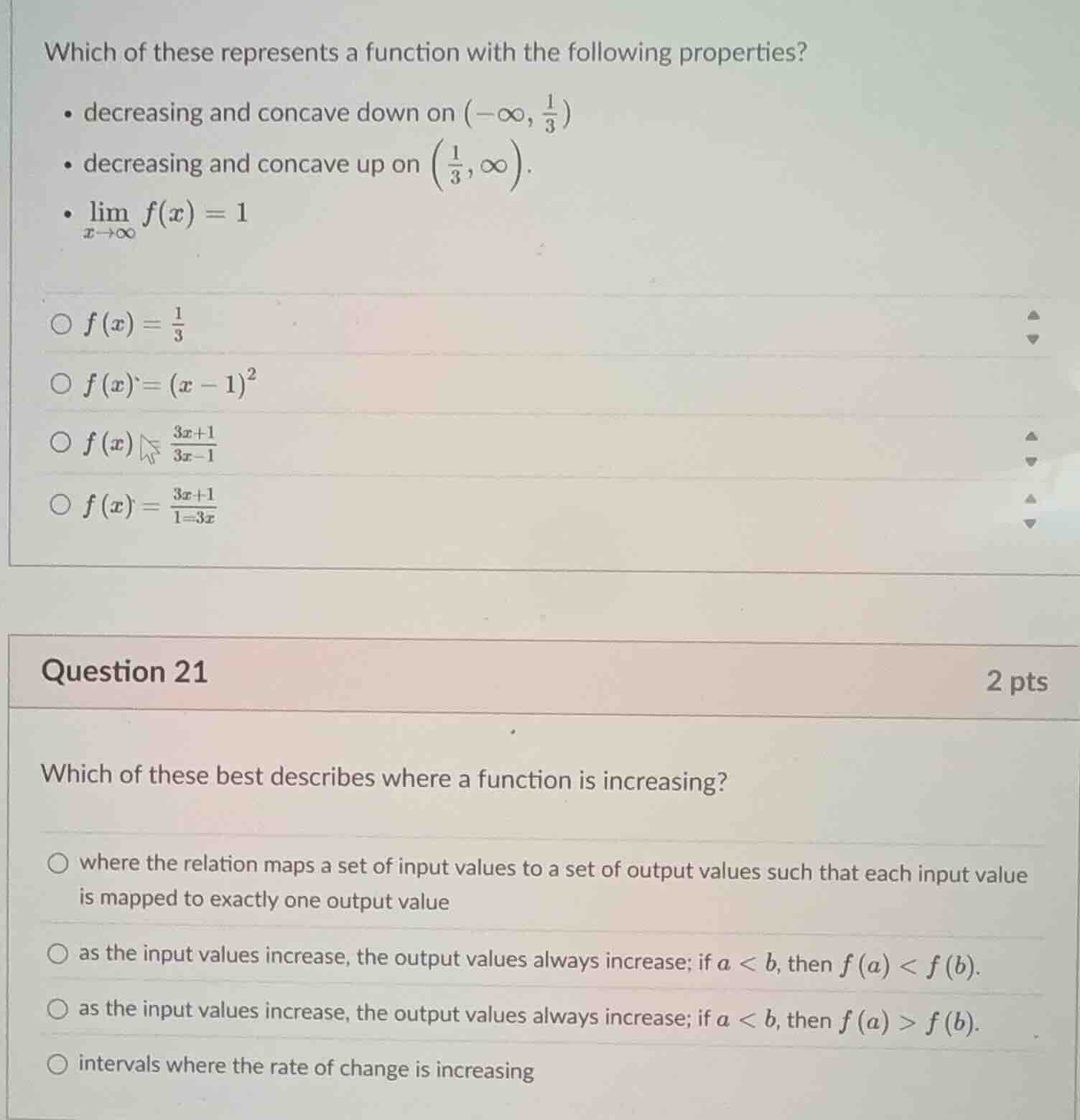
which of these represents a function with the following properties?
- decreasing and concave down on $(-infty, \frac{1}{3})$
- decreasing and concave up on $(\frac{1}{3}, \infty)$.
- $\lim\limits_{x \to \infty} f(x) = 1$
\\(\bigcirc\\) $f(x) = \frac{1}{3}$
\\(\bigcirc\\) $f(x) = (x - 1)^2$
\\(\bigcirc\\) $f(x) = \frac{3x + 1}{3x - 1}$
\\(\bigcirc\\) $f(x) = \frac{3x + 1}{1 - 3x}$
question 21
2 pts
which of these best describes where a function is increasing?
\\(\bigcirc\\) where the relation maps a set of input values to a set of output values such that each input value is mapped to exactly one output value
\\(\bigcirc\\) as the input values increase, the output values always increase; if $a < b$, then $f(a) < f(b)$.
\\(\bigcirc\\) as the input values increase, the output values always increase; if $a < b$, then $f(a) > f(b)$.
\\(\bigcirc\\) intervals where the rate of change is increasing
---
First Question
Step1: Eliminate constant function
$f(x)=\frac{1}{3}$ is constant, so it is neither decreasing nor has concavity changes. Eliminate this option.
Step2: Eliminate quadratic function
$f(x)=(x-1)^2$: Its derivative $f'(x)=2(x-1)$, which is negative only when $x<1$, positive when $x>1$, so it is not decreasing on all $\mathbb{R}$. Eliminate this option.
Step3: Analyze $\boldsymbol{f(x)=\frac{3x+1}{3x-1}}$
Rewrite as $f(x)=1+\frac{2}{3x-1}$.
First derivative: $f'(x)=-\frac{6}{(3x-1)^2}$, which is always negative (so function is decreasing everywhere in domain).
Second derivative: $f''(x)=\frac{36}{(3x-1)^3}$.
- For $x<\frac{1}{3}$, $(3x-1)^3<0$, so $f''(x)<0$ (concave down).
- For $x>\frac{1}{3}$, $(3x-1)^3>0$, so $f''(x)>0$ (concave up).
Limit: $\lim_{x\to\infty} f(x)=\lim_{x\to\infty} \frac{3x+1}{3x-1}=\lim_{x\to\infty} \frac{3+\frac{1}{x}}{3-\frac{1}{x}}=1$. This matches all properties.
Step4: Verify last option
$f(x)=\frac{3x+1}{1-3x}=-1-\frac{2}{3x-1}$.
Limit: $\lim_{x\to\infty} f(x)=\lim_{x\to\infty} \frac{3x+1}{1-3x}=-1
eq1$. Eliminate this option.
- The first option defines a function, not an increasing function.
- The third option describes a decreasing function (since $a
- The fourth option describes where a function is concave up, not increasing.
- The correct definition is: as input values increase, output values increase, so if $a

Snap & solve any problem in the app
Get step-by-step solutions on Sovi AI
Photo-based solutions with guided steps
Explore more problems and detailed explanations
$f(x)=\frac{3x+1}{3x-1}$
---