QUESTION IMAGE
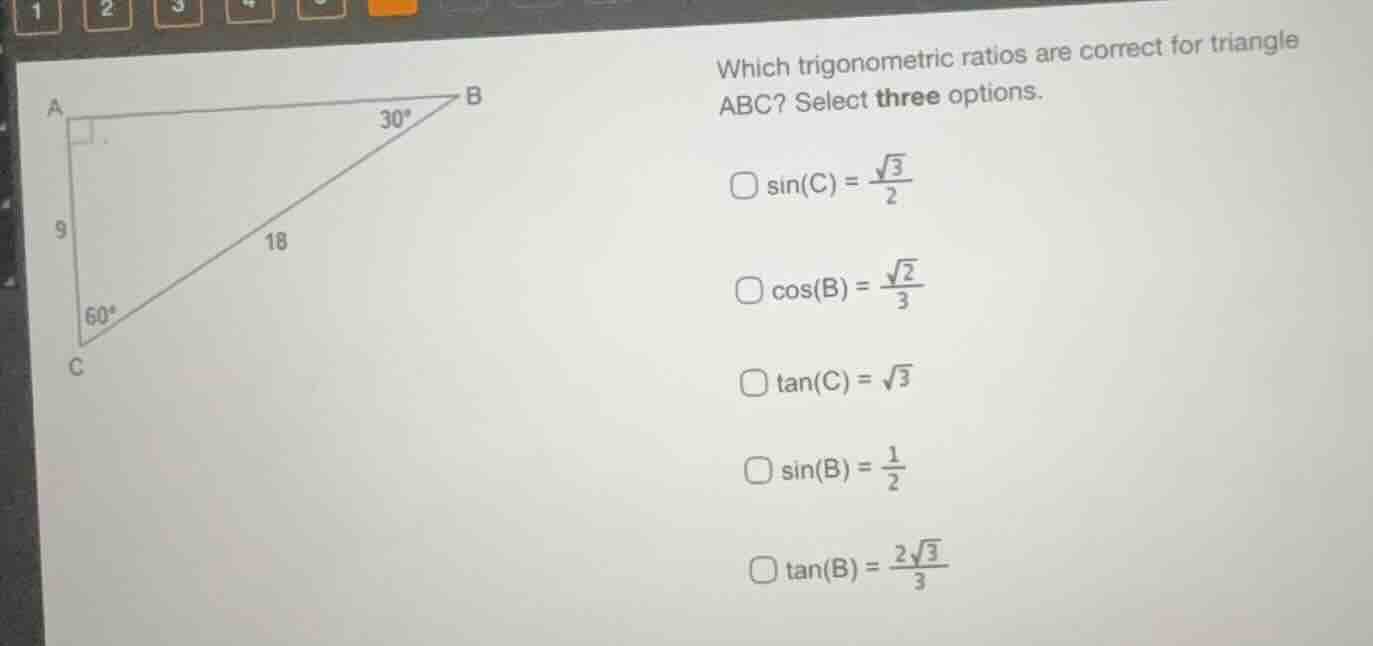
Question
which trigonometric ratios are correct for triangle abc? select three options. \\(\sin(c) = \frac{\sqrt{3}}{2}\\) \\(\cos(b) = \frac{\sqrt{2}}{3}\\) \\(\tan(c) = \sqrt{3}\\) \\(\sin(b) = \frac{1}{2}\\) \\(\tan(b) = \frac{2\sqrt{3}}{3}\\)
- First, identify the sides of the right - triangle \(ABC\) with \(\angle A = 90^{\circ}\), \(\angle B=30^{\circ}\), \(\angle C = 60^{\circ}\), hypotenuse \(BC = 18\), \(AC = 9\) (opposite to \(30^{\circ}\) angle, since in a \(30 - 60-90\) triangle, the side opposite \(30^{\circ}\) is half of the hypotenuse). Using Pythagoras theorem, \(AB=\sqrt{BC^{2}-AC^{2}}=\sqrt{18^{2}-9^{2}}=\sqrt{324 - 81}=\sqrt{243}=9\sqrt{3}\).
- For \(\sin(C)\): \(\sin(C)=\sin(60^{\circ})=\frac{\text{opposite}}{\text{hypotenuse}}=\frac{AB}{BC}=\frac{9\sqrt{3}}{18}=\frac{\sqrt{3}}{2}\), so \(\sin(C)=\frac{\sqrt{3}}{2}\) is correct.
- For \(\cos(B)\): \(\cos(B)=\cos(30^{\circ})=\frac{\text{adjacent}}{\text{hypotenuse}}=\frac{AB}{BC}=\frac{9\sqrt{3}}{18}=\frac{\sqrt{3}}{2}
eq\frac{\sqrt{2}}{3}\), so \(\cos(B)=\frac{\sqrt{2}}{3}\) is incorrect.
- For \(\tan(C)\): \(\tan(C)=\tan(60^{\circ})=\frac{\text{opposite}}{\text{adjacent}}=\frac{AB}{AC}=\frac{9\sqrt{3}}{9}=\sqrt{3}\), so \(\tan(C)=\sqrt{3}\) is correct.
- For \(\sin(B)\): \(\sin(B)=\sin(30^{\circ})=\frac{\text{opposite}}{\text{hypotenuse}}=\frac{AC}{BC}=\frac{9}{18}=\frac{1}{2}\), so \(\sin(B)=\frac{1}{2}\) is correct.
- For \(\tan(B)\): \(\tan(B)=\tan(30^{\circ})=\frac{\text{opposite}}{\text{adjacent}}=\frac{AC}{AB}=\frac{9}{9\sqrt{3}}=\frac{1}{\sqrt{3}}=\frac{\sqrt{3}}{3}
eq\frac{2\sqrt{3}}{3}\), wait, correction: \(\tan(B)=\frac{AC}{AB}=\frac{9}{9\sqrt{3}}=\frac{1}{\sqrt{3}}=\frac{\sqrt{3}}{3}\)? No, wait, \(\angle B = 30^{\circ}\), \(\tan(B)=\tan(30^{\circ})=\frac{\text{opposite}}{\text{adjacent}}=\frac{AC}{AB}=\frac{9}{9\sqrt{3}}=\frac{1}{\sqrt{3}}=\frac{\sqrt{3}}{3}\)? Wait, no, in angle \(B\), the opposite side is \(AC = 9\) and adjacent side is \(AB=9\sqrt{3}\). So \(\tan(B)=\frac{AC}{AB}=\frac{9}{9\sqrt{3}}=\frac{1}{\sqrt{3}}=\frac{\sqrt{3}}{3}\)? Wait, the option given is \(\tan(B)=\frac{2\sqrt{3}}{3}\), which is wrong? Wait, no, maybe I mixed up opposite and adjacent. Wait, angle \(B\): opposite side is \(AC\), adjacent side is \(AB\). Wait, \(AC = 9\), \(AB=9\sqrt{3}\). So \(\tan(B)=\frac{AC}{AB}=\frac{9}{9\sqrt{3}}=\frac{1}{\sqrt{3}}=\frac{\sqrt{3}}{3}\). But wait, the option \(\tan(B)=\frac{2\sqrt{3}}{3}\) is incorrect? Wait, no, maybe I made a mistake in calculating \(AB\). Wait, hypotenuse \(BC = 18\), \(AC = 9\) (opposite \(30^{\circ}\)), so \(AB=\sqrt{18^{2}-9^{2}}=\sqrt{324 - 81}=\sqrt{243}=9\sqrt{3}\). Then for angle \(B = 30^{\circ}\), \(\tan(B)=\frac{AC}{AB}=\frac{9}{9\sqrt{3}}=\frac{1}{\sqrt{3}}=\frac{\sqrt{3}}{3}\), but the option is \(\frac{2\sqrt{3}}{3}\), which is wrong. But let's re - check the correct ratios:
- \(\sin(C)=\frac{\sqrt{3}}{2}\) (correct, as \(\sin(60^{\circ})=\frac{\sqrt{3}}{2}\)).
- \(\tan(C)=\sqrt{3}\) (correct, as \(\tan(60^{\circ})=\sqrt{3}\)).
- \(\sin(B)=\frac{1}{2}\) (correct, as \(\sin(30^{\circ})=\frac{1}{2}\)). Also, let's check \(\tan(B)\) again. Wait, maybe I had opposite and adjacent reversed. For angle \(B\), the opposite side is \(AC = 9\) and adjacent side is \(AB = 9\sqrt{3}\). Wait, no, in a right - triangle, for angle \(B\), the sides: opposite is \(AC\), adjacent is \(AB\). Wait, but \(\tan(B)=\frac{\text{opposite}}{\text{adjacent}}=\frac{AC}{AB}=\frac{9}{9\sqrt{3}}=\frac{1}{\sqrt{3}}=\frac{\sqrt{3}}{3}\), but if we consider angle \(B\), the adjacent side to \(B\) is \(AB\) and opposite is \(AC\). Wait, maybe the option \(\tan(B)=\frac{2\sqrt{3}}{3}\) is wrong, but let's check the three correct ones: \(\sin(C)=\frac{\sqrt{3}}{2}\), \(\tan(C)=\sqrt{3}\), \(\sin(B)=\frac{1}{2}\) are correct. Also, let's check \(\tan(B)\) again. W…

Snap & solve any problem in the app
Get step-by-step solutions on Sovi AI
Photo-based solutions with guided steps
Explore more problems and detailed explanations
- \(\boldsymbol{\sin(C)=\frac{\sqrt{3}}{2}}\)
- \(\boldsymbol{\tan(C)=\sqrt{3}}\)
- \(\boldsymbol{\sin(B)=\frac{1}{2}}\)