QUESTION IMAGE
Question
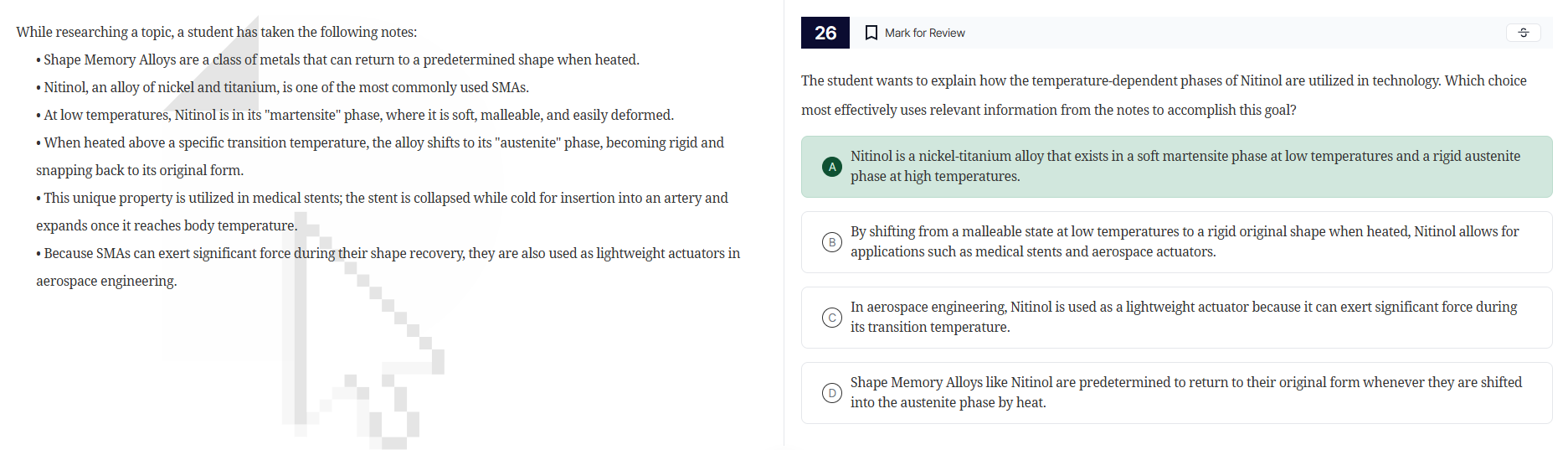
while researching a topic, a student has taken the following notes:
- shape memory alloys are a class of metals that can return to a predetermined shape when heated.
- nitinol, an alloy of nickel and titanium, is one of the most commonly used smas.
- at low temperatures, nitinol is in its \martensite\ phase, where it is soft, malleable, and easily deformed.
- when heated above a specific transition temperature, the alloy shifts to its \austenite\ phase, becoming rigid and snapping back to its original form.
- this unique property is utilized in medical stents; the stent is collapsed while cold for insertion into an artery and expands once it reaches body temperature.
- because smas can exert significant force during their shape recovery, they are also used as lightweight actuators in aerospace engineering.
26 mark for review
the student wants to explain how the temperature - dependent phases of nitinol are utilized in technology. which choice most effectively uses relevant information from the notes to accomplish this goal?
a nitinol is a nickel - titanium alloy that exists in a soft martensite phase at low temperatures and a rigid austenite phase at high temperatures.
b by shifting from a malleable state at low temperatures to a rigid original shape when heated, nitinol allows for applications such as medical stents and aerospace actuators.
c in aerospace engineering, nitinol is used as a lightweight actuator because it can exert significant force during its transition temperature.
d shape memory alloys like nitinol are predetermined to return to their original form whenever they are shifted into the austenite phase by heat.
To determine the best choice, we analyze each option:
- Option A: Only describes Nitinol's phases, not how they are utilized in technology. Eliminate.
- Option B: Explains that Nitinol's change from malleable (low temp) to rigid (when heated) is used in medical stents (collapsed cold, expands at body temp) and aerospace actuators (uses force during shape recovery), effectively linking the phase change to technological applications.
- Option C: Only focuses on aerospace engineering, not the broader utilization of phase change. Eliminate.
- Option D: Describes the shape - return property but not its technological use. Eliminate.

Snap & solve any problem in the app
Get step-by-step solutions on Sovi AI
Photo-based solutions with guided steps
Explore more problems and detailed explanations
B. By shifting from a malleable state at low temperatures to a rigid original shape when heated, Nitinol allows for applications such as medical stents and aerospace actuators.