QUESTION IMAGE
Question
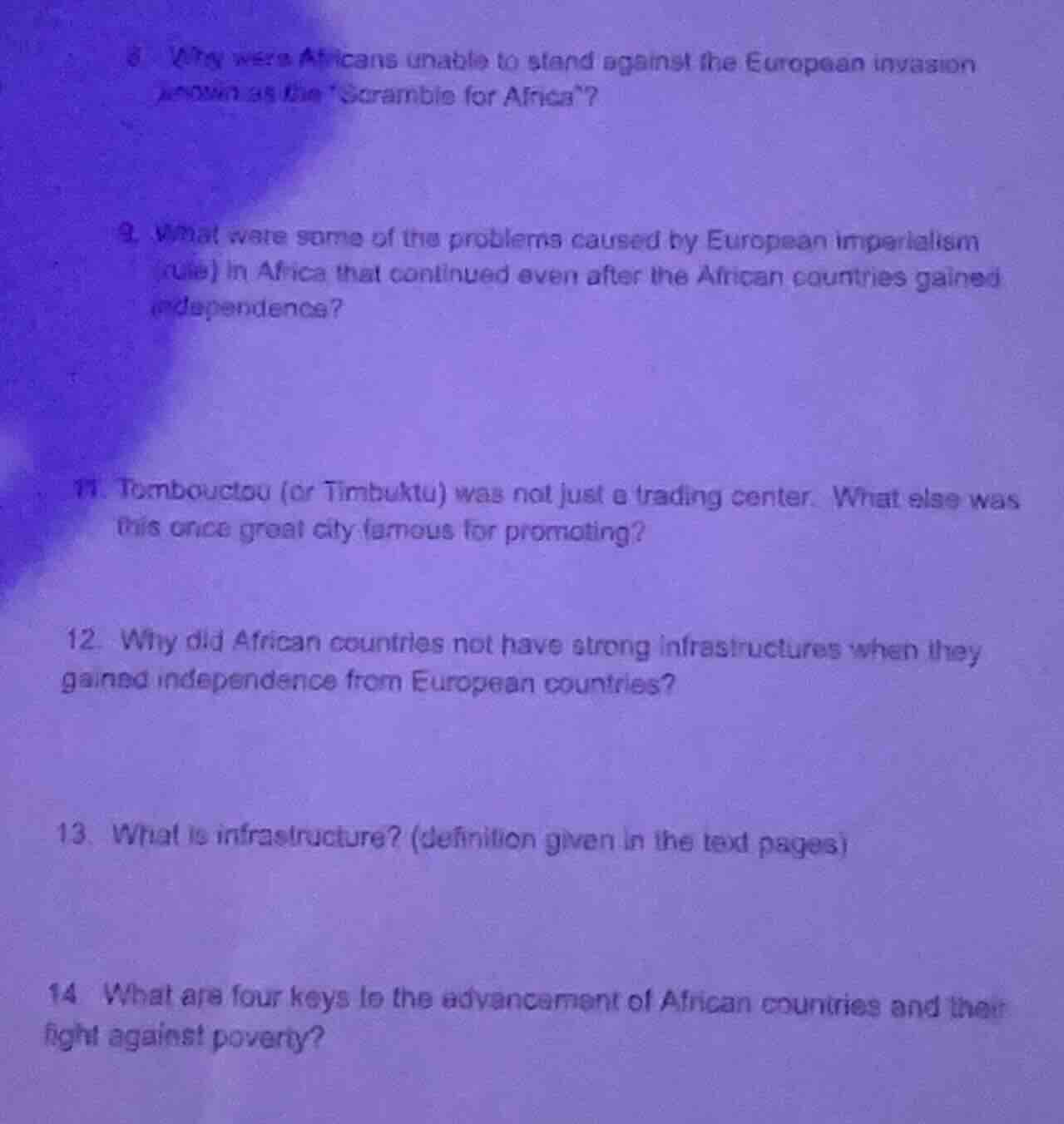
8 why were africans unable to stand against the european invasion known as the scramble for africa?
9 what were some of the problems caused by european imperialism (rule) in africa that continued even after the african countries gained independence?
11 tombouctou (or timbuktu) was not just a trading center. what else was this once great city famous for promoting?
12 why did african countries not have strong infrastructures when they gained independence from european countries?
13 what is infrastructure? (definition given in the text pages)
14 what are four keys to the advancement of african countries and their fight against poverty?
Question 8
During the "Scramble for Africa," Africans faced several disadvantages. European powers had advanced military technology (like machine guns, artillery) while most African groups had traditional weapons. Also, African societies were often divided into small, rival ethnic groups, lacking unified resistance. European powers used divide - and - rule tactics, exploiting ethnic tensions. Additionally, many African regions had not industrialized, so their economies and military capabilities were underdeveloped compared to Europe.
European imperialism left long - lasting problems. Politically, arbitrary colonial borders (ignoring ethnic/linguistic groups) led to ethnic conflicts post - independence. Economically, Africa was made into a resource - extraction colony, so economies were dependent on exporting raw materials and importing finished goods, lacking diversified industries. Socially, colonial education systems promoted European culture, undermining local cultures, and there were issues of unequal development (urban vs rural, coastal vs interior). Also, the colonial political systems were authoritarian, and when independence came, there was a lack of trained local leadership.
Timbuktu (Tombouctou) was a major center of Islamic learning and scholarship during the Mali Empire and beyond. It had famous universities and libraries. Scholars from across the Islamic world came there to study, and it was a hub for the spread of Islamic knowledge, including in fields like theology, law, astronomy, and literature. It also preserved and promoted African - Islamic cultural synthesis, with local scholars contributing to Islamic intellectual heritage.

Snap & solve any problem in the app
Get step-by-step solutions on Sovi AI
Photo-based solutions with guided steps
Explore more problems and detailed explanations
Africans were unable to stand against the European invasion due to: 1. European military superiority (advanced weapons like machine guns). 2. Ethnic divisions and lack of unified resistance (small, rival ethnic groups, no pan - African unity). 3. European divide - and - rule tactics (exploiting ethnic tensions). 4. Underdeveloped economies and lack of industrialization (no modern military or economic base to resist).