QUESTION IMAGE
Question
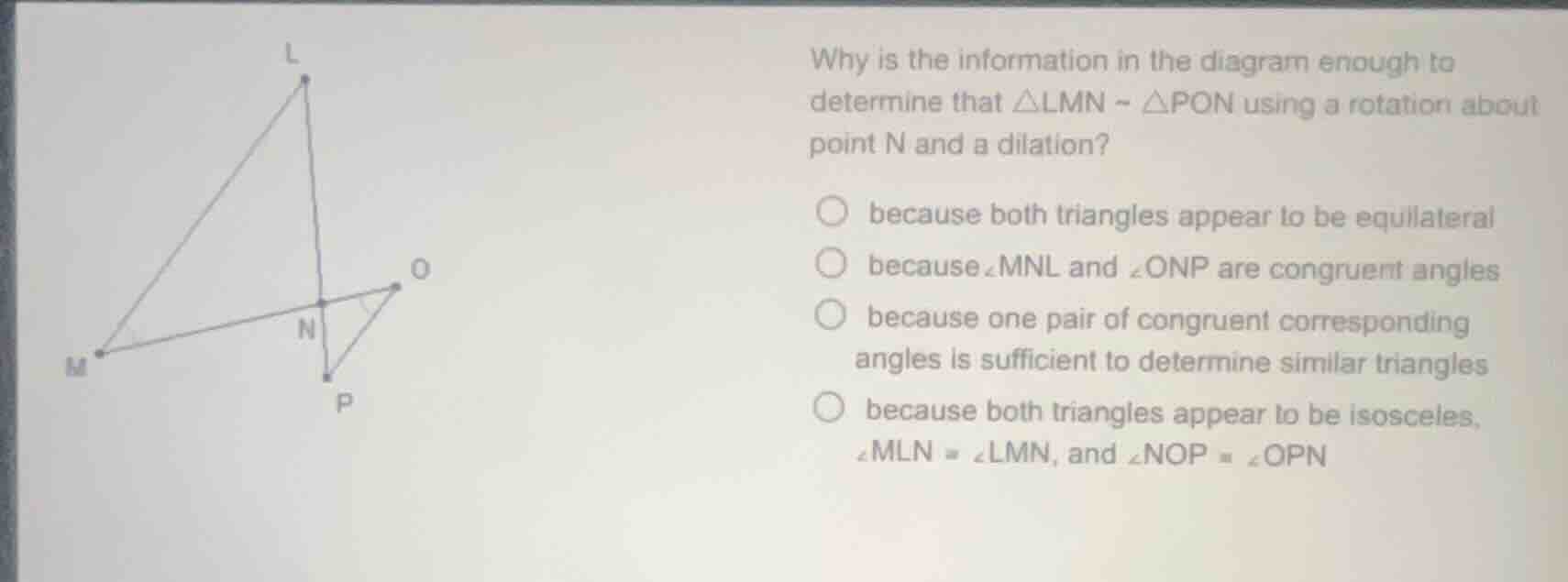
why is the information in the diagram enough to determine that $\triangle lmn sim \triangle pon$ using a rotation about point n and a dilation?
because both triangles appear to be equilateral
because $angle mnl$ and $angle onp$ are congruent angles
because one pair of congruent corresponding angles is sufficient to determine similar triangles
because both triangles appear to be isosceles, $angle mln = angle lmn$, and $angle nop = angle opn$
First, identify the vertical angles: $\angle MNL$ and $\angle ONP$ are vertical angles, so they are congruent. A rotation about point N maps $\triangle LMN$ to a triangle where this angle aligns with $\angle ONP$, and a dilation can adjust the side lengths. Additionally, the AA (Angle-Angle) similarity criterion tells us that one pair of congruent corresponding angles is not sufficient on its own, but the vertical angles give a congruent pair, and the rotation/dilation setup implies the corresponding sides are proportional and other angles will match due to the transformation. The incorrect options: "appearing equilateral/isosceles" is not a valid proof, and one pair of angles alone does not prove similarity. The key is the congruent vertical angles $\angle MNL$ and $\angle ONP$, which, combined with the rotation (preserving angles) and dilation (preserving angle measures, scaling sides), confirms similarity.

Snap & solve any problem in the app
Get step-by-step solutions on Sovi AI
Photo-based solutions with guided steps
Explore more problems and detailed explanations
because $\angle MNL$ and $\angle ONP$ are congruent angles