QUESTION IMAGE
Question
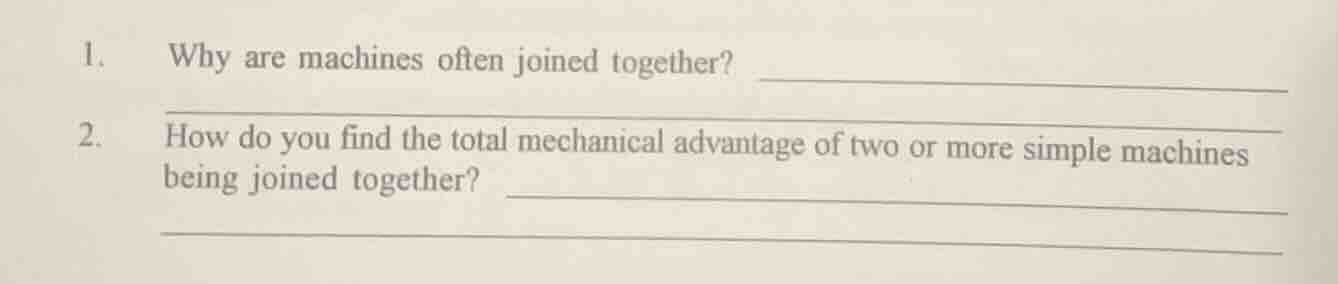
- why are machines often joined together?
- how do you find the total mechanical advantage of two or more simple machines being joined together?
Question 1
Machines are joined together (forming a compound machine) to obtain a greater total mechanical advantage than what a single simple machine can offer. This allows us to perform tasks that require more force or to move loads more easily, as the mechanical advantage of each machine in the system can add up (or multiply, depending on the type of machines and their arrangement) to provide a larger overall advantage. For example, in a bicycle, multiple simple machines (gears, levers, wheels and axles) are combined to make pedaling easier and to achieve different speeds or force outputs.
To find the total mechanical advantage (TMA) of two or more simple machines joined together (a compound machine), we multiply the mechanical advantages of each individual simple machine. If we denote the mechanical advantage of the first machine as \( MA_1 \), the second as \( MA_2 \), the third as \( MA_3 \), and so on, then the total mechanical advantage \( TMA \) is given by the formula:
\( TMA = MA_1 \times MA_2 \times MA_3 \times \dots \)
For example, if one lever has a mechanical advantage of 2 and a gear system (a type of wheel - and - axle or pulley - like system in terms of force transmission) has a mechanical advantage of 3, the total mechanical advantage of the compound machine made by joining them would be \( 2\times3 = 6 \). This is because each machine modifies the force (or distance) in the system, and when they are in series (one machine's output is the input to the next), their effects on the mechanical advantage multiply.

Snap & solve any problem in the app
Get step-by-step solutions on Sovi AI
Photo-based solutions with guided steps
Explore more problems and detailed explanations
Machines are often joined together to achieve a greater total mechanical advantage (than a single simple machine) to make work easier (e.g., move heavier loads or apply more force with less input effort) by combining the mechanical advantages of multiple simple machines.