QUESTION IMAGE
Question
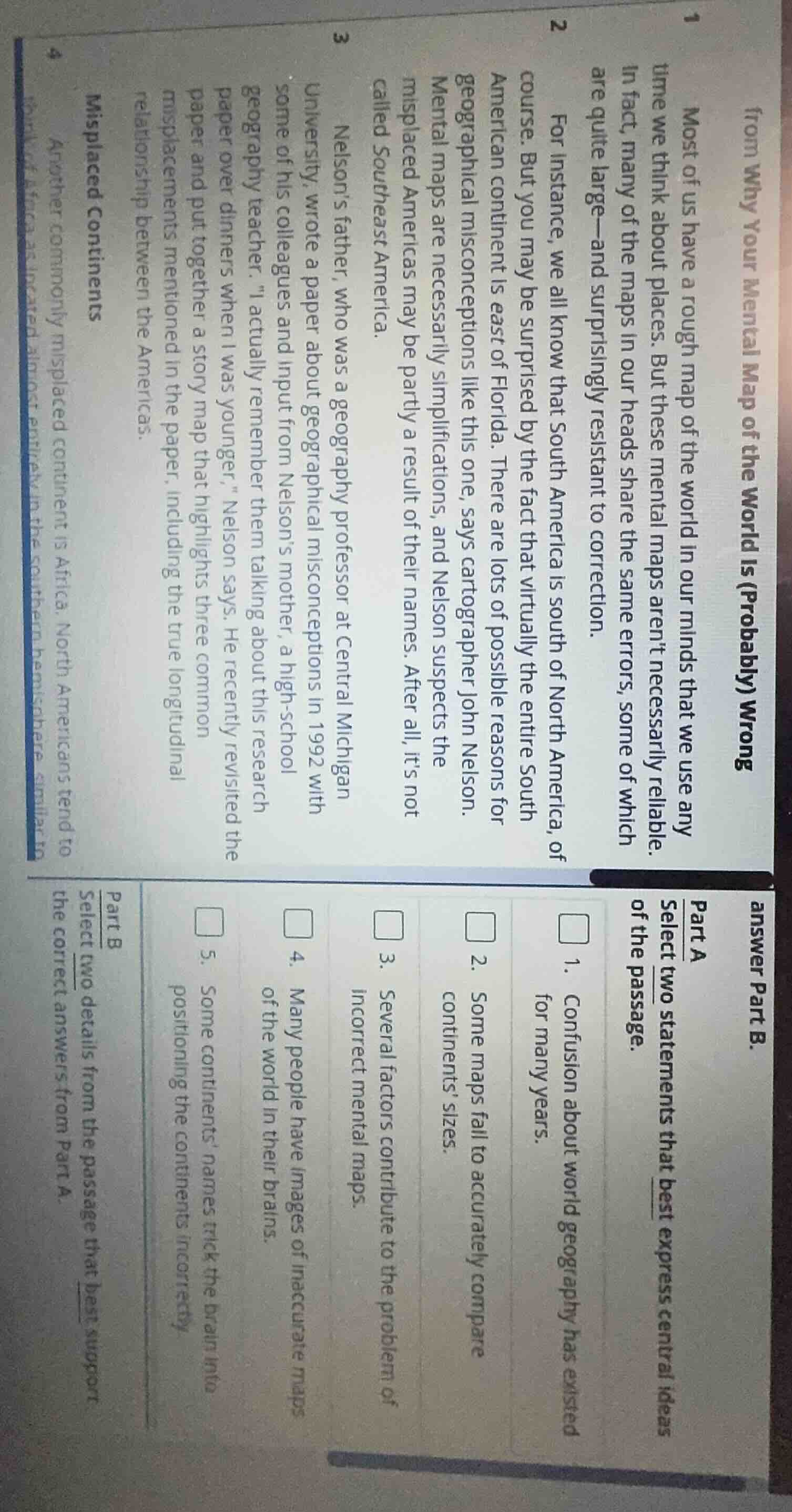
from why your mental map of the world is (probably) wrong
most of us have a rough map of the world in our minds that we use any time we think about places. but these mental maps aren’t necessarily reliable. in fact, many of the maps in our heads share the same errors, some of which are quite large—and surprisingly resistant to correction.
2
for instance, we all know that south america is south of north america, of course. but you may be surprised by the fact that virtually the entire south american continent is east of florida. there are lots of possible reasons for geographical misconceptions like this one, says cartographer john nelson. mental maps are necessarily simplifications, and nelson suspects the misplaced americas may be partly a result of their names. after all, it’s not called southeast america.
3
nelson’s father, who was a geography professor at central michigan university, wrote a paper about geographical misconceptions in 1992 with some of his colleagues and input from nelson’s mother, a high - school geography teacher. “i actually remember them talking about this research paper over dinners when i was younger,” nelson says. he recently revisited the paper and put together a story map that highlights three common misplacements mentioned in the paper, including the true longitudinal relationship between the americas.
misplaced continents
4
another commonly misplaced continent is africa. north americans tend to
answer part b.
part a
select two statements that best express central ideas of the passage.
- confusion about world geography has existed for many years.
- some maps fail to accurately compare continents’ sizes.
- several factors contribute to the problem of incorrect mental maps.
- many people have images of inaccurate maps of the world in their brains.
- some continents’ names trick the brain into positioning the continents incorrectly
part b
select two details from the passage that best support the correct answers from part a.
Part A
- Analyze Option 1: The passage focuses on mental maps' inaccuracies, not long - term confusion about world geography. Eliminate.
- Analyze Option 2: The passage doesn't discuss maps' accuracy in comparing continent sizes. Eliminate.
- Analyze Option 3: The passage mentions that mental maps have errors (e.g., misplacing Americas) and Nelson's research on geographical misconceptions, so multiple factors (like names, simplifications) contribute to incorrect mental maps. This is correct.
- Analyze Option 4: The first paragraph says "Most of us have a rough map of the world in our minds", which means many people have mental (image - like) maps of the world, and these are inaccurate (as later explained). This is correct.
- Analyze Option 5: The passage is about mental maps' inaccuracies, not continents' names tricking the brain. Eliminate.
We need to select two details from Part A. From Part A, Option 3 (Several factors contribute to the problem of incorrect mental maps) is supported by details like "Mental maps are necessarily simplifications, and Nelson suspects the misplaced Americas may be part of a result of their names" and Nelson's father's paper on geographical misconceptions with colleague and mother's input. Option 4 (Many people have images of inaccurate maps of the world in their brains) is supported by "Most of us have a rough map of the world in our minds that we use any time we think about places. But these mental maps aren't necessarily reliable. In fact, many of the maps in our heads share the same errors".

Snap & solve any problem in the app
Get step-by-step solutions on Sovi AI
Photo-based solutions with guided steps
Explore more problems and detailed explanations
- Several factors contribute to the problem of incorrect mental maps.
- Many people have images of inaccurate maps of the world in their brains.