QUESTION IMAGE
Question
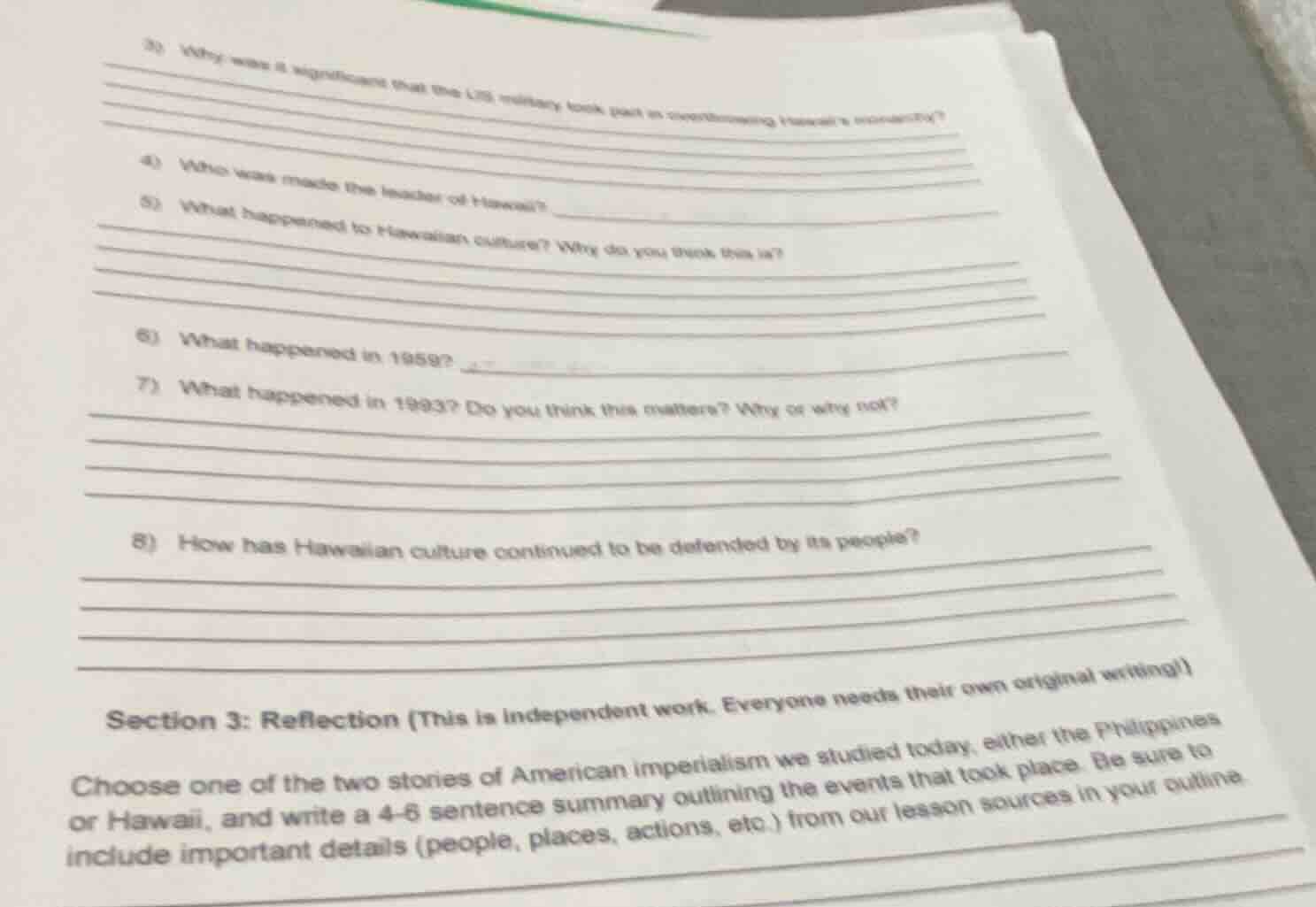
- why was it significant that the us military took part in overthrowing hawaiis monarchy?
- who was made the leader of hawaii?
- what happened to hawaiian culture? why do you think this is?
- what happened in 1959?
- what happened in 1993? do you think this matters? why or why not?
- how has hawaiian culture continued to be defended by its people?
section 3: reflection (this is independent work. everyone needs their own original writing!)
choose one of the two stories of american imperialism we studied today, either the philippines or hawaii, and write a 4-6 sentence summary outlining the events that took place. be sure to include important details (people, places, actions, etc.) from our lesson sources in your outline.
Brief Explanations
- The US military's role meant the overthrow was backed by a major world power, ensuring the monarchy could not reestablish control, and paved the way for Hawaii's eventual annexation to the US.
- Sanford B. Dole, a prominent American-Hawaiian businessman and politician, was made the leader of the Provisional Government of Hawaii after the overthrow.
- Hawaiian culture was suppressed: traditional language was banned in schools, cultural practices were discouraged, and land was taken from native Hawaiians. This occurred because the new ruling class (American and American-Hawaiian elites) sought to impose Western systems and erase native sovereignty to consolidate power and align Hawaii with US interests.
- In 1959, Hawaii was admitted as the 50th state of the United States, formalizing its status as part of the US after decades of being a US territory.
- In 1993, the US Congress passed the Apology Resolution (Public Law 103-150), which formally apologized to native Hawaiians for the US government's role in the 1893 overthrow of the Hawaiian monarchy. This matters because it acknowledged the US's role in a violation of Hawaiian sovereignty, validating native Hawaiian claims to self-determination and providing a formal recognition of historical injustice.
- Native Hawaiians have defended their culture by reviving traditional practices (like hula, native language immersion schools), advocating for land back movements, establishing cultural organizations, and pushing for political recognition of Hawaiian sovereignty through legal and grassroots efforts.
- (Hawaii summary example): In 1893, with the support of US military troops, a group of American and American-Hawaiian businessmen overthrew Queen Liliuokalani, the last reigning monarch of Hawaii, citing fears of her efforts to strengthen native Hawaiian power. Sanford B. Dole established a provisional government, which pushed for annexation to the US, a goal that was finalized in 1898 with the Newlands Resolution. For decades, Hawaii remained a US territory, with native Hawaiian culture suppressed as Western systems and values were imposed. In 1959, Hawaii became the 50th US state, but native Hawaiian activism persisted, leading to the 1993 US Apology Resolution, which recognized the US's role in the unjust overthrow. Today, grassroots movements continue to fight for Hawaiian sovereignty and the revival of traditional cultural practices.

Snap & solve any problem in the app
Get step-by-step solutions on Sovi AI
Photo-based solutions with guided steps
Explore more problems and detailed explanations
- It ensured the monarchy could not reassert control, directly enabling Hawaii's path to US annexation, as the US military's backing eliminated the monarchy's ability to resist the coup.
- Sanford B. Dole
- Hawaiian culture was suppressed (language banned in schools, practices discouraged, land seized); this was done to impose Western systems and erase native sovereignty, consolidating power for American-aligned elites.
- Hawaii was admitted as the 50th state of the United States.
- The US Congress passed the Apology Resolution, formally apologizing for its role in the 1893 overthrow of the Hawaiian monarchy. This matters because it validates native Hawaiian claims of historical injustice and recognizes the US's violation of their sovereignty, supporting ongoing efforts for self-determination.
- Native Hawaiians defend their culture through language immersion programs, reviving traditional arts like hula, land back movements, grassroots sovereignty advocacy, and cultural preservation organizations.
- (Hawaii summary example): In 1893, US military troops supported a coup by American and American-Hawaiian elites that overthrew Queen Liliuokalani, who had sought to expand native Hawaiian political power. Sanford B. Dole led the new provisional government, which lobbied heavily for US annexation, which was completed in 1898 via the Newlands Resolution. As a US territory, native Hawaiian culture was systematically suppressed, with the Hawaiian language banned in public schools and traditional practices discouraged. In 1959, Hawaii became the 50th US state, but native Hawaiian activism continued, culminating in the 1993 US Apology Resolution that acknowledged the US's role in the illegal overthrow. Today, native Hawaiian groups continue to push for sovereignty and work to revive traditional cultural practices through immersion schools and community-led initiatives.