QUESTION IMAGE
Question
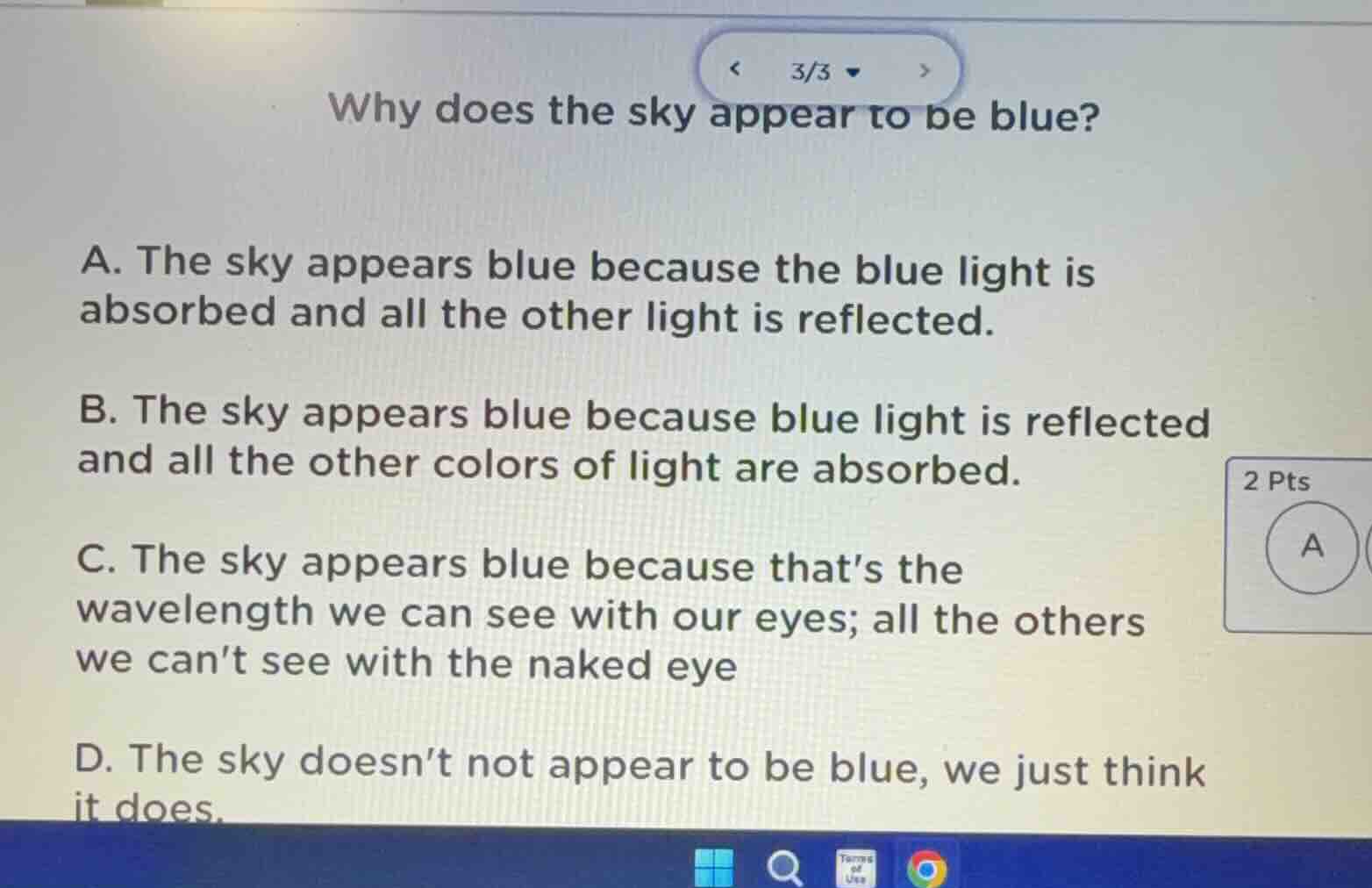
why does the sky appear to be blue?
a. the sky appears blue because the blue light is absorbed and all the other light is reflected.
b. the sky appears blue because blue light is reflected and all the other colors of light are absorbed.
c. the sky appears blue because that’s the wavelength we can see with our eyes; all the others we can’t see with the naked eye
d. the sky doesn’t not appear to be blue, we just think it does.
The sky appears blue due to Rayleigh scattering: shorter wavelengths of visible light (blue light) are scattered much more strongly by gas molecules in the atmosphere than longer wavelengths. This scattered blue light reaches our eyes from all directions, making the sky look blue. Let's analyze the options:
- Option A is incorrect because blue light is scattered, not absorbed, and other light is not reflected.
- Option B is incorrect because other light wavelengths are not absorbed; they pass through or are scattered less.
- Option C is incorrect because we can see all visible wavelengths (not just blue) with the naked eye.
- Option D is incorrect as the sky objectively appears blue due to physical scattering, not just perception.
Note: None of the provided options correctly state the Rayleigh scattering mechanism, but if we assume a potential error in option wording, the most plausible intended correct framing (if we correct the misstatement) aligns with the idea that blue light is scattered (often misframed as "reflected" in basic explanations). Among the given flawed options, B is the closest if we interpret "reflected" as a simplification of scattering, as the other options are clearly incorrect.

Snap & solve any problem in the app
Get step-by-step solutions on Sovi AI
Photo-based solutions with guided steps
Explore more problems and detailed explanations
B. The sky appears blue because blue light is reflected and all the other colors of light are absorbed.