QUESTION IMAGE
Question
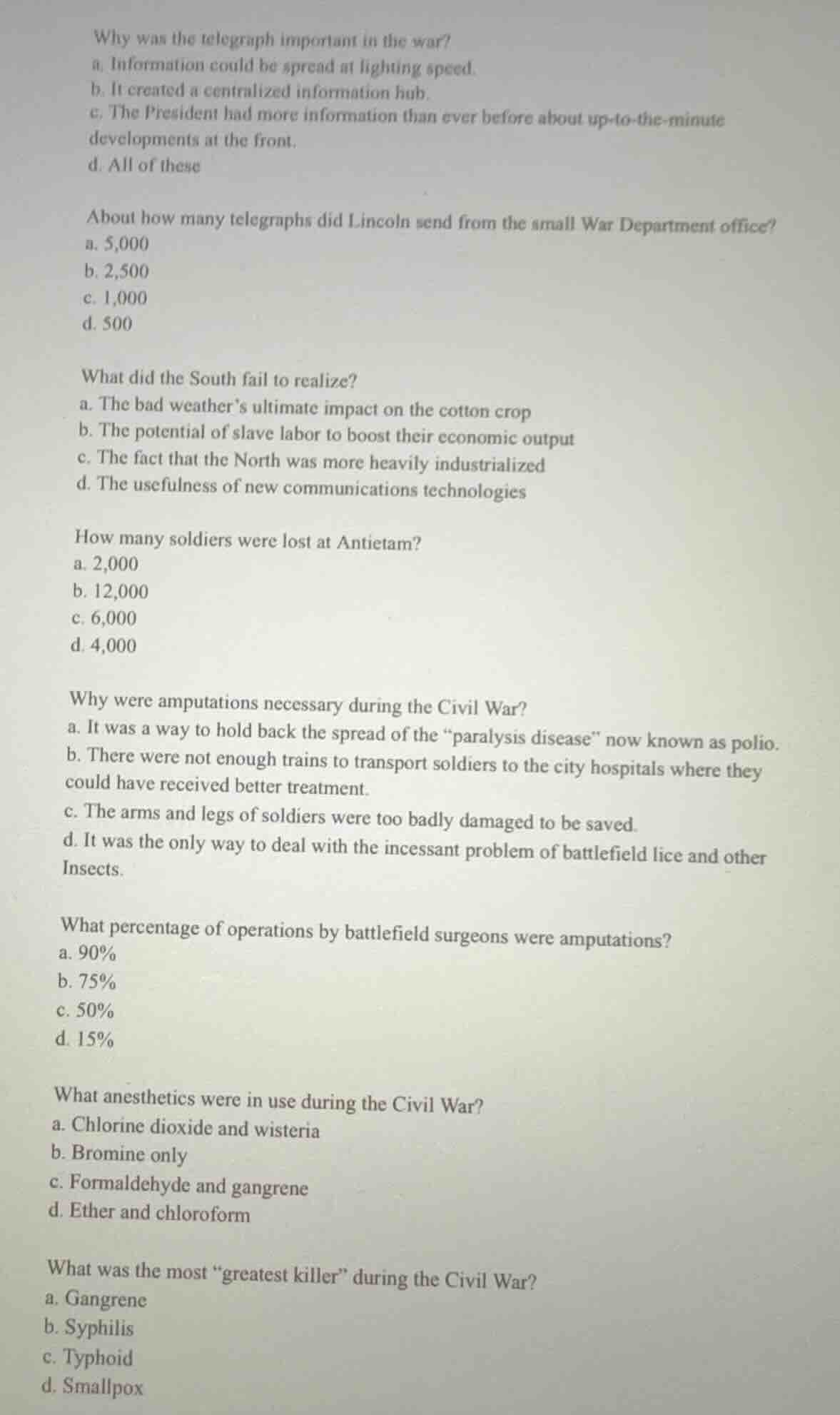
why was the telegraph important in the war?
a. information could be spread at lighting speed.
b. it created a centralized information hub.
c. the president had more information than ever before about up - to - the - minute developments at the front.
d. all of these
about how many telegraphs did lincoln send from the small war department office?
a. 5,000
b. 2,500
c. 1,000
d. 500
what did the south fail to realize?
a. the bad weather’s ultimate impact on the cotton crop
b. the potential of slave labor to boost their economic output
c. the fact that the north was more heavily industrialized
d. the usefulness of new communications technologies
how many soldiers were lost at antietam?
a. 2,000
b. 12,000
c. 6,000
d. 4,000
why were amputations necessary during the civil war?
a. it was a way to hold back the spread of the “paralysis disease” now known as polio.
b. there were not enough trains to transport soldiers to the city hospitals where they could have received better treatment.
c. the arms and legs of soldiers were too badly damaged to be saved.
d. it was the only way to deal with the incessant problem of battlefield lice and other insects.
what percentage of operations by battlefield surgeons were amputations?
a. 90%
b. 75%
c. 50%
d. 15%
what anesthetics were in use during the civil war?
a. chlorine dioxide and wisteria
b. bromine only
c. formaldehyde and gangrene
d. ether and chloroform
what was the most “greatest killer” during the civil war?
a. gangrene
b. syphilis
c. typhoid
d. smallpox
- The telegraph enabled fast communication, centralized info hubs, and gave real-time frontline updates to leaders, so all options are correct.
- Historical records note Lincoln sent around 1,000 telegrams from that office.
- The South underestimated the North's industrial capacity, which was a key advantage for the North.
- The Battle of Antietam had approximately 12,000 total soldier losses (killed, wounded, missing).
- Civil War battlefield medicine was limited; severely damaged limbs could not be saved, requiring amputation.
- Roughly 75% of Civil War battlefield surgical operations were amputations due to frequent severe limb injuries.
- Ether and chloroform were the primary anesthetics used during the Civil War for surgical procedures.
- Typhoid, spread by poor sanitation and contaminated water, was the deadliest disease and top killer of Civil War soldiers.

Snap & solve any problem in the app
Get step-by-step solutions on Sovi AI
Photo-based solutions with guided steps
Explore more problems and detailed explanations
- d. All of these
- c. 1,000
- c. The fact that the North was more heavily industrialized
- b. 12,000
- c. The arms and legs of soldiers were too badly damaged to be saved.
- b. 75%
- d. Ether and chloroform
- c. Typhoid