QUESTION IMAGE
Question
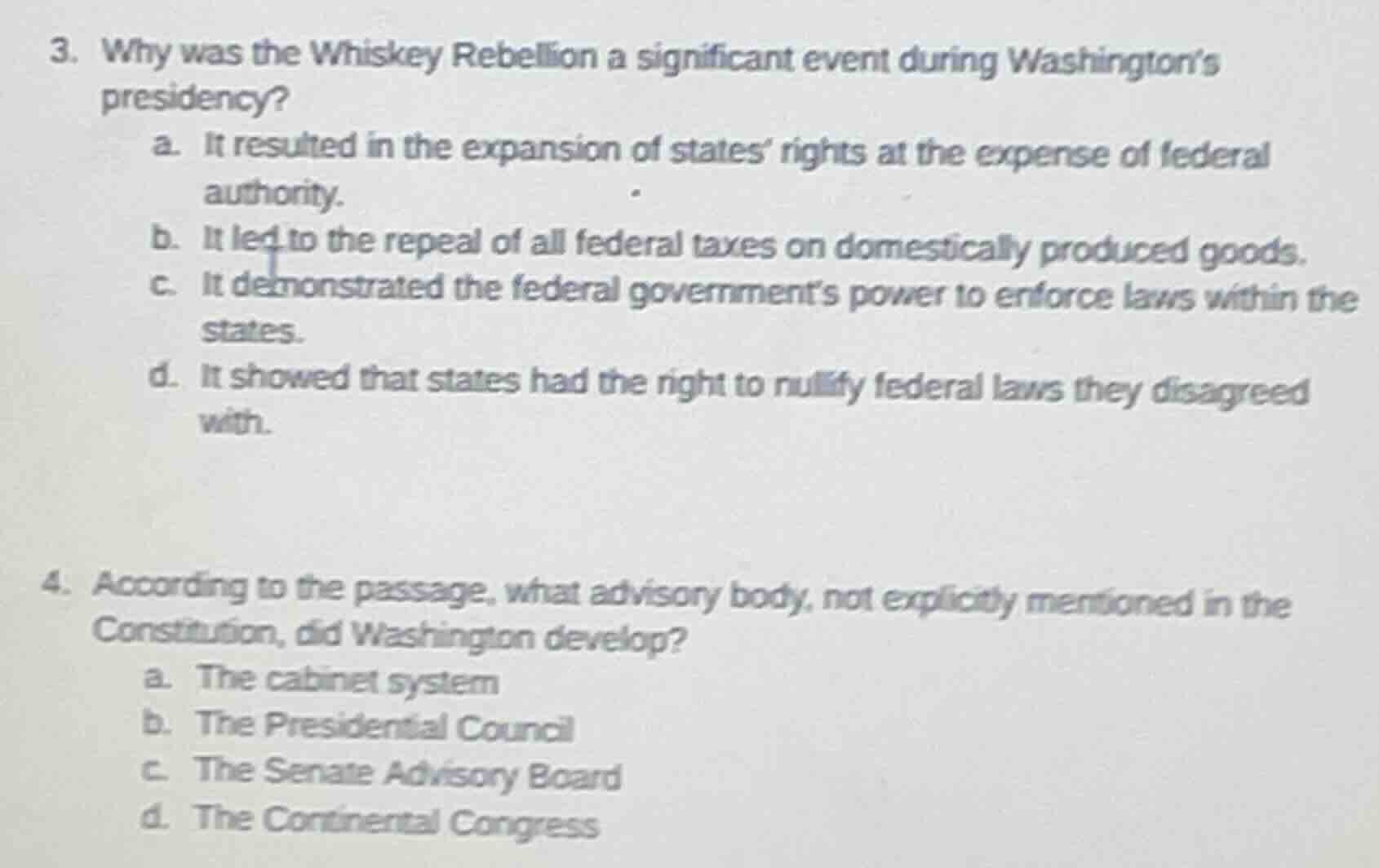
- why was the whiskey rebellion a significant event during washington’s presidency?
a. it resulted in the expansion of states’ rights at the expense of federal authority.
b. it led to the repeal of all federal taxes on domestically produced goods.
c. it demonstrated the federal government’s power to enforce laws within the states.
d. it showed that states had the right to nullify federal laws they disagreed with.
- according to the passage, what advisory body, not explicitly mentioned in the constitution, did washington develop?
a. the cabinet system
b. the presidential council
c. the senate advisory board
d. the continental congress
Response
Question 3
Brief Explanations
- Option a: The Whiskey Rebellion was about the federal government enforcing its law (the whiskey tax), not expanding states’ rights over federal authority. So a is incorrect.
- Option b: The rebellion didn’t lead to the repeal of all domestic federal taxes, only the whiskey tax wasn’t a long - term issue in the same way, and the statement is too extreme. So b is incorrect.
- Option c: When the Whiskey Rebellion occurred, Washington led troops to enforce the federal tax law. This showed that the federal government had the power to enforce its laws within the states. So c is correct.
- Option d: The idea of states nullifying federal laws was more associated with later events (like the Kentucky and Virginia Resolutions), and the Whiskey Rebellion was about federal enforcement, not state nullification. So d is incorrect.
Brief Explanations
- Option a: Washington developed the cabinet system as an advisory body, and it was not explicitly mentioned in the Constitution.
- Option b: There is no such thing as the Presidential Council developed by Washington in this context.
- Option c: The Senate Advisory Board is not a body developed by Washington.
- Option d: The Continental Congress existed before Washington’s presidency and was not an advisory body he developed.

Snap & solve any problem in the app
Get step-by-step solutions on Sovi AI
Photo-based solutions with guided steps
Explore more problems and detailed explanations
c. It demonstrated the federal government’s power to enforce laws within the states.