QUESTION IMAGE
Question
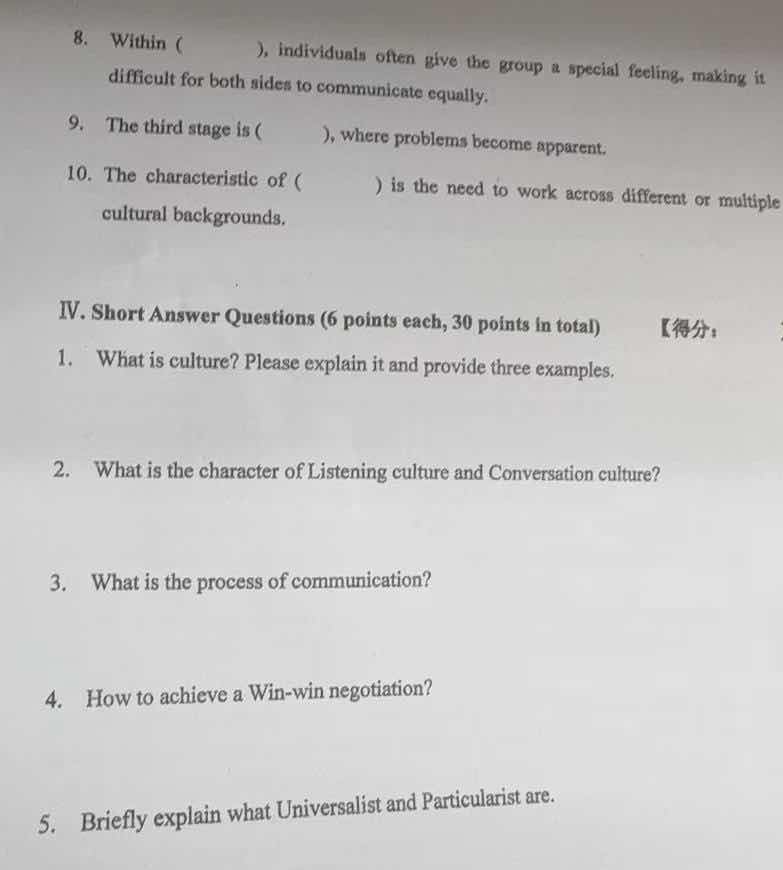
- within ( ), individuals often give the group a special feeling, making it difficult for both sides to communicate equally.
- the third stage is ( ), where problems become apparent.
- the characteristic of ( ) is the need to work across different or multiple cultural backgrounds.
ⅳ. short answer questions (6 points each, 30 points in total) 【得分:
- what is culture? please explain it and provide three examples.
- what is the character of listening culture and conversation culture?
- what is the process of communication?
- how to achieve a win - win negotiation?
- briefly explain what universalist and particularist are.
Question 1
Culture refers to the shared beliefs, values, customs, behaviors, and artifacts that characterize a group or society. It is learned and transmitted across generations. Examples: 1. Language: English, Chinese, etc., as a system of communication. 2. Festivals: Christmas (celebrated by Christians), Chinese New Year (celebrated by Chinese people). 3. Art: Painting styles like Impressionism (artistic culture).
- Listening Culture: People tend to listen more, value silence, and think before speaking. They focus on understanding others' views deeply, e.g., in some Asian cultures.
- Conversation Culture: People are more talkative, value expressing ideas, and see conversation as a way to build relationships, e.g., in some Western cultures.
The communication process includes: 1. Sender: Encodes a message. 2. Message: The content to be communicated (verbal/non - verbal). 3. Channel: Medium (e.g., face - to - face, phone, email). 4. Receiver: Decodes the message. 5. Feedback: Receiver's response to the sender. 6. Noise: Interference (e.g., background noise, language barriers) that affects communication.

Snap & solve any problem in the app
Get step-by-step solutions on Sovi AI
Photo-based solutions with guided steps
Explore more problems and detailed explanations
Culture is the shared beliefs, values, customs, behaviors, and artifacts of a group/society, learned and transmitted. Examples: Language (e.g., English), Festivals (e.g., Chinese New Year), Art (e.g., Impressionist paintings).