QUESTION IMAGE
Question
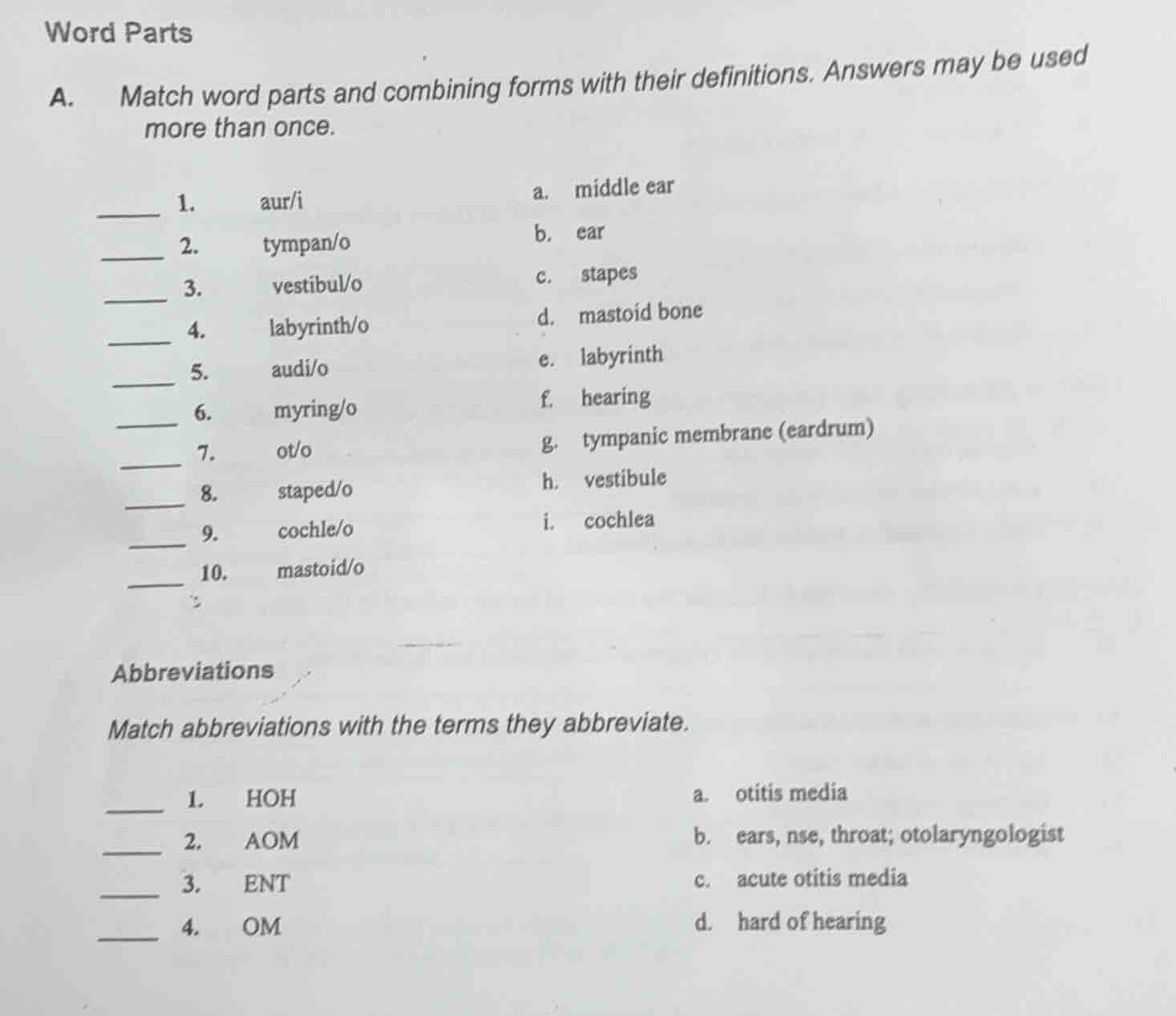
word parts
a. match word parts and combining forms with their definitions. answers may be used more than once.
_____ 1. aur/i a. middle ear
_____ 2. tympan/o b. ear
_____ 3. vestibul/o c. stapes
_____ 4. labyrinth/o d. mastoid bone
_____ 5. audi/o e. labyrinth
_____ 6. myring/o f. hearing
_____ 7. ot/o g. tympanic membrane (eardrum)
_____ 8. staped/o h. vestibule
_____ 9. cochle/o i. cochlea
_____ 10. mastoid/o
abbreviations
match abbreviations with the terms they abbreviate.
_____ 1. hoh a. otitis media
_____ 2. aom b. ears, nse, throat; otolaryngologist
_____ 3. ent c. acute otitis media
_____ 4. om d. hard of hearing
Part A: Match word parts and combining forms with their definitions
- aur/i: The combining form "aur/i" is related to the ear. So it matches with b. ear.
- tympan/o: "Tympan/o" is associated with the middle ear (tympanic cavity is part of the middle ear) or the tympanic membrane, but more directly the middle ear context here, so it matches with a. middle ear.
- vestibul/o: "Vestibul/o" refers to the vestibule (part of the inner ear). So it matches with h. vestibule.
- labyrinth/o: "Labyrinth/o" is related to the labyrinth (the inner ear structure including vestibule, cochlea, etc.). So it matches with e. labyrinth.
- audi/o: "Audi/o" is related to hearing (e.g., audiology is the study of hearing). So it matches with f. hearing.
- myring/o: "Myring/o" refers to the tympanic membrane (eardrum), also called myringa. So it matches with g. tympanic membrane (eardrum).
- ot/o: "Ot/o" is a combining form for ear (e.g., otology is the study of the ear). So it matches with b. ear (note: "aur/i" and "ot/o" both relate to ear, but "ot/o" is a more general ear - related combining form here).
- staped/o: "Staped/o" is related to the stapes (one of the ear ossicles). So it matches with c. stapes.
- cochle/o: "Cochle/o" is related to the cochlea (part of the inner ear). So it matches with i. cochlea.
- mastoid/o: "Mastoid/o" is related to the mastoid bone (part of the temporal bone, related to the ear). So it matches with d. mastoid bone.
Part B: Match abbreviations with the terms they abbreviate
- HOH: "HOH" stands for hard of hearing. So it matches with d. hard of hearing.
- AOM: "AOM" stands for acute otitis media (acute middle ear infection). So it matches with c. acute otitis media.
- ENT: "ENT" stands for ears, nose, throat (and the specialist is an otolaryngologist). So it matches with b. ears, nose, throat; otolaryngologist.
- OM: "OM" stands for otitis media (middle ear infection). So it matches with a. otitis media.
Final Answers (Part A)
- b
- a
- h
- e
- f
- g
- b
- c
- i
- d
Final Answers (Part B)
- d
- c
- b
- a

Snap & solve any problem in the app
Get step-by-step solutions on Sovi AI
Photo-based solutions with guided steps
Explore more problems and detailed explanations
Part A: Match word parts and combining forms with their definitions
- aur/i: The combining form "aur/i" is related to the ear. So it matches with b. ear.
- tympan/o: "Tympan/o" is associated with the middle ear (tympanic cavity is part of the middle ear) or the tympanic membrane, but more directly the middle ear context here, so it matches with a. middle ear.
- vestibul/o: "Vestibul/o" refers to the vestibule (part of the inner ear). So it matches with h. vestibule.
- labyrinth/o: "Labyrinth/o" is related to the labyrinth (the inner ear structure including vestibule, cochlea, etc.). So it matches with e. labyrinth.
- audi/o: "Audi/o" is related to hearing (e.g., audiology is the study of hearing). So it matches with f. hearing.
- myring/o: "Myring/o" refers to the tympanic membrane (eardrum), also called myringa. So it matches with g. tympanic membrane (eardrum).
- ot/o: "Ot/o" is a combining form for ear (e.g., otology is the study of the ear). So it matches with b. ear (note: "aur/i" and "ot/o" both relate to ear, but "ot/o" is a more general ear - related combining form here).
- staped/o: "Staped/o" is related to the stapes (one of the ear ossicles). So it matches with c. stapes.
- cochle/o: "Cochle/o" is related to the cochlea (part of the inner ear). So it matches with i. cochlea.
- mastoid/o: "Mastoid/o" is related to the mastoid bone (part of the temporal bone, related to the ear). So it matches with d. mastoid bone.
Part B: Match abbreviations with the terms they abbreviate
- HOH: "HOH" stands for hard of hearing. So it matches with d. hard of hearing.
- AOM: "AOM" stands for acute otitis media (acute middle ear infection). So it matches with c. acute otitis media.
- ENT: "ENT" stands for ears, nose, throat (and the specialist is an otolaryngologist). So it matches with b. ears, nose, throat; otolaryngologist.
- OM: "OM" stands for otitis media (middle ear infection). So it matches with a. otitis media.
Final Answers (Part A)
- b
- a
- h
- e
- f
- g
- b
- c
- i
- d
Final Answers (Part B)
- d
- c
- b
- a