QUESTION IMAGE
Question
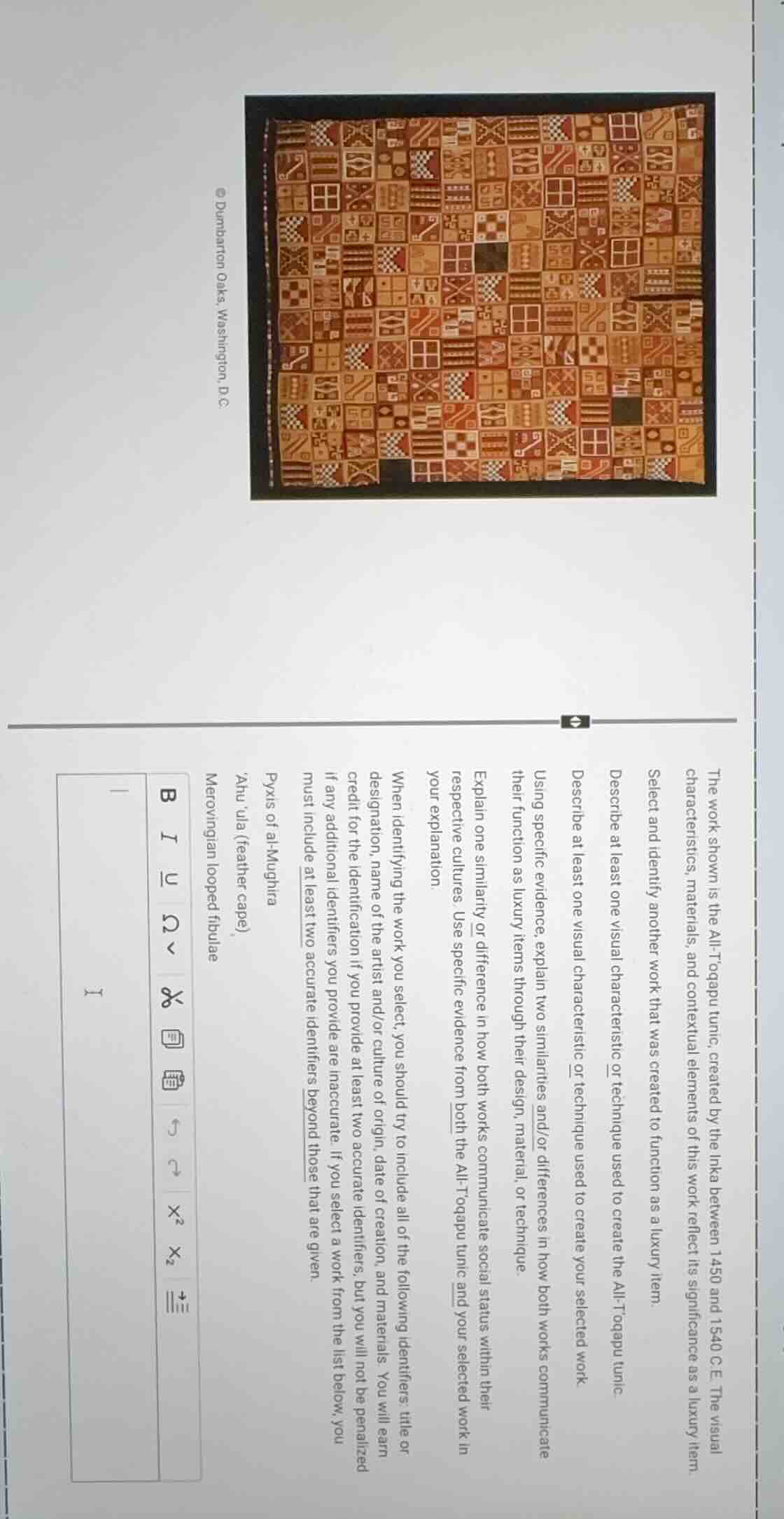
the work shown is the all-toqapu tunic, created by the inka between 1450 and 1540 ce. the visual characteristics, materials, and contextual elements of this work reflect its significance as a luxury item. select and identify another work that was created to function as a luxury item. describe at least one visual characteristic or technique used to create the all-toqapu tunic. describe at least one visual characteristic or technique used to create your selected work. using specific evidence, explain two similarities and/or differences in how both works communicate their function as luxury items through their design, material, or technique. explain one similarity or difference in how both works communicate social status within their respective cultures. use specific evidence from both the all-toqapu tunic and your selected work in your explanation. when identifying the work you select, you should try to include all of the following identifiers: title or designation, name of the artist and/or culture of origin, date of creation, and materials. you will earn credit for the identification if you provide at least two accurate identifiers, but you will not be penalized if any additional identifiers you provide are inaccurate. if you select a work from the list below, you must include at least two accurate identifiers beyond those that are given.
list of works to choose from:
pyxis of al-mughira
āhu ula (feather cape)
merovingian looped fibulae
To solve this problem, we analyze the All - T'oqapu Tunic and compare it with the 'Ãhu 'ula (feather cape)':
Step 1: Visual Characteristics/Techniques
- All - T'oqapu Tunic: It is made of cotton and camelid fiber. Visually, it has a grid of squares (t'oqapu) with different geometric and symbolic designs. The technique involves complex weaving, and the use of dyed fibers to create the patterns. These t'oqapu squares are a key visual characteristic, each potentially representing a different concept or group within Inka society.
- 'Ãhu 'ula (feather cape): Made from feathers (usually from birds like 'i'iwi and mamo) and fiber. Visually, it has a rich, colorful appearance due to the feathers, and the technique involves attaching feathers to a fiber base, often in intricate patterns. A key visual characteristic is the iridescent or brightly colored feather arrangement.
Step 2: Function as Luxury Items
- All - T'oqapu Tunic: It was a luxury item worn by Inka nobles or royalty. The use of fine cotton and camelid fiber (which was valuable in Inka society), along with the symbolic t'oqapu designs, signified the wearer's high social status. The tunic's design communicated the wearer's connection to different groups or aspects of Inka life represented by the t'oqapu.
- 'Ãhu 'ula (feather cape): Worn by Hawaiian chiefs or royalty. The feathers used were difficult to obtain (especially rare feather colors), and the intricate feather - working technique made it a luxury item. It signified the chief's power and divine connection (in Hawaiian culture, feathers were associated with the gods), communicating the wearer's high social and spiritual status.
Step 3: Similarity/Difference in Communicating Status
- Similarity: Both the All - T'oqapu Tunic and the 'Ãhu 'ula are luxury items that use rare or valuable materials (camelid fiber and fine cotton for the tunic, rare feathers for the cape) to signify the high social status of the wearer. The intricate techniques used in their creation (weaving for the tunic, feather - working for the cape) also add to their luxury and status - communicating nature, as these techniques required skilled artisans and a significant amount of time.
- Difference: The All - T'oqapu Tunic uses symbolic geometric and cultural designs (t'oqapu) to communicate the wearer's connection to Inka social and political structures. The 'Ãhu 'ula uses the symbolic meaning of feathers (associated with Hawaiian deities and spiritual power) to communicate the wearer's spiritual and political authority. Also, the materials are different (textile - based vs. feather - based), which reflects the different environments and available resources of the Inka (Andes, with camelids and cotton) and Hawaiian (Pacific Islands, with abundant bird life) cultures.
Step 4: Identifiers for the Works
- All - T'oqapu Tunic:
- Title: All - T'oqapu Tunic
- Artist/Culture: Inka, 1450 - 1540 CE
- Materials: Cotton, camelid fiber
- Creation Date: 1450 - 1540 CE
- 'Ãhu 'ula (feather cape):
- Title: 'Ãhu 'ula (feather cape)
- Artist/Culture: Hawaiian, pre - contact (before European arrival, roughly 18th century or earlier)
- Materials: Feathers (e.g., 'i'iwi, mamo), fiber
- Creation Date: Pre - contact Hawaiian period
Step 5: Explanation of Similarity/Difference in Status Communication
- The similarity lies in the use of luxury materials and skilled craftsmanship to denote high social status. The difference is in the cultural symbols (t'oqapu vs. feather symbolism) and the speci…

Snap & solve any problem in the app
Get step-by-step solutions on Sovi AI
Photo-based solutions with guided steps
Explore more problems and detailed explanations
- Visual Characteristics/Techniques:
- All - T'oqapu Tunic: Grid of t'oqapu squares, woven cotton/camelid fiber.
- 'Ãhu 'ula: Feather - covered, feather - working technique.
- Function as Luxury Items: Both signify high social status; tunic for Inka nobles, cape for Hawaiian chiefs.
- Similarity in Status Communication: Use of rare materials and skilled techniques to show high status.
- Difference in Status Communication: Tunic uses t'oqapu (Inka social symbols), cape uses feather (Hawaiian spiritual/political symbols).
- Identifiers:
- All - T'oqapu Tunic: Title - All - T'oqapu Tunic, Culture - Inka, Date - 1450 - 1540 CE, Materials - Cotton, camelid fiber.
- 'Ãhu 'ula: Title - 'Ãhu 'ula (feather cape), Culture - Hawaiian, Date - Pre - contact, Materials - Feathers, fiber.