QUESTION IMAGE
Question
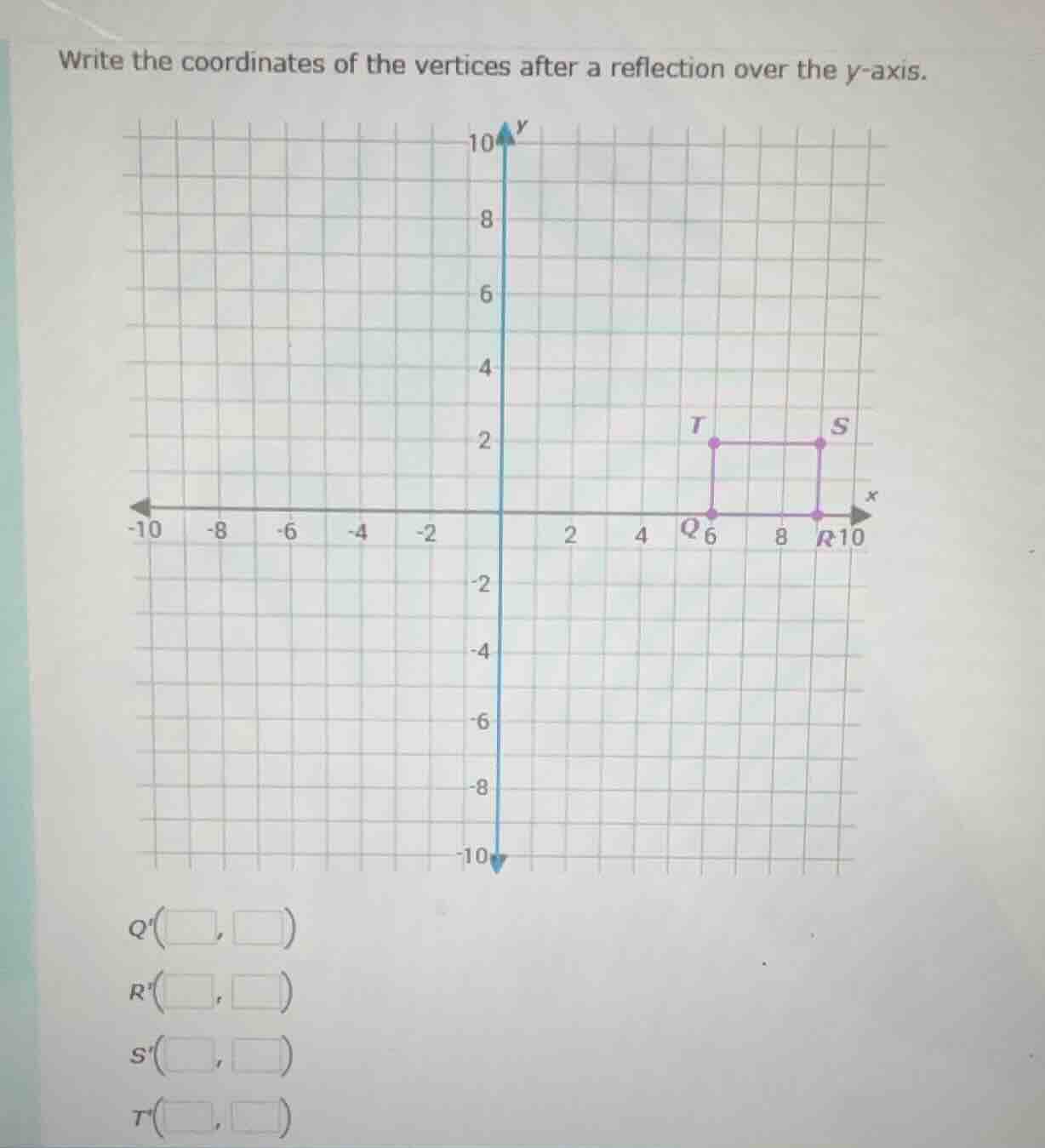
write the coordinates of the vertices after a reflection over the ( y )-axis.
( q(square, square) )
( r(square, square) )
( s(square, square) )
( t(square, square) )
Step1: Find original coordinates
First, identify the original coordinates of each vertex from the graph:
- \( Q \): \( (6, 0) \)
- \( R \): \( (9, 0) \) (Wait, looking at the graph, \( R \) is at \( x = 9 \)? Wait, no, the grid: \( Q \) is at \( x = 6 \), \( R \) is at \( x = 9 \)? Wait, the graph shows \( Q \) at \( (6,0) \), \( T \) at \( (6,2) \), \( S \) at \( (9,2) \), \( R \) at \( (9,0) \). Let's confirm:
- \( Q \): \( (6, 0) \)
- \( R \): \( (9, 0) \)
- \( S \): \( (9, 2) \)
- \( T \): \( (6, 2) \)
Step2: Apply reflection over y-axis
The rule for reflection over the \( y \)-axis is \( (x, y)
ightarrow (-x, y) \).
For \( Q(6, 0) \):
Apply the rule: \( (6, 0)
ightarrow (-6, 0) \), so \( Q' = (-6, 0) \).
For \( R(9, 0) \):
Apply the rule: \( (9, 0)
ightarrow (-9, 0) \), so \( R' = (-9, 0) \).
For \( S(9, 2) \):
Apply the rule: \( (9, 2)
ightarrow (-9, 2) \), so \( S' = (-9, 2) \).
For \( T(6, 2) \):
Apply the rule: \( (6, 2)
ightarrow (-6, 2) \), so \( T' = (-6, 2) \).

Snap & solve any problem in the app
Get step-by-step solutions on Sovi AI
Photo-based solutions with guided steps
Explore more problems and detailed explanations
\( Q'(-6, 0) \)
\( R'(-9, 0) \)
\( S'(-9, 2) \)
\( T'(-6, 2) \)