QUESTION IMAGE
Question
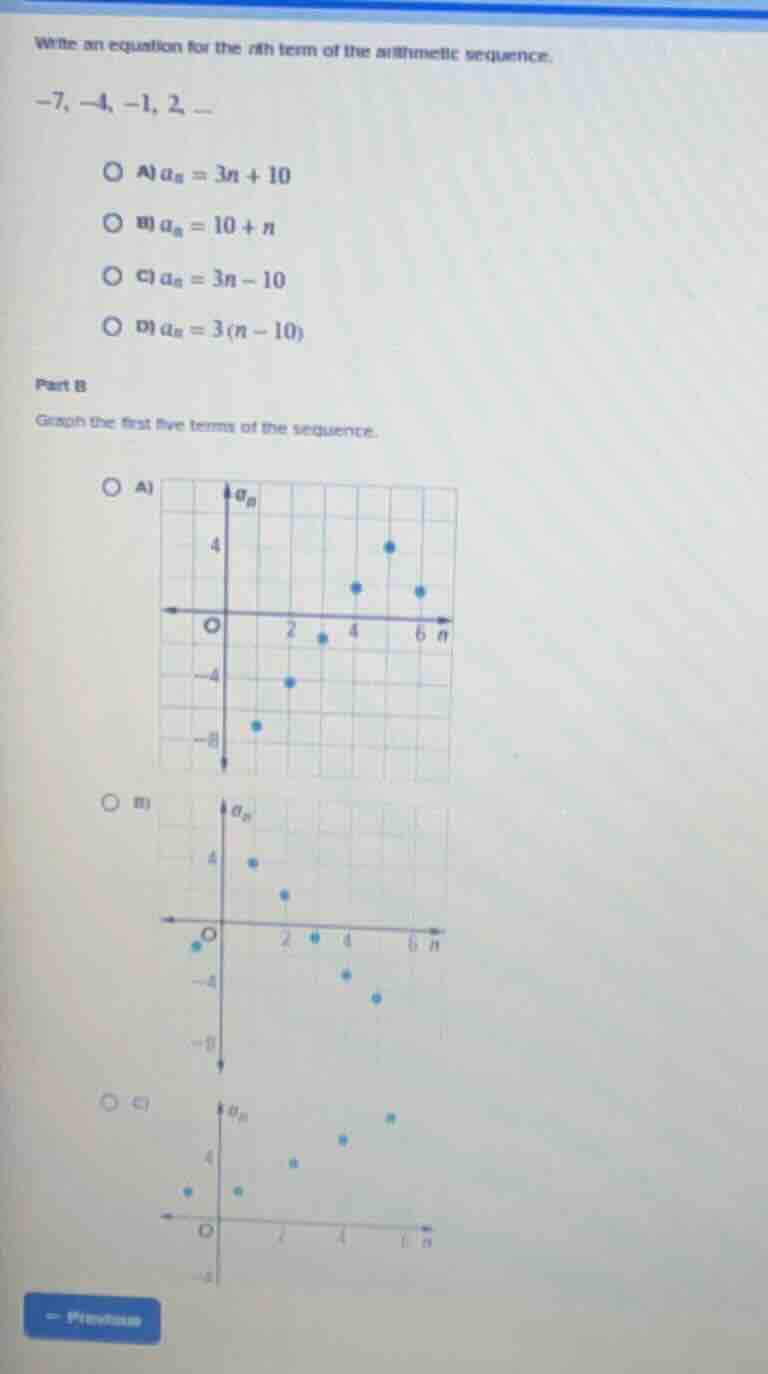
write an equation for the nth term of the arithmetic sequence.
-7, -4, -1, 2, ...
a) ( a_n = 3n + 10 )
b) ( a_n = 10 + n )
c) ( a_n = 3n - 10 )
d) ( a_n = 3(n - 10) )
part b
graph the first five terms of the sequence.
a) graph with points
b) graph with points
c) graph with points
Part A
Step1: Identify the first term and common difference
The arithmetic sequence is \(-7, -4, -1, 2, \dots\). The first term \(a_1 = -7\). The common difference \(d\) is calculated by subtracting consecutive terms: \(-4 - (-7) = 3\), \(-1 - (-4) = 3\), \(2 - (-1) = 3\), so \(d = 3\).
Step2: Use the formula for the nth term of an arithmetic sequence
The formula for the \(n\)-th term of an arithmetic sequence is \(a_n = a_1 + (n - 1)d\). Substitute \(a_1 = -7\) and \(d = 3\) into the formula:
\[
\]
First, find the first five terms using the formula \(a_n = 3n - 10\):
- For \(n = 1\): \(a_1 = 3(1) - 10 = -7\)
- For \(n = 2\): \(a_2 = 3(2) - 10 = -4\)
- For \(n = 3\): \(a_3 = 3(3) - 10 = -1\)
- For \(n = 4\): \(a_4 = 3(4) - 10 = 2\)
- For \(n = 5\): \(a_5 = 3(5) - 10 = 5\)
Now, we analyze the graphs:
- The first five terms are \((1, -7)\), \((2, -4)\), \((3, -1)\), \((4, 2)\), \((5, 5)\). These points should show an increasing linear pattern (since the sequence is arithmetic with positive common difference).
Looking at the options:
- Option A: The points seem to match the coordinates \((1, -7)\), \((2, -4)\), \((3, -1)\), \((4, 2)\), \((5, 5)\) (visually, the y-values increase by 3 each time as \(n\) increases by 1).
- Option B: The points are decreasing, which contradicts the positive common difference.
- Option C: The points do not align with the calculated terms.
So the correct graph is Option A.

Snap & solve any problem in the app
Get step-by-step solutions on Sovi AI
Photo-based solutions with guided steps
Explore more problems and detailed explanations
C) \(a_n = 3n - 10\)