QUESTION IMAGE
Question
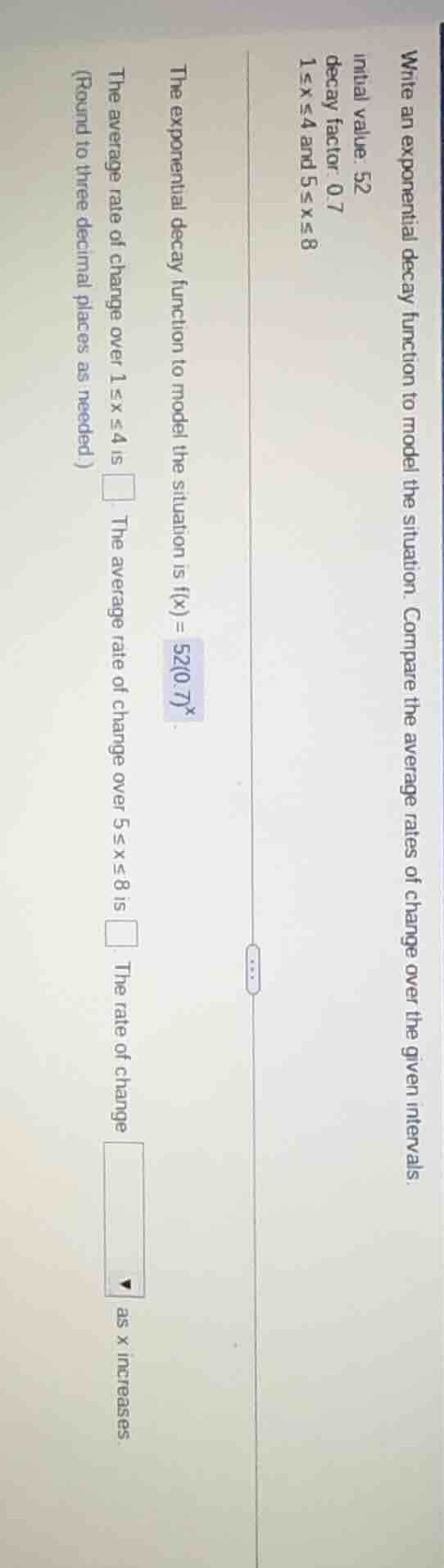
write an exponential decay function to model the situation. compare the average rates of change over the given intervals. initial value: 52 decay factor: 0.7 1≤x≤4 and 5≤x≤8 the exponential decay function to model the situation is f(x) = 52(0.7)^x. the average rate of change over 1≤x≤4 is \boxed{}. the average rate of change over 5≤x≤8 is \boxed{}. the rate of change \boxed{} as x increases. (round to three decimal places as needed.)
Step1: Recall the formula for average rate of change
The average rate of change of a function \( f(x) \) over the interval \([a, b]\) is given by \(\frac{f(b) - f(a)}{b - a}\).
Step2: Find the average rate of change over \( 1 \leq x \leq 4 \)
First, find \( f(1) \) and \( f(4) \) for the function \( f(x) = 52(0.7)^x \).
- For \( x = 1 \): \( f(1) = 52(0.7)^1 = 52 \times 0.7 = 36.4 \)
- For \( x = 4 \): \( f(4) = 52(0.7)^4 \). Calculate \( (0.7)^4 = 0.7 \times 0.7 \times 0.7 \times 0.7 = 0.2401 \). Then \( f(4) = 52 \times 0.2401 = 12.4852 \)
Now, use the average rate of change formula with \( a = 1 \), \( b = 4 \):
\[
\frac{f(4) - f(1)}{4 - 1} = \frac{12.4852 - 36.4}{3} = \frac{-23.9148}{3} \approx -7.9716
\]
Step3: Find the average rate of change over \( 5 \leq x \leq 8 \)
First, find \( f(5) \) and \( f(8) \) for the function \( f(x) = 52(0.7)^x \).
- For \( x = 5 \): \( f(5) = 52(0.7)^5 \). Since \( (0.7)^5 = (0.7)^4 \times 0.7 = 0.2401 \times 0.7 = 0.16807 \), then \( f(5) = 52 \times 0.16807 = 8.73964 \)
- For \( x = 8 \): \( f(8) = 52(0.7)^8 \). Calculate \( (0.7)^8 = [(0.7)^4]^2 = (0.2401)^2 = 0.05764801 \). Then \( f(8) = 52 \times 0.05764801 = 2.99769652 \)
Now, use the average rate of change formula with \( a = 5 \), \( b = 8 \):
\[
\frac{f(8) - f(5)}{8 - 5} = \frac{2.99769652 - 8.73964}{3} = \frac{-5.74194348}{3} \approx -1.91398116
\]
Step4: Analyze the rate of change as \( x \) increases
Since the function is an exponential decay function (\( 0 < 0.7 < 1 \)), the rate of change (average rate of change over intervals) becomes less negative (or increases) as \( x \) increases. We can see that the average rate of change over \( 1 \leq x \leq 4 \) is approximately \(-7.972\) and over \( 5 \leq x \leq 8 \) is approximately \(-1.914\), so the rate of change increases (becomes less negative) as \( x \) increases.

Snap & solve any problem in the app
Get step-by-step solutions on Sovi AI
Photo-based solutions with guided steps
Explore more problems and detailed explanations
The exponential decay function to model the situation is \( f(x) = 52(0.7)^x \).
The average rate of change over \( 1 \leq x \leq 4 \) is \(\approx -7.972\).
The average rate of change over \( 5 \leq x \leq 8 \) is \(\approx -1.914\).
The rate of change increases as \( x \) increases.