QUESTION IMAGE
Question
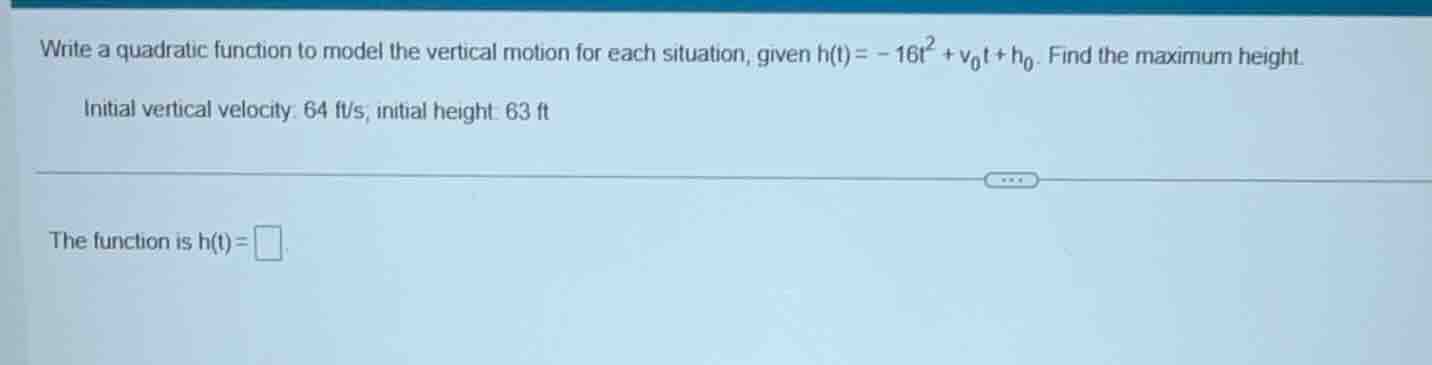
write a quadratic function to model the vertical motion for each situation, given $h(t) = -16t^2 + v_0t + h_0$. find the maximum height. initial vertical velocity: 64 ft/s; initial height: 63 ft the function is $h(t) = \square$.
Step1: Identify given values
We know the formula for vertical motion is \( h(t) = -16t^2 + v_0t + h_0 \), where \( v_0 \) is the initial vertical velocity and \( h_0 \) is the initial height. Here, \( v_0 = 64 \) ft/s and \( h_0 = 63 \) ft.
Step2: Substitute values into the formula
Substitute \( v_0 = 64 \) and \( h_0 = 63 \) into the formula \( h(t) = -16t^2 + v_0t + h_0 \). So we get \( h(t) = -16t^2 + 64t + 63 \).
To find the maximum height, we can use the formula for the vertex of a parabola. For a quadratic function \( ax^2+bx + c \), the x - coordinate of the vertex is \( t=-\frac{b}{2a} \). Here, \( a=-16 \) and \( b = 64 \).
Step3: Find the time at which maximum height occurs
Calculate \( t=-\frac{64}{2\times(-16)}=-\frac{64}{-32} = 2 \) seconds.
Step4: Find the maximum height
Substitute \( t = 2 \) into the function \( h(t)=-16t^2 + 64t+63 \).
\( h(2)=-16\times(2)^2+64\times2 + 63=-16\times4 + 128+63=-64 + 128+63=64 + 63=127 \) feet.

Snap & solve any problem in the app
Get step-by-step solutions on Sovi AI
Photo-based solutions with guided steps
Explore more problems and detailed explanations
The function is \( h(t)=\boldsymbol{-16t^2 + 64t + 63} \) and the maximum height is \( \boldsymbol{127} \) feet.