QUESTION IMAGE
Question
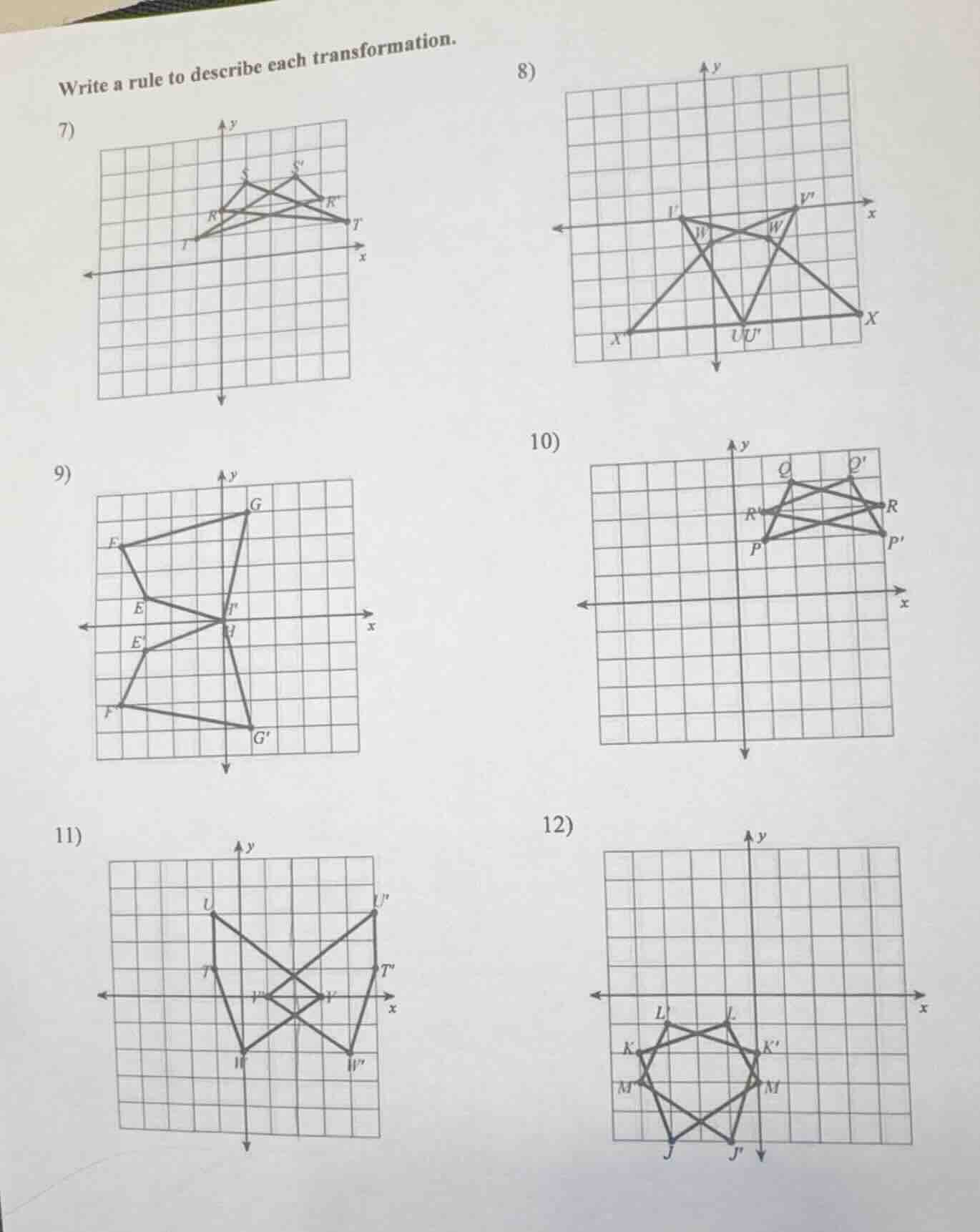
write a rule to describe each transformation.
7)
8)
9)
10)
11)
12)
Let's solve problem 7 first (we can follow the same approach for others).
Problem 7:
Step1: Identify a point and its image
Let's take point \( I \), \( R \), \( S \), \( T \) and their images \( I \) (wait, no, looking at the graph, let's pick a point, say \( S \). Let's assume coordinates. Let's say original \( S \) is at \((x_1, y_1)\) and \( S' \) is at \((x_1 + 2, y_1)\) (shifting right 2 units). Let's check another point, like \( R \). If \( R \) is at \((x_2, y_2)\), \( R' \) is at \((x_2 + 2, y_2)\). \( T \) seems to stay? Wait, no, maybe translation. Let's check the horizontal shift. From the graph, the figure is shifted 2 units to the right. So the transformation rule is a translation.
Step2: Write the rule
For a translation, the rule is \((x, y) \to (x + 2, y)\) (since it's shifted 2 units right, no vertical shift).
Step1: Identify symmetry or transformation
Looking at the graph, the figure seems to be reflected over the \( y \)-axis? Wait, no, let's check points. \( X' \) and \( X \), \( U' \) and \( U \), \( V' \) and \( V \), \( W' \) and \( W \). Wait, maybe reflection over the \( y \)-axis? Wait, no, let's see coordinates. If \( X' \) is at \((-a, b)\) and \( X \) is at \((a, b)\), then reflection over \( y \)-axis is \((x, y) \to (-x, y)\)? Wait, no, maybe reflection over the \( x \)-axis? Wait, no, the figure is symmetric with respect to the \( y \)-axis? Wait, no, looking at the graph, the left and right sides: \( X' \) is left, \( X \) is right, same \( y \)-coordinate (since it's on the \( x \)-axis? Wait, \( X' \) and \( X \) are on the \( x \)-axis, \( U' \) and \( U \) are on the \( y \)-axis? Wait, maybe reflection over the \( y \)-axis. Let's take a point \( V' \) and \( V \). If \( V' \) is at \((-c, d)\) and \( V \) is at \((c, d)\), then the rule is \((x, y) \to (-x, y)\)? Wait, no, maybe it's a reflection over the \( y \)-axis. Wait, alternatively, maybe a translation? No, the shape is mirrored. So reflection over \( y \)-axis: \((x, y) \to (-x, y)\)? Wait, no, let's check the graph again. Wait, the original figure (left) and the image (right) – maybe reflection over the \( y \)-axis. So the rule is \((x, y) \to (-x, y)\).
Step2: Confirm with points
Take \( U' \) (on \( y \)-axis, so \( x = 0 \), image \( U \) is also \( x = 0 \), so that's consistent. Take \( X' \) at, say, \((-5, 0)\), \( X \) at \((5, 0)\), so \((-5, 0) \to (5, 0)\) which is \((x, y) \to (-x, y)\) (since \( -(-5) = 5 \)). So the rule is reflection over \( y \)-axis: \((x, y) \to (-x, y)\).
Step1: Identify transformation (rotation? reflection? translation? dilation? No, looks like rotation or reflection. Wait, the figure is symmetric with respect to the origin? Wait, no, let's check points. \( E \), \( F \), \( G \), \( H \) and their images \( E' \), \( F' \), \( G' \), \( H' \). Wait, \( H \) is at the origin? \( H \) is \((0,0)\), so \( H' \) is also \((0,0)\). \( E \) and \( E' \): if \( E \) is at \((-3, 1)\), \( E' \) is at \((-3, -1)\)? No, wait, maybe reflection over the \( x \)-axis. Let's check \( G \): \( G \) is at \((1, 3)\), \( G' \) is at \((1, -3)\). \( F \) is at \((-4, -2)\), \( F' \) is at \((-4, 2)\)? No, wait, maybe reflection over the \( x \)-axis: \((x, y) \to (x, -y)\). Let's check \( G \): \((1, 3) \to (1, -3)\), which matches \( G' \). \( E \): if \( E \) is at \((-4, 2)\), \( E' \) is at \((-4, -2)\)? Wait, no, the graph: \( E \) is above \( x \)-axis, \( E' \) is below. So reflection over \( x \)-axis: \((x, y) \to (x, -y)\).
Step2: Confirm
Yes, reflection over \( x \)-axis: \( y \)-coordinate flips sign. So the rule is \((x, y) \to (x, -y)\).

Snap & solve any problem in the app
Get step-by-step solutions on Sovi AI
Photo-based solutions with guided steps
Explore more problems and detailed explanations
The transformation rule for problem 7 is \(\boldsymbol{(x, y) \to (x + 2, y)}\) (translation 2 units to the right).
---