QUESTION IMAGE
Question
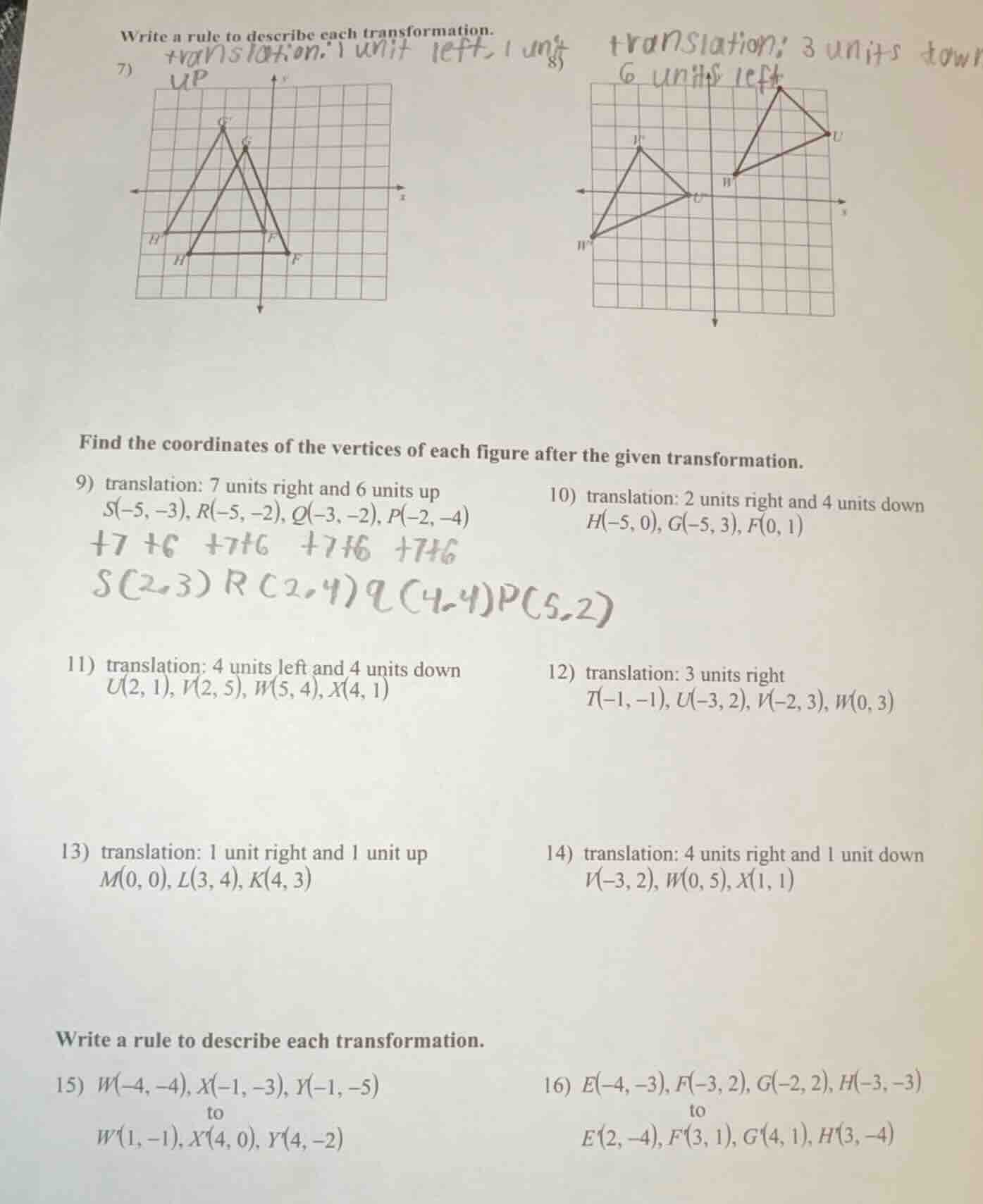
write a rule to describe each transformation.
7)
8)
find the coordinates of the vertices of each figure after the given transformation.
- translation: 7 units right and 6 units up
( s(-5, -3), r(-5, -2), q(-3, -2), p(-2, -4) )
- translation: 2 units right and 4 units down
( h(-5, 0), g(-5, 3), f(0, 1) )
- translation: 4 units left and 4 units down
( u(2, 1), v(2, 5), w(5, 4), x(4, 1) )
- translation: 3 units right
( t(-1, -1), u(-3, 2), v(-2, 3), w(0, 3) )
- translation: 1 unit right and 1 unit up
( m(0, 0), l(3, 4), k(4, 3) )
- translation: 4 units right and 1 unit down
( v(-3, 2), w(0, 5), x(1, 1) )
write a rule to describe each transformation.
- ( w(-4, -4), x(-1, -3), y(-1, -5) )
to
( w(1, -1), x(4, 0), y(4, -2) )
- ( e(-4, -3), f(-3, 2), g(-2, 2), h(-3, -3) )
to
( e(2, -4), f(3, 1), g(4, 1), h(3, -4) )
Let's solve problem 9 first (we can solve other problems similarly following the translation rule for coordinates: for a translation of \( h \) units right and \( k \) units up, the new coordinate of a point \( (x,y) \) is \( (x + h, y + k) \)).
Problem 9:
Step 1: Recall the translation rule
For a translation of 7 units right (so \( h = 7 \)) and 6 units up (so \( k = 6 \)), the new coordinates of a point \( (x,y) \) are given by \( (x + 7, y + 6) \).
Step 2: Apply the rule to each vertex
- For \( S(-5, -3) \):
New \( x \)-coordinate: \( -5 + 7 = 2 \)
New \( y \)-coordinate: \( -3 + 6 = 3 \)
So \( S' = (2, 3) \)
- For \( R(-5, -2) \):
New \( x \)-coordinate: \( -5 + 7 = 2 \)
New \( y \)-coordinate: \( -2 + 6 = 4 \)
So \( R' = (2, 4) \)
- For \( Q(-3, -2) \):
New \( x \)-coordinate: \( -3 + 7 = 4 \)
New \( y \)-coordinate: \( -2 + 6 = 4 \)
So \( Q' = (4, 4) \)
- For \( P(-2, -4) \):
New \( x \)-coordinate: \( -2 + 7 = 5 \)
New \( y \)-coordinate: \( -4 + 6 = 2 \)
So \( P' = (5, 2) \)
Problem 10:
Step 1: Recall the translation rule
For a translation of 2 units right ( \( h = 2 \)) and 4 units down ( \( k = - 4 \) since down is negative in vertical direction), the new coordinates of a point \( (x,y) \) are \( (x + 2, y - 4) \).
Step 2: Apply the rule to each vertex
- For \( H(-5, 0) \):
New \( x \)-coordinate: \( -5 + 2 = -3 \)
New \( y \)-coordinate: \( 0 - 4 = -4 \)
So \( H' = (-3, -4) \)
- For \( G(-5, 3) \):
New \( x \)-coordinate: \( -5 + 2 = -3 \)
New \( y \)-coordinate: \( 3 - 4 = -1 \)
So \( G' = (-3, -1) \)
- For \( F(0, 1) \):
New \( x \)-coordinate: \( 0 + 2 = 2 \)
New \( y \)-coordinate: \( 1 - 4 = -3 \)
So \( F' = (2, -3) \)
Problem 11:
Step 1: Recall the translation rule
For a translation of 4 units left ( \( h = - 4 \)) and 4 units down ( \( k = - 4 \)), the new coordinates of a point \( (x,y) \) are \( (x - 4, y - 4) \).
Step 2: Apply the rule to each vertex
- For \( U(2, 1) \):
New \( x \)-coordinate: \( 2 - 4 = -2 \)
New \( y \)-coordinate: \( 1 - 4 = -3 \)
So \( U' = (-2, -3) \)
- For \( V(2, 5) \):
New \( x \)-coordinate: \( 2 - 4 = -2 \)
New \( y \)-coordinate: \( 5 - 4 = 1 \)
So \( V' = (-2, 1) \)
- For \( W(5, 4) \):
New \( x \)-coordinate: \( 5 - 4 = 1 \)
New \( y \)-coordinate: \( 4 - 4 = 0 \)
So \( W' = (1, 0) \)
- For \( X(4, 1) \):
New \( x \)-coordinate: \( 4 - 4 = 0 \)
New \( y \)-coordinate: \( 1 - 4 = -3 \)
So \( X' = (0, -3) \)
Problem 12:
Step 1: Recall the translation rule
For a translation of 3 units right ( \( h = 3 \)) and 0 units up/down (since only right is mentioned, vertical translation is 0), the new coordinates of a point \( (x,y) \) are \( (x + 3, y) \).
Step 2: Apply the rule to each vertex
- For \( T(-1, -1) \):
New \( x \)-coordinate: \( -1 + 3 = 2 \)
New \( y \)-coordinate: \( -1 \) (no change)
So \( T' = (2, -1) \)
- For \( U(-3, 2) \):
New \( x \)-coordinate: \( -3 + 3 = 0 \)
New \( y \)-coordinate: \( 2 \) (no change)
So \( U' = (0, 2) \)
- For \( V(-2, 3) \):
New \( x \)-coordinate: \( -2 + 3 = 1 \)
New \( y \)-coordinate: \( 3 \) (no change)
So \( V' = (1, 3) \)
- For \( W(0, 3) \):
New \( x \)-coordinate: \( 0 + 3 = 3 \)
New \( y \)-coordinate: \( 3 \) (no change)
So \( W' = (3, 3) \)
Problem 13:
Step 1: Recall the translation rule
For a translation of 1 unit right ( \( h = 1 \)) and 1 unit up ( \( k = 1 \)), the new coordinates of a point \( (x,y) \) are \( (x + 1, y + 1) \).
Step 2: Apply the rule to each vertex
- For \( M(0, 0) \):
New \( x \)-coordinate: \( 0 + 1 = 1 \)
New \( y \)-coordin…

Snap & solve any problem in the app
Get step-by-step solutions on Sovi AI
Photo-based solutions with guided steps
Explore more problems and detailed explanations
Let's solve problem 9 first (we can solve other problems similarly following the translation rule for coordinates: for a translation of \( h \) units right and \( k \) units up, the new coordinate of a point \( (x,y) \) is \( (x + h, y + k) \)).
Problem 9:
Step 1: Recall the translation rule
For a translation of 7 units right (so \( h = 7 \)) and 6 units up (so \( k = 6 \)), the new coordinates of a point \( (x,y) \) are given by \( (x + 7, y + 6) \).
Step 2: Apply the rule to each vertex
- For \( S(-5, -3) \):
New \( x \)-coordinate: \( -5 + 7 = 2 \)
New \( y \)-coordinate: \( -3 + 6 = 3 \)
So \( S' = (2, 3) \)
- For \( R(-5, -2) \):
New \( x \)-coordinate: \( -5 + 7 = 2 \)
New \( y \)-coordinate: \( -2 + 6 = 4 \)
So \( R' = (2, 4) \)
- For \( Q(-3, -2) \):
New \( x \)-coordinate: \( -3 + 7 = 4 \)
New \( y \)-coordinate: \( -2 + 6 = 4 \)
So \( Q' = (4, 4) \)
- For \( P(-2, -4) \):
New \( x \)-coordinate: \( -2 + 7 = 5 \)
New \( y \)-coordinate: \( -4 + 6 = 2 \)
So \( P' = (5, 2) \)
Problem 10:
Step 1: Recall the translation rule
For a translation of 2 units right ( \( h = 2 \)) and 4 units down ( \( k = - 4 \) since down is negative in vertical direction), the new coordinates of a point \( (x,y) \) are \( (x + 2, y - 4) \).
Step 2: Apply the rule to each vertex
- For \( H(-5, 0) \):
New \( x \)-coordinate: \( -5 + 2 = -3 \)
New \( y \)-coordinate: \( 0 - 4 = -4 \)
So \( H' = (-3, -4) \)
- For \( G(-5, 3) \):
New \( x \)-coordinate: \( -5 + 2 = -3 \)
New \( y \)-coordinate: \( 3 - 4 = -1 \)
So \( G' = (-3, -1) \)
- For \( F(0, 1) \):
New \( x \)-coordinate: \( 0 + 2 = 2 \)
New \( y \)-coordinate: \( 1 - 4 = -3 \)
So \( F' = (2, -3) \)
Problem 11:
Step 1: Recall the translation rule
For a translation of 4 units left ( \( h = - 4 \)) and 4 units down ( \( k = - 4 \)), the new coordinates of a point \( (x,y) \) are \( (x - 4, y - 4) \).
Step 2: Apply the rule to each vertex
- For \( U(2, 1) \):
New \( x \)-coordinate: \( 2 - 4 = -2 \)
New \( y \)-coordinate: \( 1 - 4 = -3 \)
So \( U' = (-2, -3) \)
- For \( V(2, 5) \):
New \( x \)-coordinate: \( 2 - 4 = -2 \)
New \( y \)-coordinate: \( 5 - 4 = 1 \)
So \( V' = (-2, 1) \)
- For \( W(5, 4) \):
New \( x \)-coordinate: \( 5 - 4 = 1 \)
New \( y \)-coordinate: \( 4 - 4 = 0 \)
So \( W' = (1, 0) \)
- For \( X(4, 1) \):
New \( x \)-coordinate: \( 4 - 4 = 0 \)
New \( y \)-coordinate: \( 1 - 4 = -3 \)
So \( X' = (0, -3) \)
Problem 12:
Step 1: Recall the translation rule
For a translation of 3 units right ( \( h = 3 \)) and 0 units up/down (since only right is mentioned, vertical translation is 0), the new coordinates of a point \( (x,y) \) are \( (x + 3, y) \).
Step 2: Apply the rule to each vertex
- For \( T(-1, -1) \):
New \( x \)-coordinate: \( -1 + 3 = 2 \)
New \( y \)-coordinate: \( -1 \) (no change)
So \( T' = (2, -1) \)
- For \( U(-3, 2) \):
New \( x \)-coordinate: \( -3 + 3 = 0 \)
New \( y \)-coordinate: \( 2 \) (no change)
So \( U' = (0, 2) \)
- For \( V(-2, 3) \):
New \( x \)-coordinate: \( -2 + 3 = 1 \)
New \( y \)-coordinate: \( 3 \) (no change)
So \( V' = (1, 3) \)
- For \( W(0, 3) \):
New \( x \)-coordinate: \( 0 + 3 = 3 \)
New \( y \)-coordinate: \( 3 \) (no change)
So \( W' = (3, 3) \)
Problem 13:
Step 1: Recall the translation rule
For a translation of 1 unit right ( \( h = 1 \)) and 1 unit up ( \( k = 1 \)), the new coordinates of a point \( (x,y) \) are \( (x + 1, y + 1) \).
Step 2: Apply the rule to each vertex
- For \( M(0, 0) \):
New \( x \)-coordinate: \( 0 + 1 = 1 \)
New \( y \)-coordinate: \( 0 + 1 = 1 \)
So \( M' = (1, 1) \)
- For \( L(3, 4) \):
New \( x \)-coordinate: \( 3 + 1 = 4 \)
New \( y \)-coordinate: \( 4 + 1 = 5 \)
So \( L' = (4, 5) \)
- For \( K(4, 3) \):
New \( x \)-coordinate: \( 4 + 1 = 5 \)
New \( y \)-coordinate: \( 3 + 1 = 4 \)
So \( K' = (5, 4) \)
Problem 14:
Step 1: Recall the translation rule
For a translation of 4 units right ( \( h = 4 \)) and 1 unit down ( \( k = - 1 \)), the new coordinates of a point \( (x,y) \) are \( (x + 4, y - 1) \).
Step 2: Apply the rule to each vertex
- For \( V(-3, 2) \):
New \( x \)-coordinate: \( -3 + 4 = 1 \)
New \( y \)-coordinate: \( 2 - 1 = 1 \)
So \( V' = (1, 1) \)
- For \( W(0, 5) \):
New \( x \)-coordinate: \( 0 + 4 = 4 \)
New \( y \)-coordinate: \( 5 - 1 = 4 \)
So \( W' = (4, 4) \)
- For \( X(1, 1) \):
New \( x \)-coordinate: \( 1 + 4 = 5 \)
New \( y \)-coordinate: \( 1 - 1 = 0 \)
So \( X' = (5, 0) \)
Problem 15:
To find the translation rule, we find the difference in \( x \)-coordinates and \( y \)-coordinates between the original and new points.
Step 1: Find the change in \( x \) ( \( \Delta x \)) and change in \( y \) ( \( \Delta y \))
Take point \( W(-4, -4) \) and \( W'(1, -1) \):
\( \Delta x = 1 - (-4) = 5 \)
\( \Delta y = -1 - (-4) = 3 \)
Check with \( X(-1, -3) \) and \( X'(4, 0) \):
\( \Delta x = 4 - (-1) = 5 \)
\( \Delta y = 0 - (-3) = 3 \)
Check with \( Y(-1, -5) \) and \( Y'(4, -2) \):
\( \Delta x = 4 - (-1) = 5 \)
\( \Delta y = -2 - (-5) = 3 \)
Step 2: Write the rule
Since \( \Delta x = 5 \) (5 units right) and \( \Delta y = 3 \) (3 units up), the translation rule is: \((x, y) \to (x + 5, y + 3)\)
Problem 16:
To find the translation rule, we find the difference in \( x \)-coordinates and \( y \)-coordinates between the original and new points.
Step 1: Find the change in \( x \) ( \( \Delta x \)) and change in \( y \) ( \( \Delta y \))
Take point \( E(-4, -3) \) and \( E'(2, -4) \):
\( \Delta x = 2 - (-4) = 6 \)
\( \Delta y = -4 - (-3) = -1 \)
Check with \( F(-3, 2) \) and \( F'(3, 1) \):
\( \Delta x = 3 - (-3) = 6 \)
\( \Delta y = 1 - 2 = -1 \)
Check with \( G(-2, 2) \) and \( G'(4, 1) \):
\( \Delta x = 4 - (-2) = 6 \)
\( \Delta y = 1 - 2 = -1 \)
Check with \( H(-3, -3) \) and \( H'(3, -4) \):
\( \Delta x = 3 - (-3) = 6 \)
\( \Delta y = -4 - (-3) = -1 \)
Step 2: Write the rule
Since \( \Delta x = 6 \) (6 units right) and \( \Delta y = -1 \) (1 unit down), the translation rule is: \((x, y) \to (x + 6, y - 1)\)
Final Answers (Summarized for each problem):
- Problem 9: \( S'(2, 3) \), \( R'(2, 4) \), \( Q'(4, 4) \), \( P'(5, 2) \)
- Problem 10: \( H'(-3, -4) \), \( G'(-3, -1) \), \( F'(2, -3) \)
- Problem 11: \( U'(-2, -3) \), \( V'(-2, 1) \), \( W'(1, 0) \), \( X'(0, -3) \)
- Problem 12: \( T'(2, -1) \), \( U'(0, 2) \), \( V'(1, 3) \), \( W'(3, 3) \)
- Problem 13: \( M'(1, 1) \), \( L'(4, 5) \), \( K'(5, 4) \)
- Problem 14: \( V'(1, 1) \), \( W'(4, 4) \), \( X'(5, 0) \)
- Problem 15: Translation rule: \((x, y) \to (x + 5, y + 3)\)
- Problem 16: Translation rule: \((x, y) \to (x + 6, y - 1)\)