Sovi.AI - AI Math Tutor

Scan to solve math questions

QUESTION IMAGE

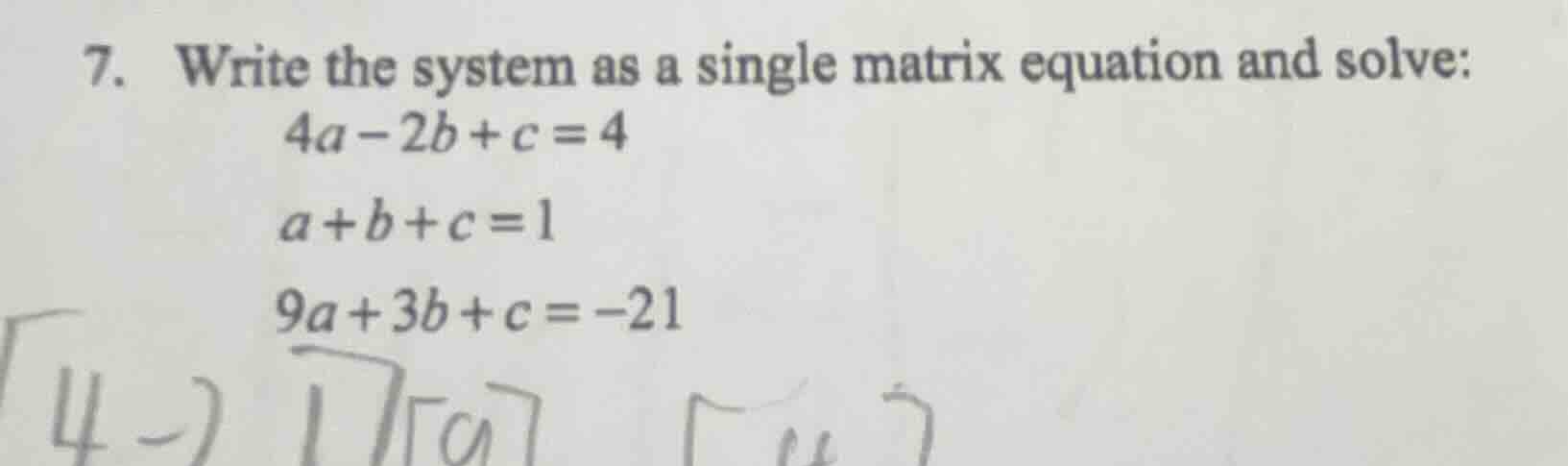
7. write the system as a single matrix equation and solve: 4a - 2b + c …

Question

  1. write the system as a single matrix equation and solve:

4a - 2b + c = 4

a + b + c = 1

9a + 3b + c = -21

Explanation:

Step1: Write the matrix equation

A system of linear equations \(

$$\begin{cases} 4a - 2b + c = 4 \\ a + b + c = 1 \\ 9a + 3b + c = -21 \end{cases}$$

\) can be written in the form \( AX = B \), where \( A \) is the coefficient matrix, \( X \) is the variable matrix, and \( B \) is the constant matrix.

So, \( A=

$$\begin{bmatrix}4&-2&1\\1&1&1\\9&3&1\end{bmatrix}$$

\), \( X=

$$\begin{bmatrix}a\\b\\c\end{bmatrix}$$

\), and \( B=

$$\begin{bmatrix}4\\1\\-21\end{bmatrix}$$

\). The matrix equation is \(

$$\begin{bmatrix}4&-2&1\\1&1&1\\9&3&1\end{bmatrix}$$
$$\begin{bmatrix}a\\b\\c\end{bmatrix}$$

=

$$\begin{bmatrix}4\\1\\-21\end{bmatrix}$$

\).

Step2: Find the inverse of matrix \( A \) (if it exists)

First, calculate the determinant of \( A \), \( \det(A) \).

\[

$$\begin{align*} \det(A)&=4\begin{vmatrix}1&1\\3&1\end{vmatrix}-(-2)\begin{vmatrix}1&1\\9&1\end{vmatrix}+1\begin{vmatrix}1&1\\9&3\end{vmatrix}\\ &=4(1\times1 - 1\times3)+2(1\times1 - 1\times9)+1(1\times3 - 1\times9)\\ &=4(1 - 3)+2(1 - 9)+1(3 - 9)\\ &=4(-2)+2(-8)+1(-6)\\ &=-8 - 16 - 6\\ &=-30 \end{align*}$$

\]

Since \( \det(A)=-30
eq0 \), the inverse of \( A \) exists. The inverse of a \( 3\times3 \) matrix \( A=

$$\begin{bmatrix}a_{11}&a_{12}&a_{13}\\a_{21}&a_{22}&a_{23}\\a_{31}&a_{32}&a_{33}\end{bmatrix}$$

\) is given by \( A^{-1}=\frac{1}{\det(A)}\text{adj}(A) \), where \( \text{adj}(A) \) is the adjugate matrix (transpose of the cofactor matrix).

Calculating the cofactor matrix:

  • \( C_{11}=(-1)^{1 + 1}
$$\begin{vmatrix}1&1\\3&1\end{vmatrix}$$

=1 - 3=-2 \)

  • \( C_{12}=(-1)^{1 + 2}
$$\begin{vmatrix}1&1\\9&1\end{vmatrix}$$

=-(1 - 9)=8 \)

  • \( C_{13}=(-1)^{1 + 3}
$$\begin{vmatrix}1&1\\9&3\end{vmatrix}$$

=3 - 9=-6 \)

  • \( C_{21}=(-1)^{2 + 1}
$$\begin{vmatrix}-2&1\\3&1\end{vmatrix}$$

=-(-2 - 3)=5 \)

  • \( C_{22}=(-1)^{2 + 2}
$$\begin{vmatrix}4&1\\9&1\end{vmatrix}$$

=4 - 9=-5 \)

  • \( C_{23}=(-1)^{2 + 3}
$$\begin{vmatrix}4&-2\\9&3\end{vmatrix}$$

=-(12 + 18)=-30 \)

  • \( C_{31}=(-1)^{3 + 1}
$$\begin{vmatrix}-2&1\\1&1\end{vmatrix}$$

=-2 - 1=-3 \)

  • \( C_{32}=(-1)^{3 + 2}
$$\begin{vmatrix}4&1\\1&1\end{vmatrix}$$

=-(4 - 1)=-3 \)

  • \( C_{33}=(-1)^{3 + 3}
$$\begin{vmatrix}4&-2\\1&1\end{vmatrix}$$

=4 + 2=6 \)

So the cofactor matrix is \(

$$\begin{bmatrix}-2&8&-6\\5&-5&-30\\-3&-3&6\end{bmatrix}$$

\). The adjugate matrix \( \text{adj}(A) \) is the transpose of the cofactor matrix:

\( \text{adj}(A)=

$$\begin{bmatrix}-2&5&-3\\8&-5&-3\\-6&-30&6\end{bmatrix}$$

\)

Then, \( A^{-1}=\frac{1}{-30}

$$\begin{bmatrix}-2&5&-3\\8&-5&-3\\-6&-30&6\end{bmatrix}$$

=

$$\begin{bmatrix}\frac{1}{15}&-\frac{1}{6}&\frac{1}{10}\\-\frac{4}{15}&\frac{1}{6}&\frac{1}{10}\\\frac{1}{5}&1&-\frac{1}{5}\end{bmatrix}$$

\)

Step3: Solve for \( X \)

Since \( AX = B \), then \( X = A^{-1}B \).

\[

$$\begin{align*} X&=\begin{bmatrix}\frac{1}{15}&-\frac{1}{6}&\frac{1}{10}\\-\frac{4}{15}&\frac{1}{6}&\frac{1}{10}\\\frac{1}{5}&1&-\frac{1}{5}\end{bmatrix}\begin{bmatrix}4\\1\\-21\end{bmatrix}\\ &=\begin{bmatrix}\frac{1}{15}\times4+(-\frac{1}{6})\times1+\frac{1}{10}\times(-21)\\-\frac{4}{15}\times4+\frac{1}{6}\times1+\frac{1}{10}\times(-21)\\\frac{1}{5}\times4+1\times1+(-\frac{1}{5})\times(-21)\end{bmatrix}\\ &=\begin{bmatrix}\frac{4}{15}-\frac{1}{6}-\frac{21}{10}\\-\frac{16}{15}+\frac{1}{6}-\frac{21}{10}\\\frac{4}{5}+1+\frac{21}{5}\end{bmatrix}\\ &=\begin{bmatrix}\frac{8 - 5 - 63}{30}\\-\frac{32 + 5 - 63}{30}\\\frac{4 + 5 + 21}{5}\end{bmatrix}\\ &=\begin{bmatrix}\frac{-60}{30}\\-\frac{-26}{30}\\\frac{30}{5}\end{bmatrix}\\ &=\begin{bmatrix}-2\\\frac{13}{15}\\6\end{bmatrix} \end{align*}$$

\]

Wait, there seems to be a calculation error in the second component. Let's recalculate the second component:

For the second row:

\( -\frac{4}{15}\times4 =…

Answer:

The matrix equation is \( \boldsymbol{

$$\begin{bmatrix}4&-2&1\\1&1&1\\9&3&1\end{bmatrix}$$
$$\begin{bmatrix}a\\b\\c\end{bmatrix}$$

=

$$\begin{bmatrix}4\\1\\-21\end{bmatrix}$$

} \), and the solution is \( \boldsymbol{a = -2, b = -3, c = 6} \) (or \( \boldsymbol{

$$\begin{bmatrix}a\\b\\c\end{bmatrix}$$

=

$$\begin{bmatrix}-2\\-3\\6\end{bmatrix}$$

} \))