QUESTION IMAGE
Question
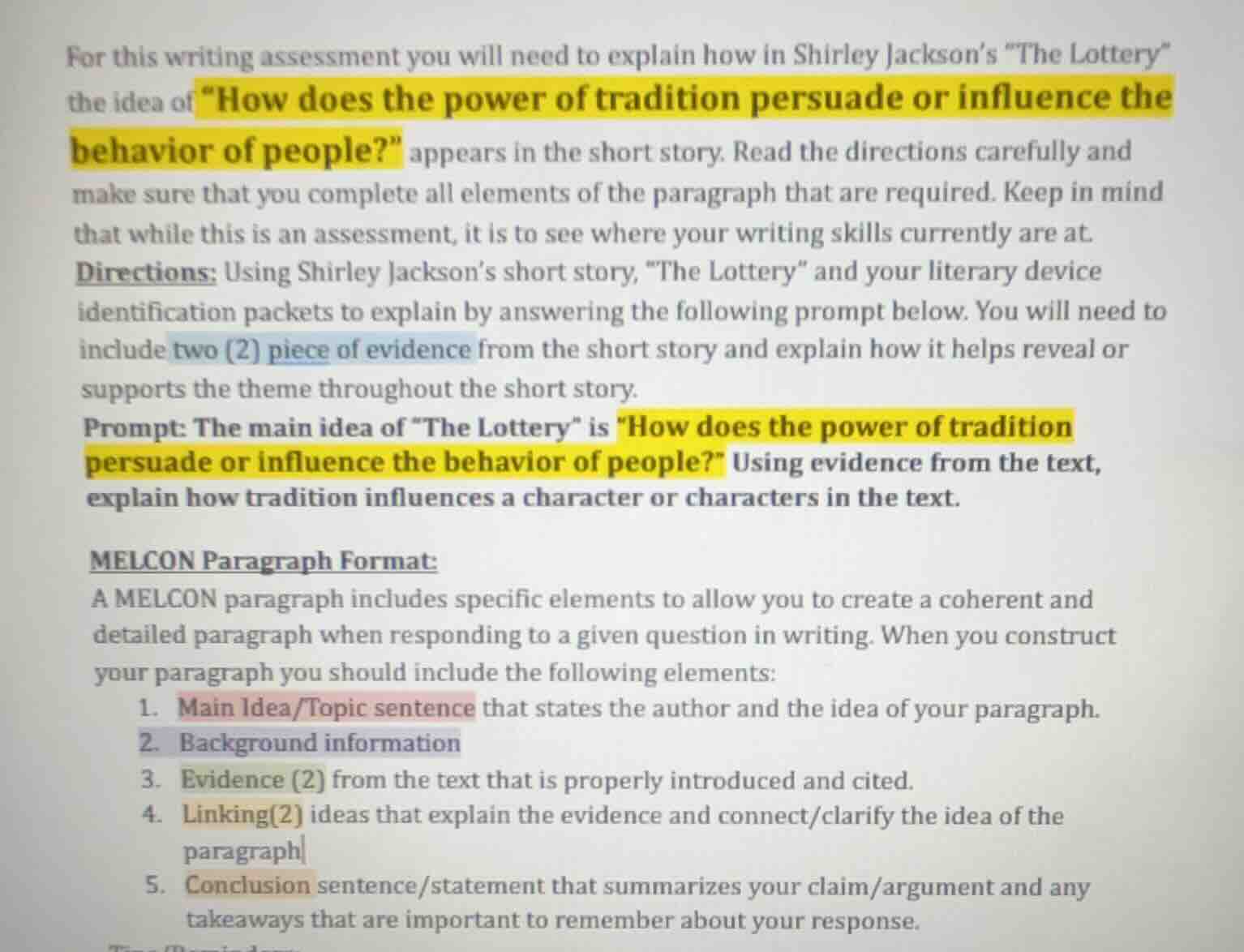
for this writing assessment you will need to explain how in shirley jackson’s \the lottery\ the idea of \how does the power of tradition persuade or influence the behavior of people?\ appears in the short story. read the directions carefully and make sure that you complete all elements of the paragraph that are required. keep in mind that while this is an assessment, it is to see where your writing skills currently are at. directions: using shirley jackson’s short story, \the lottery\ and your literary device identification packets to explain by answering the following prompt below. you will need to include two (2) piece of evidence from the short story and explain how it helps reveal or supports the theme throughout the short story. prompt: the main idea of \the lottery\ is \how does the power of tradition persuade or influence the behavior of people?\ using evidence from the text, explain how tradition influences a character or characters in the text. melcon paragraph format: a melcon paragraph includes specific elements to allow you to create a coherent and detailed paragraph when responding to a given question in writing. when you construct your paragraph you should include the following elements: 1. main idea/topic sentence that states the author and the idea of your paragraph. 2. background information 3. evidence (2) from the text that is properly introduced and cited. 4. linking(2) ideas that explain the evidence and connect/clarify the idea of the paragraph 5. conclusion sentence/statement that summarizes your claim/argument and any takeaways that are important to remember about your response.
- Main Idea/Topic Sentence: Introduce Shirley Jackson and the core claim that blind adherence to tradition in The Lottery compels the townspeople to act against their humanity.
- Background Information: Note that the small town holds an annual lottery rooted in unremembered old customs, with the winner stoned to death as a ritual sacrifice.
- Evidence 1: Cite the text: "Mr. Summers spoke frequently to the villagers about making a new box, but no one liked to upset even as much tradition as was represented by the black box" (Jackson).
- Linking 1: Explain that the townspeople cling to the worn black box, a symbol of their tradition, even though they cannot recall its original purpose or why they maintain the ritual—showing tradition's hold over their choices.
- Evidence 2: Cite the text: "It's not the way it used to be... People ain't the way they used to be." Old Man Warner said, "Pack of crazy fools... Listening to the young folks, nothing's good enough for them" (Jackson).
- Linking 2: Explain that Old Man Warner, a long-time participant, mocks any suggestion of ending the lottery, framing dissent as foolish. His influence reinforces the group's compliance, as the townspeople follow his lead to uphold the tradition rather than question its morality.
- Conclusion Sentence: Restate that the lottery's hold on the town shows how tradition can override empathy, forcing people to participate in cruel acts simply because "it's always been done that way."

Snap & solve any problem in the app
Get step-by-step solutions on Sovi AI
Photo-based solutions with guided steps
Explore more problems and detailed explanations
In Shirley Jackson’s The Lottery, blind adherence to long-held tradition compels the small town’s residents to participate in a violent, dehumanizing ritual without question. Set in a tight-knit rural community, the story centers on an annual lottery where the "winner" is stoned to death, a practice rooted in forgotten old customs that the townspeople refuse to abandon. For example, the text notes, "Mr. Summers spoke frequently to the villagers about making a new box, but no one liked to upset even as much tradition as was represented by the black box." The townspeople cling to the tattered, splintered black box not out of any practical need, but because it symbolizes their unbroken commitment to the lottery tradition—even though they cannot recall the box’s original design or the ritual’s true origins. Later, when a young villager mentions other towns are ending their lotteries, Old Man Warner scoffs, "Pack of crazy fools... Listening to the young folks, nothing's good enough for them." As the oldest resident, Warner frames dissent as disrespect for the past, and his influence keeps the other townspeople compliant; they choose to uphold the violent tradition rather than challenge the status quo or confront its cruelty. Ultimately, The Lottery reveals how tradition can erode human empathy, convincing people to perpetrate harm simply because a practice has been passed down through generations.