QUESTION IMAGE
Question
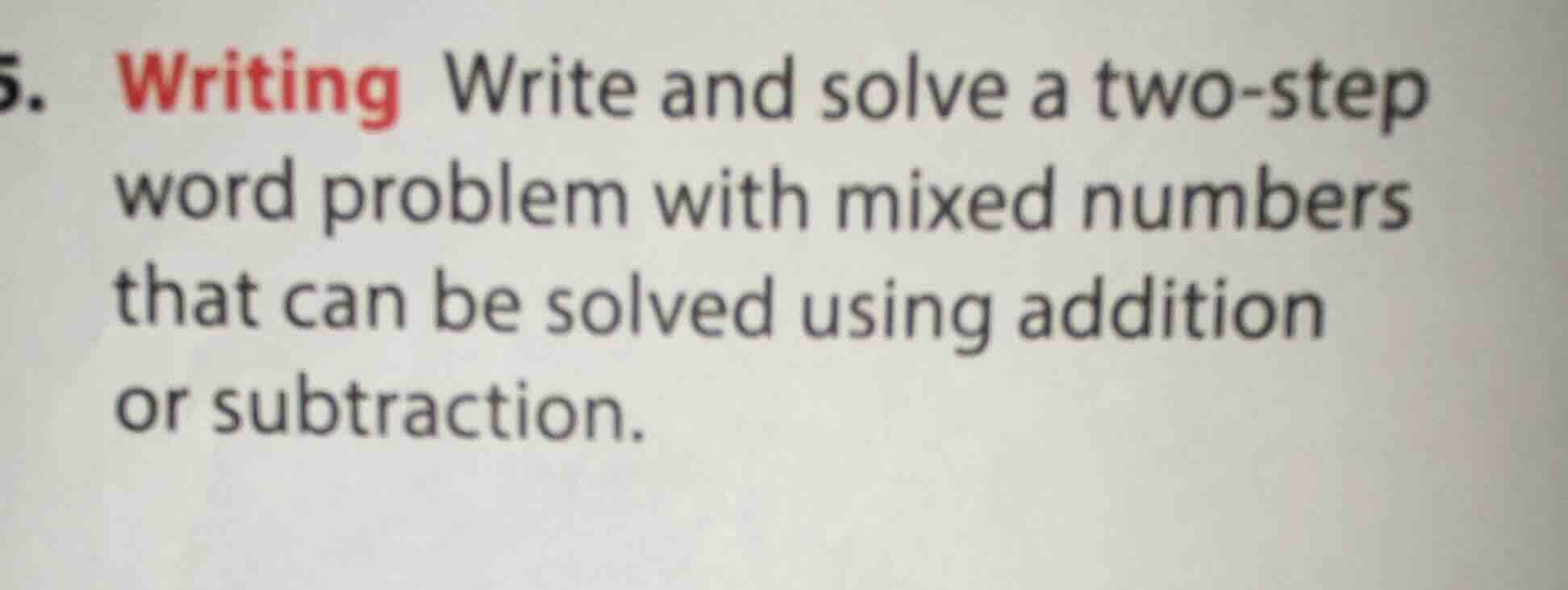
- writing write and solve a two-step word problem with mixed numbers that can be solved using addition or subtraction.
Step 1: Create the word problem
Let's make a problem about baking. Suppose you have a recipe that requires \( 2\frac{1}{2} \) cups of flour for the first part and \( 1\frac{3}{4} \) cups of flour for the second part. But you spilled \( \frac{1}{2} \) cup of flour while measuring. How much flour do you actually use in total?
Step 2: Translate the problem into math operations
First, find the total flour needed before spilling: \( 2\frac{1}{2}+ 1\frac{3}{4} \). Then subtract the spilled flour: \( (2\frac{1}{2}+ 1\frac{3}{4})-\frac{1}{2} \).
Step 3: Convert mixed numbers to improper fractions (or use fraction addition/subtraction rules)
Convert \( 2\frac{1}{2} \) to \( \frac{5}{2} \), \( 1\frac{3}{4} \) to \( \frac{7}{4} \), and \( \frac{1}{2} \) is \( \frac{1}{2} \).
First, add \( \frac{5}{2}+\frac{7}{4} \). Find a common denominator, which is 4. So \( \frac{5}{2}=\frac{10}{4} \). Then \( \frac{10}{4}+\frac{7}{4}=\frac{17}{4} \).
Then subtract \( \frac{17}{4}-\frac{1}{2} \). Convert \( \frac{1}{2} \) to \( \frac{2}{4} \). So \( \frac{17}{4}-\frac{2}{4}=\frac{15}{4} \).
Step 4: Convert back to mixed number (if needed)
\( \frac{15}{4}=3\frac{3}{4} \).
Another way (using commutative property for easier calculation)
Notice that \( 2\frac{1}{2}-\frac{1}{2}=2 \), then add \( 1\frac{3}{4} \). So \( 2 + 1\frac{3}{4}=3\frac{3}{4} \).
Final Answer
The total flour used is \( 3\frac{3}{4} \) cups.
(Note: The problem creation and solution can vary. Another example: John has \( 3\frac{1}{3} \) dollars. He earns \( 2\frac{1}{2} \) dollars more, but then spends \( 1\frac{1}{4} \) dollars. How much money does he have now? Solution: \( (3\frac{1}{3}+2\frac{1}{2}) - 1\frac{1}{4} \). Convert to improper fractions: \( \frac{10}{3}+\frac{5}{2}-\frac{5}{4} \). Common denominator 12: \( \frac{40}{12}+\frac{30}{12}-\frac{15}{12}=\frac{55}{12}=4\frac{7}{12} \).)

Snap & solve any problem in the app
Get step-by-step solutions on Sovi AI
Photo-based solutions with guided steps
Explore more problems and detailed explanations
Step 1: Create the word problem
Let's make a problem about baking. Suppose you have a recipe that requires \( 2\frac{1}{2} \) cups of flour for the first part and \( 1\frac{3}{4} \) cups of flour for the second part. But you spilled \( \frac{1}{2} \) cup of flour while measuring. How much flour do you actually use in total?
Step 2: Translate the problem into math operations
First, find the total flour needed before spilling: \( 2\frac{1}{2}+ 1\frac{3}{4} \). Then subtract the spilled flour: \( (2\frac{1}{2}+ 1\frac{3}{4})-\frac{1}{2} \).
Step 3: Convert mixed numbers to improper fractions (or use fraction addition/subtraction rules)
Convert \( 2\frac{1}{2} \) to \( \frac{5}{2} \), \( 1\frac{3}{4} \) to \( \frac{7}{4} \), and \( \frac{1}{2} \) is \( \frac{1}{2} \).
First, add \( \frac{5}{2}+\frac{7}{4} \). Find a common denominator, which is 4. So \( \frac{5}{2}=\frac{10}{4} \). Then \( \frac{10}{4}+\frac{7}{4}=\frac{17}{4} \).
Then subtract \( \frac{17}{4}-\frac{1}{2} \). Convert \( \frac{1}{2} \) to \( \frac{2}{4} \). So \( \frac{17}{4}-\frac{2}{4}=\frac{15}{4} \).
Step 4: Convert back to mixed number (if needed)
\( \frac{15}{4}=3\frac{3}{4} \).
Another way (using commutative property for easier calculation)
Notice that \( 2\frac{1}{2}-\frac{1}{2}=2 \), then add \( 1\frac{3}{4} \). So \( 2 + 1\frac{3}{4}=3\frac{3}{4} \).
Final Answer
The total flour used is \( 3\frac{3}{4} \) cups.
(Note: The problem creation and solution can vary. Another example: John has \( 3\frac{1}{3} \) dollars. He earns \( 2\frac{1}{2} \) dollars more, but then spends \( 1\frac{1}{4} \) dollars. How much money does he have now? Solution: \( (3\frac{1}{3}+2\frac{1}{2}) - 1\frac{1}{4} \). Convert to improper fractions: \( \frac{10}{3}+\frac{5}{2}-\frac{5}{4} \). Common denominator 12: \( \frac{40}{12}+\frac{30}{12}-\frac{15}{12}=\frac{55}{12}=4\frac{7}{12} \).)