QUESTION IMAGE
Question
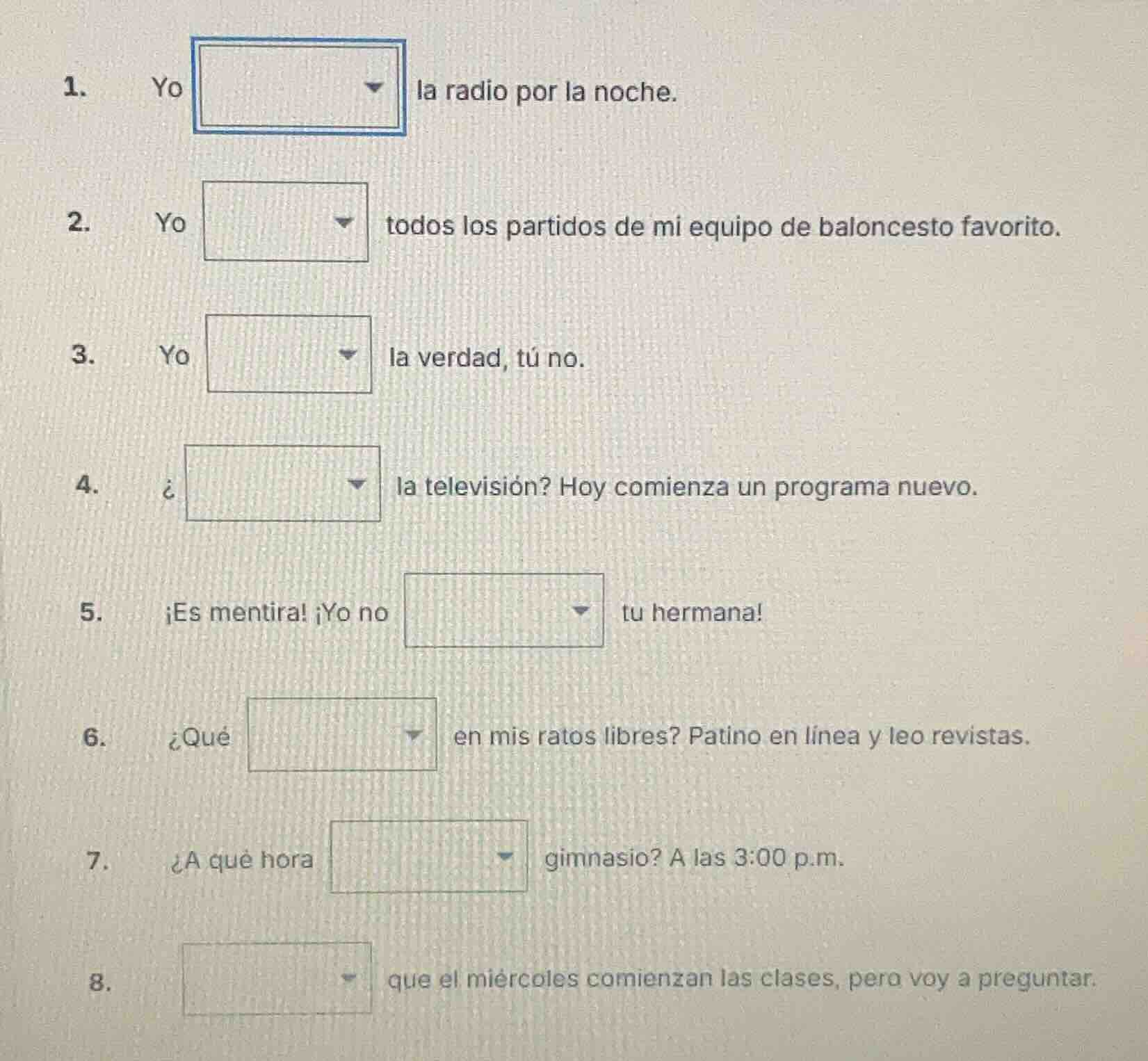
- yo la radio por la noche.
- yo todos los partidos de mi equipo de baloncesto favorito.
- yo la verdad, tú no.
- ¿ la televisión? hoy comienza un programa nuevo.
- ¡es mentira! ¡yo no tu hermana!
- ¿qué en mis ratos libres? patino en línea y leo revistas.
- ¿a qué hora gimnasio? a las 3:00 p.m.
- que el miércoles comienzan las clases, pero voy a preguntar.
To solve these Spanish verb - filling problems, we need to consider the context of each sentence and the appropriate Spanish verbs (usually from the present tense of regular or common irregular verbs related to actions like listening, watching, telling, etc.). However, since the dropdown options for the verbs are not provided, we can only analyze the context and the likely verbs:
Sentence 1: "Yo ____ la radio por la noche."
The action related to the radio is usually "escuchar" (to listen to). In the first - person singular (yo) of the present tense, the verb "escuchar" conjugates to "escucho". So the sentence would be "Yo escucho la radio por la noche."
Sentence 2: "Yo ____ todos los partidos de mi equipo de baloncesto favorito."
The action of watching a sports game is "ver" (to watch). In the first - person singular (yo) of the present tense, "ver" conjugates to "veo". So the sentence would be "Yo veo todos los partidos de mi equipo de baloncesto favorito."
Sentence 3: "Yo ____ la verdad, tú no."
The action of telling the truth is "decir" (to tell). In the first - person singular (yo) of the present tense, "decir" conjugates to "digo". So the sentence would be "Yo digo la verdad, tú no."
Sentence 4: "¿____ la televisión? Hoy comienza un programa nuevo."
The action of watching TV is "ver". For the second - person singular (tú) in the present tense (since it's a question addressed to "you"), "ver" conjugates to "ves". So the sentence would be "¿Ves la televisión? Hoy comienza un programa nuevo."
Sentence 5: "¡Es mentira! ¡Yo no ____ tu hermana!"
The action of believing is "creer". In the first - person singular (yo) of the present tense (negative form), "creer" conjugates to "creo" (and with "no" it becomes "no creo"). So the sentence would be "¡Es mentira! ¡Yo no creo tu hermana!" (Note: The more accurate phrase would be "creo en tu hermana" if it's "believe in your sister", but if it's "believe your sister" (her words), it can also be "creo a tu hermana", but the most common context - appropriate verb here is "creer".)
Sentence 6: "¿Qué ____ en mis ratos libres? Patino en línea y leo revistas."
The action of doing in free time is "hacer". For the second - person singular (tú) in the present tense (since it's a question addressed to "you"), "hacer" conjugates to "haces". So the sentence would be "¿Qué haces en mis ratos libres? Patino en línea y leo revistas."
Sentence 7: "¿A qué hora ____ gimnasio? A las 3:00 p.m."
The action of going to the gym is "ir al" (to go to). In the first - person singular (yo) of the present tense, "ir" conjugates to "voy". So the sentence would be "¿A qué hora voy al gimnasio? A las 3:00 p.m."
Sentence 8: "____ que el miércoles comienzan las clases, pero voy a preguntar."
The action of thinking is "creer" or "pensar". "Creer" in the first - person singular (yo) of the present tense is "creo", and "pensar" is "pienso". A common phrase here is "Creo que..." (I think that...). So the sentence would be "Creo que el miércoles comienzan las clases, pero voy a preguntar."
If we assume that the dropdown options contain these conjugated verbs, the answers would be:
- escucho
- veo
- digo
- Ves
- creo
- haces
- voy al (or if the verb is just "ir" and the preposition is included in the context, "voy")
- Creo
Since the original problem has dropdowns (the options are not shown), but based on common Spanish verb usage in these contexts, the above are the likely answers.

Snap & solve any problem in the app
Get step-by-step solutions on Sovi AI
Photo-based solutions with guided steps
Explore more problems and detailed explanations
To solve these Spanish verb - filling problems, we need to consider the context of each sentence and the appropriate Spanish verbs (usually from the present tense of regular or common irregular verbs related to actions like listening, watching, telling, etc.). However, since the dropdown options for the verbs are not provided, we can only analyze the context and the likely verbs:
Sentence 1: "Yo ____ la radio por la noche."
The action related to the radio is usually "escuchar" (to listen to). In the first - person singular (yo) of the present tense, the verb "escuchar" conjugates to "escucho". So the sentence would be "Yo escucho la radio por la noche."
Sentence 2: "Yo ____ todos los partidos de mi equipo de baloncesto favorito."
The action of watching a sports game is "ver" (to watch). In the first - person singular (yo) of the present tense, "ver" conjugates to "veo". So the sentence would be "Yo veo todos los partidos de mi equipo de baloncesto favorito."
Sentence 3: "Yo ____ la verdad, tú no."
The action of telling the truth is "decir" (to tell). In the first - person singular (yo) of the present tense, "decir" conjugates to "digo". So the sentence would be "Yo digo la verdad, tú no."
Sentence 4: "¿____ la televisión? Hoy comienza un programa nuevo."
The action of watching TV is "ver". For the second - person singular (tú) in the present tense (since it's a question addressed to "you"), "ver" conjugates to "ves". So the sentence would be "¿Ves la televisión? Hoy comienza un programa nuevo."
Sentence 5: "¡Es mentira! ¡Yo no ____ tu hermana!"
The action of believing is "creer". In the first - person singular (yo) of the present tense (negative form), "creer" conjugates to "creo" (and with "no" it becomes "no creo"). So the sentence would be "¡Es mentira! ¡Yo no creo tu hermana!" (Note: The more accurate phrase would be "creo en tu hermana" if it's "believe in your sister", but if it's "believe your sister" (her words), it can also be "creo a tu hermana", but the most common context - appropriate verb here is "creer".)
Sentence 6: "¿Qué ____ en mis ratos libres? Patino en línea y leo revistas."
The action of doing in free time is "hacer". For the second - person singular (tú) in the present tense (since it's a question addressed to "you"), "hacer" conjugates to "haces". So the sentence would be "¿Qué haces en mis ratos libres? Patino en línea y leo revistas."
Sentence 7: "¿A qué hora ____ gimnasio? A las 3:00 p.m."
The action of going to the gym is "ir al" (to go to). In the first - person singular (yo) of the present tense, "ir" conjugates to "voy". So the sentence would be "¿A qué hora voy al gimnasio? A las 3:00 p.m."
Sentence 8: "____ que el miércoles comienzan las clases, pero voy a preguntar."
The action of thinking is "creer" or "pensar". "Creer" in the first - person singular (yo) of the present tense is "creo", and "pensar" is "pienso". A common phrase here is "Creo que..." (I think that...). So the sentence would be "Creo que el miércoles comienzan las clases, pero voy a preguntar."
If we assume that the dropdown options contain these conjugated verbs, the answers would be:
- escucho
- veo
- digo
- Ves
- creo
- haces
- voy al (or if the verb is just "ir" and the preposition is included in the context, "voy")
- Creo
Since the original problem has dropdowns (the options are not shown), but based on common Spanish verb usage in these contexts, the above are the likely answers.