QUESTION IMAGE
Question
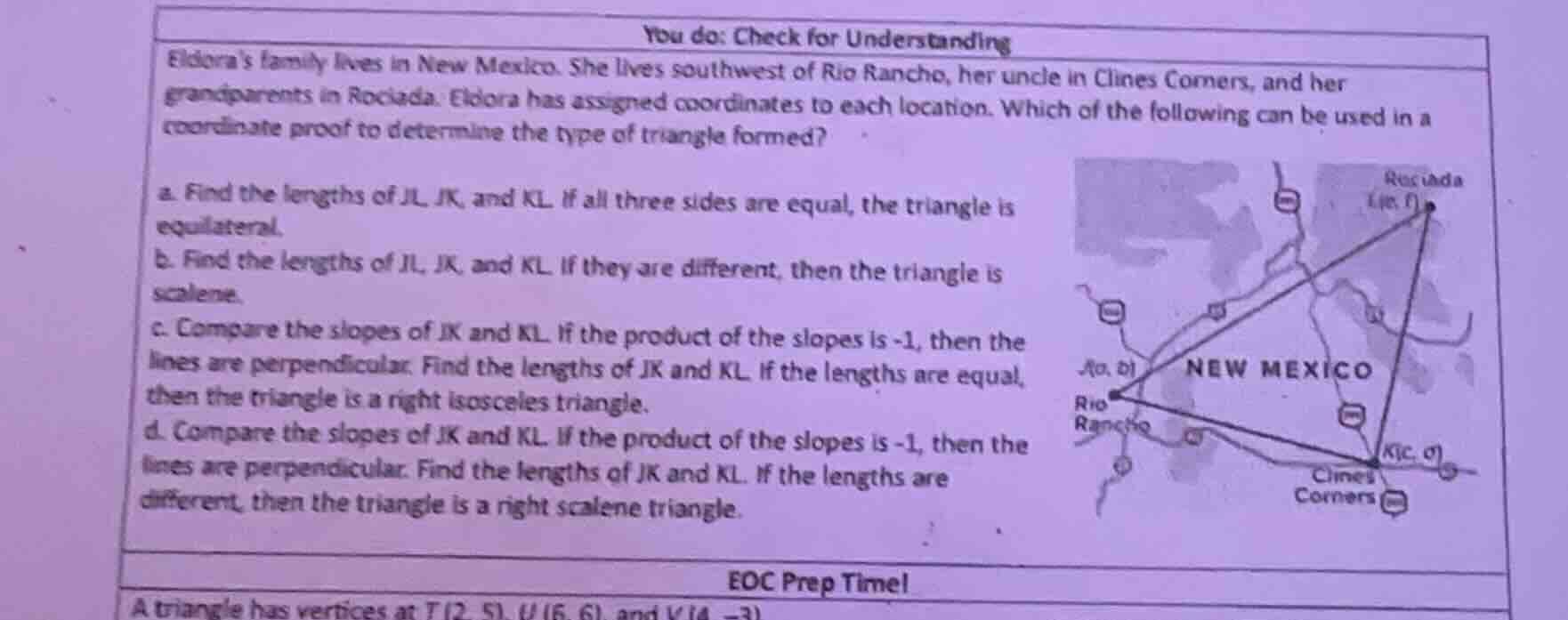
you do: check for understanding eldoras family lives in new mexico. she lives southwest of rio rancho, her uncle in clines corners, and her grandparents in rociada. eldora has assigned coordinates to each location. which of the following can be used in a coordinate proof to determine the type of triangle formed? a. find the lengths of jl, jk, and kl. if all three sides are equal, the triangle is equilateral. b. find the lengths of jl, jk, and kl. if they are different, then the triangle is scalene. c. compare the slopes of jk and kl. if the product of the slopes is -1, then the lines are perpendicular. find the lengths of jk and kl. if the lengths are equal, then the triangle is a right isosceles triangle. d. compare the slopes of jk and kl. if the product of the slopes is -1, then the lines are perpendicular. find the lengths of jk and kl. if the lengths are different, then the triangle is a right scalene triangle. eoc prep time! a triangle has vertices at t(2, 5), u(6, 6), and v(4, -3)
To determine the type of triangle, we analyze each option:
- Option a: An equilateral triangle requires all three sides equal, but we can't assume all three sides will be equal here.
- Option b: A scalene triangle has all sides different, but we need to check for right angles too (from coordinates, slopes can show perpendicularity).
- Option c: First, check if JK and KL are perpendicular (slope product -1). Then, if their lengths are equal, it's a right isosceles triangle. This is valid as we can use coordinates to find slopes (for perpendicularity) and side lengths (for equality).
- Option d: If slopes give perpendicularity and lengths are different, it's right scalene, but we need to see which is most appropriate. However, option c's approach of checking for perpendicularity (right angle) and equal sides (isosceles) is a valid coordinate proof step. Also, options a and b don't consider right angles, which is important here. Option c correctly combines slope (for right angle) and length (for isosceles) checks.

Snap & solve any problem in the app
Get step-by-step solutions on Sovi AI
Photo-based solutions with guided steps
Explore more problems and detailed explanations
c. Compare the slopes of JK and KL. If the product of the slopes is -1, then the lines are perpendicular. Find the lengths of JK and KL. If the lengths are equal, then the triangle is a right isosceles triangle.