QUESTION IMAGE
Question
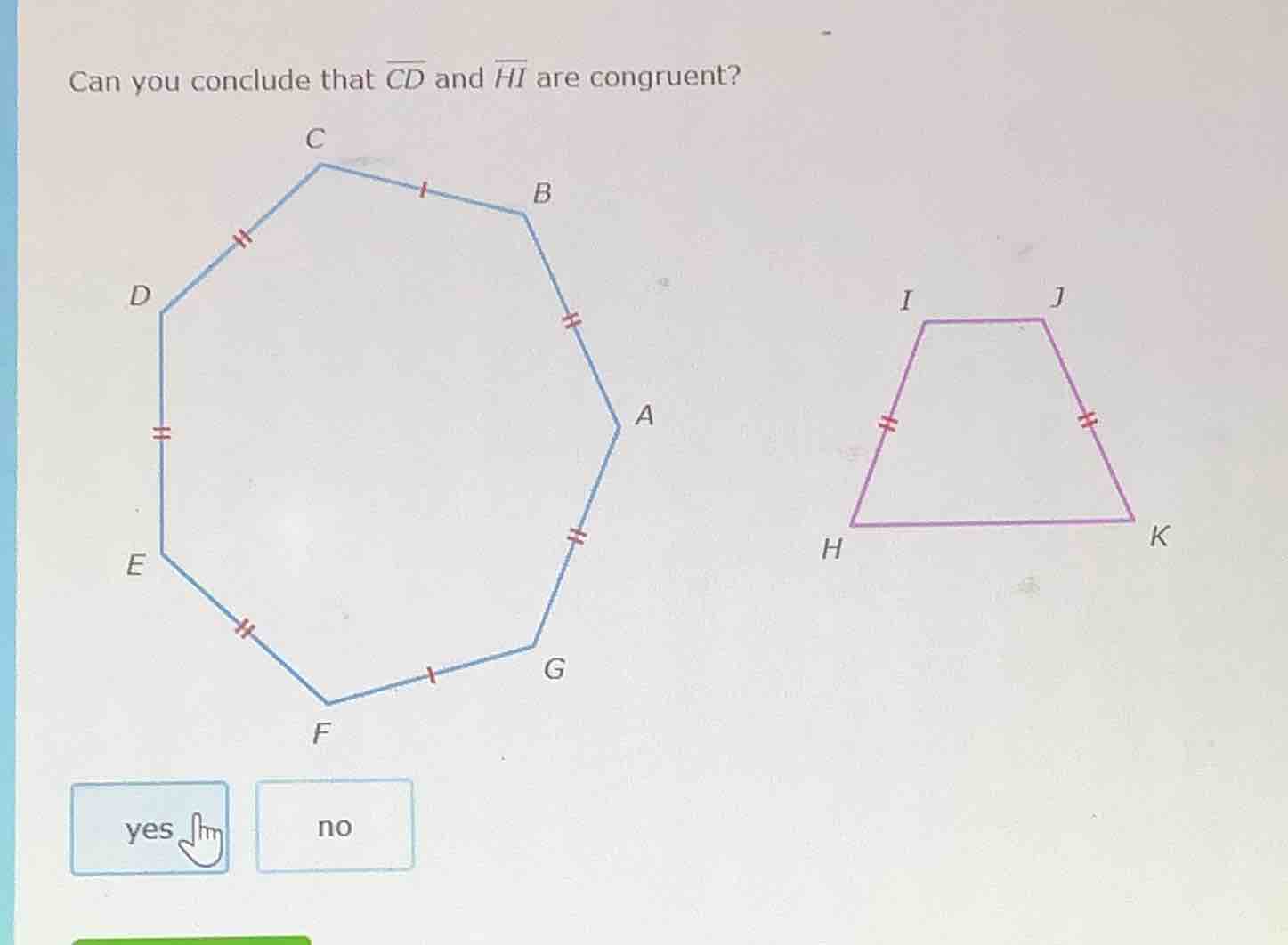
can you conclude that \\(\overline{cd}\\) and \\(\overline{hi}\\) are congruent?
(there are two figures, one is a blue polygon with vertices c, b, a, g, f, e, d, and the other is a purple quadrilateral with vertices i, j, k, h. there are also two buttons labeled yes and no at the bottom.)
Step1: Analyze congruent segment markings
In the blue polygon, segments with the same number of tick marks are congruent. $\overline{CD}$ has two tick marks? Wait, no, looking at the diagram: $\overline{CD}$ has two tick marks? Wait, no, $\overline{CD}$ has two tick marks? Wait, actually, $\overline{CD}$ has two tick marks? Wait, no, let's re - examine. The blue polygon: $\overline{CD}$ has two tick marks? Wait, no, $\overline{CD}$ has two tick marks? Wait, no, the blue polygon's sides: $\overline{CD}$ has two tick marks? Wait, no, $\overline{HI}$ is in the purple trapezoid, with two tick marks. But the blue polygon and the purple trapezoid are different figures. We only know that in their respective figures, sides with the same tick marks are congruent within their own figures. But there's no information that the tick - mark conventions (i.e., what length a single - tick or double - tick represents) are the same between the two different figures. So we can't conclude that $\overline{CD}$ (from the blue polygon) and $\overline{HI}$ (from the purple trapezoid) are congruent, because we don't know if the "congruence" (based on tick marks) in one figure translates to the same length as in the other figure.
Step2: Conclusion
Since the two segments are in different figures and we have no information about the relationship between the length scales of the two figures, we cannot conclude that $\overline{CD}$ and $\overline{HI}$ are congruent.

Snap & solve any problem in the app
Get step-by-step solutions on Sovi AI
Photo-based solutions with guided steps
Explore more problems and detailed explanations
No