QUESTION IMAGE
Question
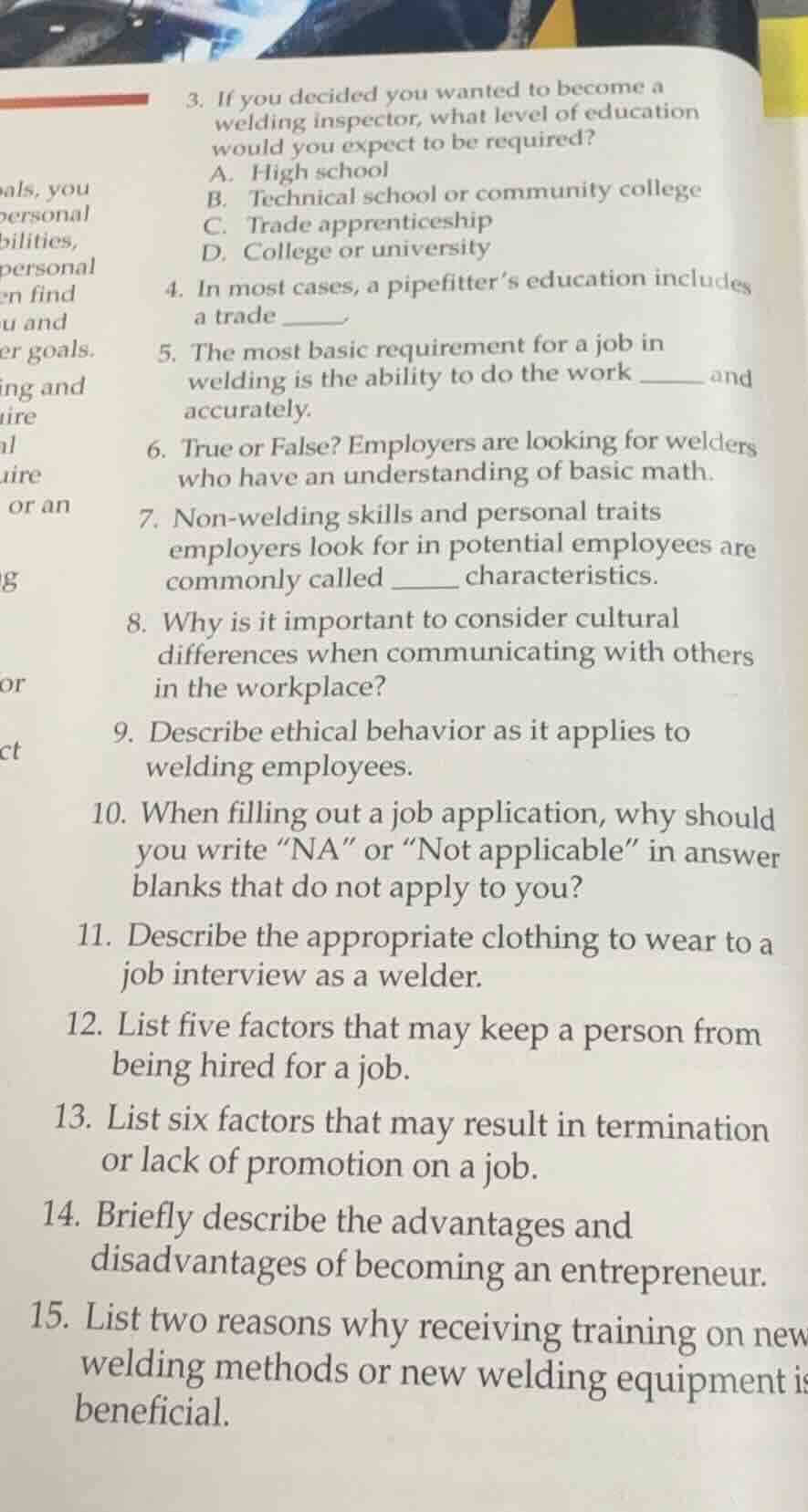
- if you decided you wanted to become a welding inspector, what level of education would you expect to be required?
a. high school
b. technical school or community college
c. trade apprenticeship
d. college or university
- in most cases, a pipefitters education includes a trade ______.
- the most basic requirement for a job in welding is the ability to do the work ______ and accurately.
- true or false? employers are looking for welders who have an understanding of basic math.
- non-welding skills and personal traits employers look for in potential employees are commonly called ______ characteristics.
- why is it important to consider cultural differences when communicating with others in the workplace?
- describe ethical behavior as it applies to welding employees.
- when filling out a job application, why should you write
a\ or
ot applicable\ in answer blanks that do not apply to you?
- describe the appropriate clothing to wear to a job interview as a welder.
- list five factors that may keep a person from being hired for a job.
- list six factors that may result in termination or lack of promotion on a job.
- briefly describe the advantages and disadvantages of becoming an entrepreneur.
- list two reasons why receiving training on new welding methods or new welding equipment is beneficial.
Brief Explanations
- Welding inspectors typically need formal technical training beyond high school, often from a technical school or community college to learn inspection standards and techniques.
- Pipefitters learn their trade through hands-on, structured training programs focused on the craft.
- Welding work requires both speed and accuracy to meet project timelines and quality standards.
- Welders use math for measurements, blueprints, and calculating materials, so employers value this skill.
- These non-technical, personal traits are referred to as soft skills or characteristics in the workplace.
- Cultural differences affect communication styles; ignoring them can lead to misinterpretation, conflict, and reduced workplace collaboration.
- Ethical behavior for welders includes following safety rules, being honest about work quality, not cutting corners on standards, and respecting workplace property and policies.
- Writing "NA" shows attention to detail, prevents the employer from assuming you missed the question, and keeps the application neat and complete.
- A welder should wear professional, clean business casual attire (e.g., collared shirt, slacks, closed-toe shoes) to balance professionalism with awareness of the trade context.
- Common barriers to hiring include lack of relevant experience, poor work history, insufficient training, negative references, unprofessional interview behavior, and not meeting basic skill requirements.
- Factors leading to termination or no promotion include consistent poor work quality, violating safety rules, excessive absenteeism, lack of teamwork, ignoring company policies, and failure to update job skills.
- Advantages of entrepreneurship: control over work, potential for higher earnings, ability to set your own schedule. Disadvantages: financial risk, no guaranteed income, increased responsibility for all business operations.
- Training on new welding methods/equipment keeps work quality high by meeting modern standards, and makes the employee more valuable and employable in the evolving trade.

Snap & solve any problem in the app
Get step-by-step solutions on Sovi AI
Photo-based solutions with guided steps
Explore more problems and detailed explanations
- B. Technical school or community college
- apprenticeship
- safely (or quickly; safely is the standard answer)
- True
- soft
- To avoid miscommunication, reduce conflict, and foster effective collaboration with colleagues from diverse backgrounds.
- Ethical behavior for welding employees includes adhering to safety protocols, being transparent about work quality, following industry and company standards, respecting workplace property, and being honest with supervisors and clients about project progress or issues.
- It demonstrates attention to detail, prevents employers from assuming the question was overlooked, and ensures the application appears complete and professional.
- Appropriate interview clothing for a welder is clean, professional business casual: a collared button-down shirt, khaki or dress slacks, closed-toe leather shoes, and avoiding overly casual or dirty workwear.
- 1. Lack of relevant training/certifications
- Poor work history (e.g., frequent job changes)
- Negative professional references
- Unprofessional behavior during the interview
- Inability to demonstrate required welding skills
- 1. Consistent failure to meet work quality standards
- Repeated violations of workplace safety rules
- Excessive unexcused absenteeism or tardiness
- Refusal to follow company policies or supervisor instructions
- Lack of teamwork or persistent conflict with colleagues
- Failure to learn new skills or adapt to job changes
- Advantages: Full control over business operations and schedule, potential for higher income based on business success, ability to specialize in preferred welding projects.
Disadvantages: Significant financial risk (no steady paycheck), responsibility for all business costs and legal obligations, increased stress from managing all aspects of the business.
- 1. It improves work quality and efficiency by allowing use of modern, more effective techniques/equipment.
- It increases employability and job security by keeping skills up-to-date with industry demands.