QUESTION IMAGE
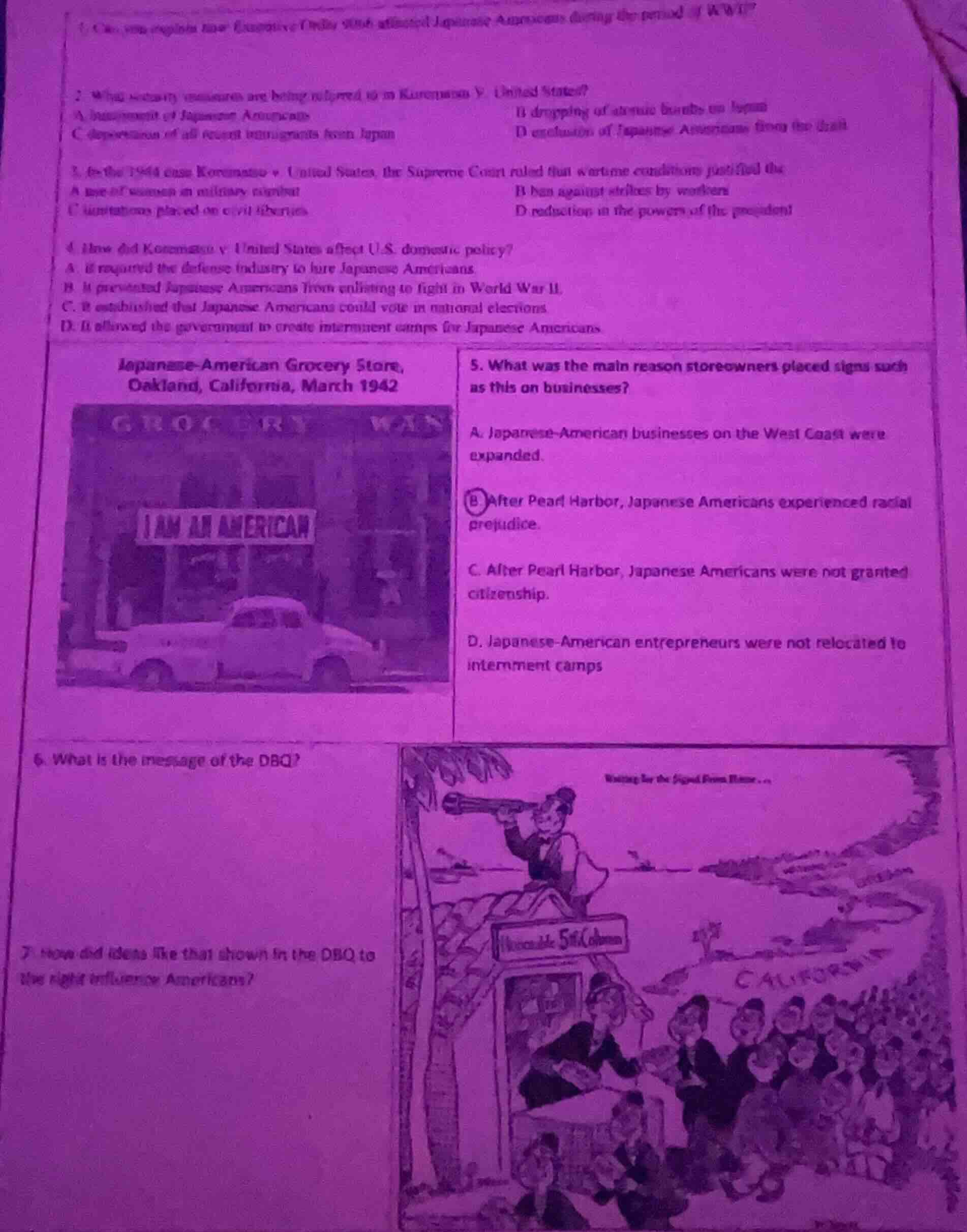
Question
- can you explain the executive order that affected japanese americans during the period of wwii?
- what security measures are being referred to in korematsu v. united states?
a. internment of japanese americans
b. dropping of atomic bombs on japan
c. deportation of all recent immigrants from japan
d. exclusion of japanese americans from the draft
- in the 1944 case korematsu v. united states, the supreme court ruled that wartime conditions justified the
a. use of women in military combat
b. ban against strikes by workers
c. limitations placed on civil liberties
d. reduction in the powers of the president
- how did korematsu v. united states affect u.s. domestic policy?
a. it required the defense industry to hire japanese americans
b. it prevented japanese americans from enlisting to fight in world war ii.
c. it established that japanese americans could vote in national elections
d. it allowed the government to create internment camps for japanese americans
- what was the main reason storeowners placed signs such as this on businesses?
(image: japanese - american grocery store, oakland, california, march 1942, with a sign \i am an american\)
a. japanese - american businesses on the west coast were expanded.
b. after pearl harbor, japanese americans experienced racial prejudice.
c. after pearl harbor, japanese americans were not granted citizenship.
d. japanese - american entrepreneurs were not relocated to internment camps
- what is the message of the dbq?
(image: cartoon with text \waiting for the signal from home...\ and a sign \hawaiian 5th column\)
- how did ideas like that shown in the dbq to the right influence americans?
Question 2
The case Korematsu v. United States was about the internment of Japanese Americans during WWII. Option A is about internment (confinement), which matches the context. Option B is about atomic bombs (not related to the case's focus on Japanese Americans' treatment). Option C is about deporting recent immigrants (the case was about citizens/long - term residents). Option D is about exclusion from the draft (the issue was internment, not draft exclusion).
In Korematsu v. United States, the Supreme Court ruled on the internment of Japanese Americans, which was a limitation on civil liberties during wartime. Option A is about women in combat (not related to this case). Option B is about a ban on strikes (not related). Option D is about reducing presidential power (the case upheld government action, not reduced presidential power).
Korematsu v. United States allowed the government to create internment camps for Japanese Americans. Option A: The case didn't require hiring Japanese Americans. Option B: It didn't prevent enlistment (many Japanese Americans served). Option C: The case was not about voting rights.

Snap & solve any problem in the app
Get step-by-step solutions on Sovi AI
Photo-based solutions with guided steps
Explore more problems and detailed explanations
A. Internment of Japanese Americans