QUESTION IMAGE
Question
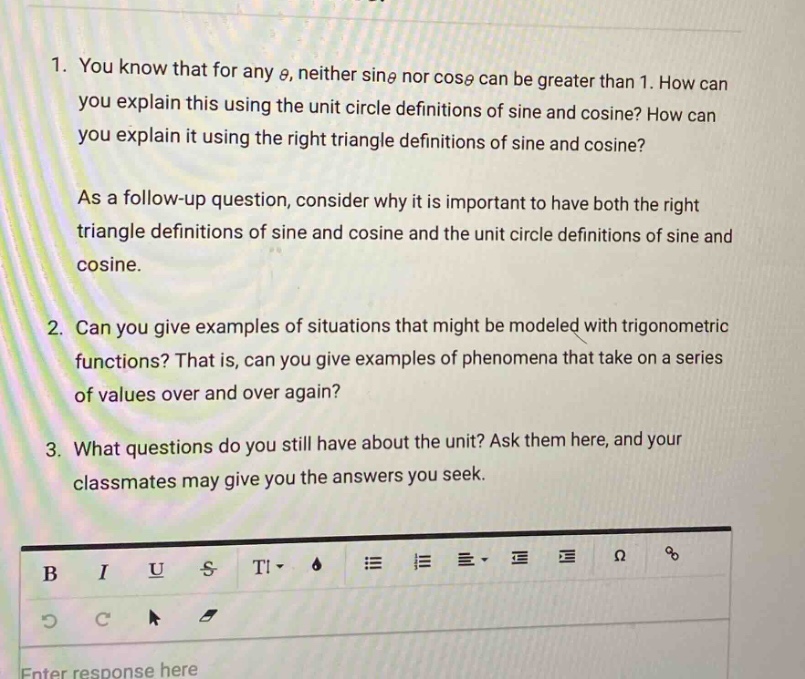
- you know that for any \\(\theta\\), neither \\(\sin\theta\\) nor \\(\cos\theta\\) can be greater than 1. how can you explain this using the unit circle definitions of sine and cosine? how can you explain it using the right triangle definitions of sine and cosine?
as a follow - up question, consider why it is important to have both the right triangle definitions of sine and cosine and the unit circle definitions of sine and cosine.
- can you give examples of situations that might be modeled with trigonometric functions? that is, can you give examples of phenomena that take on a series of values over and over again?
- what questions do you still have about the unit? ask them here, and your classmates may give you the answers you seek.
Question 2
Trigonometric functions are periodic, so phenomena with repeating patterns over time or space can be modeled. Examples include:
- Tidal Cycles: Ocean tides rise and fall due to gravitational forces, repeating approximately every 12 hours (periodic, modeled by sine/cosine for height over time).
- Sound Waves: Musical notes or ambient noise have oscillating pressure waves, with sine/cosine describing amplitude over time (e.g., a tuning fork’s vibration).
- Seasonal Temperature Changes: Annual temperature cycles follow a periodic pattern, with sine/cosine modeling temperature vs. month (peaks in summer, troughs in winter).
- Ferris Wheel Motion: A rider’s height above the ground changes periodically as the wheel rotates, modeled by \( h(t) = r\sin(\omega t) + k \) (where \( r \) = radius, \( \omega \) = angular speed, \( k \) = center height).
- Alternating Current (AC): Electrical current in power grids oscillates sinusoidally, with \( I(t) = I_0\sin(\omega t) \) describing current over time.

Snap & solve any problem in the app
Get step-by-step solutions on Sovi AI
Photo-based solutions with guided steps
Explore more problems and detailed explanations
Examples of phenomena modeled by trigonometric functions (periodic repetition) include:
- Tidal cycles (ocean height over time).
- Sound waves (e.g., a tuning fork’s vibration).
- Seasonal temperature changes (annual cycles).
- Ferris wheel rider height (rotational motion).
- Alternating current (electrical power grids).
Question 1 (Explanation for \( \sin\theta, \cos\theta \leq 1 \))
Unit Circle Definition:
On the unit circle (\( r = 1 \)), any point \( (x, y) \) on the circle satisfies \( x^2 + y^2 = 1 \). By definition, \( \cos\theta = x \) and \( \sin\theta = y \). Since \( x^2 \geq 0 \) and \( y^2 \geq 0 \), we have \( x^2 \leq 1 \) (so \( |x| \leq 1 \)) and \( y^2 \leq 1 \) (so \( |y| \leq 1 \)). Thus, \( \cos\theta, \sin\theta \in [-1, 1] \), so neither exceeds 1.
Right Triangle Definition:
In a right triangle, \( \sin\theta = \frac{\text{opposite}}{\text{hypotenuse}} \) and \( \cos\theta = \frac{\text{adjacent}}{\text{hypotenuse}} \). The hypotenuse is the longest side (by the Pythagorean theorem: \( \text{hypotenuse}^2 = \text{opposite}^2 + \text{adjacent}^2 \), so hypotenuse \( > \) opposite/adjacent for non-degenerate triangles). Thus, \( \frac{\text{opposite}}{\text{hypotenuse}} \leq 1 \) and \( \frac{\text{adjacent}}{\text{hypotenuse}} \leq 1 \), so \( \sin\theta, \cos\theta \leq 1 \).
Importance of Both Definitions:
- Right Triangle: Intuitive for acute angles (\( \theta < 90^\circ \)), connects to geometry (e.g., solving triangles, surveying).
- Unit Circle: Generalizes to all angles (including obtuse, negative, or coterminal angles), connects to calculus (limits, derivatives) and periodic phenomena (e.g., waves, rotations). Together, they bridge geometric intuition with algebraic/analytic applications.
Question 3
This is open-ended. Example questions:
- How do unit circle definitions extend to angles greater than \( 360^\circ \) or negative angles?
- Can trigonometric identities (e.g., \( \sin^2\theta + \cos^2\theta = 1 \)) be derived using both the unit circle and right triangle definitions?
- How do we use trigonometric functions to model 3D periodic phenomena (e.g., electromagnetic waves)?
(Note: For Question 3, the answer depends on the student’s curiosity—above are sample questions.)