QUESTION IMAGE
Question
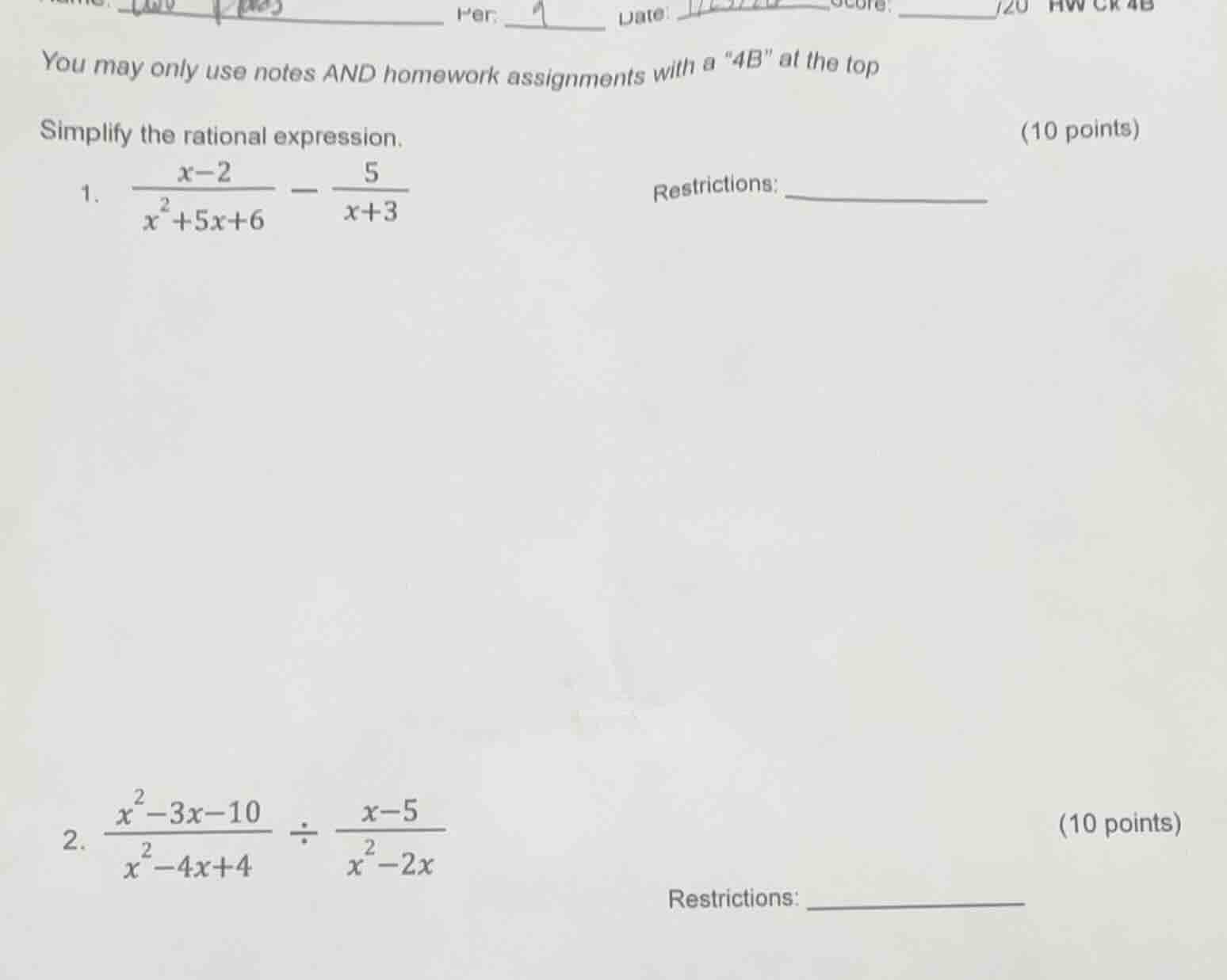
you may only use notes and homework assignments with a \4b\ at the top simplify the rational expression. (10 points) 1. \\(\dfrac{x - 2}{x^2 + 5x + 6} - \dfrac{5}{x + 3}\\) restrictions: \\(\underline{\quad\quad\quad\quad\quad}\\) 2. \\(\dfrac{x^2 - 3x - 10}{x^2 - 4x + 4} \div \dfrac{x - 5}{x^2 - 2x}\\) (10 points) restrictions: \\(\underline{\quad\quad\quad\quad\quad}\\)
Step1: Factor denominator of first term
Factor $x^2+5x+6$:
$x^2+5x+6=(x+2)(x+3)$
The expression becomes:
$\frac{x-2}{(x+2)(x+3)} - \frac{5}{x+3}$
Step2: Get common denominator
Multiply $\frac{5}{x+3}$ by $\frac{x+2}{x+2}$:
$\frac{x-2}{(x+2)(x+3)} - \frac{5(x+2)}{(x+2)(x+3)}$
Step3: Combine numerators
Subtract the numerators over common denominator:
$\frac{(x-2)-5(x+2)}{(x+2)(x+3)}$
Expand and simplify numerator:
$x-2-5x-10 = -4x-12 = -4(x+3)$
Step4: Simplify the expression
Cancel $(x+3)$ from numerator and denominator:
$\frac{-4(x+3)}{(x+2)(x+3)} = \frac{-4}{x+2}$
Step5: Find restrictions for Q1
Denominators cannot be zero:
$(x+2)(x+3)
eq 0 \implies x
eq -2, x
eq -3$
$x+3
eq 0 \implies x
eq -3$
Restrictions: $x
eq -2, x
eq -3$
---
Step6: Factor all polynomials (Q2)
Factor numerators and denominators:
$x^2-3x-10=(x-5)(x+2)$
$x^2-4x+4=(x-2)^2$
$x^2-2x=x(x-2)$
Rewrite division as multiplication by reciprocal:
$\frac{(x-5)(x+2)}{(x-2)^2} \times \frac{x(x-2)}{x-5}$
Step7: Cancel common factors
Cancel $(x-5)$ and $(x-2)$:
$\frac{(x+2) \times x}{x-2} = \frac{x(x+2)}{x-2}$
Step8: Find restrictions for Q2
Denominators cannot be zero, and original divisor cannot be zero:
$(x-2)^2
eq 0 \implies x
eq 2$
$x-5
eq 0 \implies x
eq 5$
$x(x-2)
eq 0 \implies x
eq 0, x
eq 2$
Restrictions: $x
eq 0, x
eq 2, x
eq 5$

Snap & solve any problem in the app
Get step-by-step solutions on Sovi AI
Photo-based solutions with guided steps
Explore more problems and detailed explanations
- Simplified expression: $\frac{-4}{x+2}$; Restrictions: $x
eq -2, x
eq -3$
- Simplified expression: $\frac{x(x+2)}{x-2}$; Restrictions: $x
eq 0, x
eq 2, x
eq 5$