QUESTION IMAGE
Question
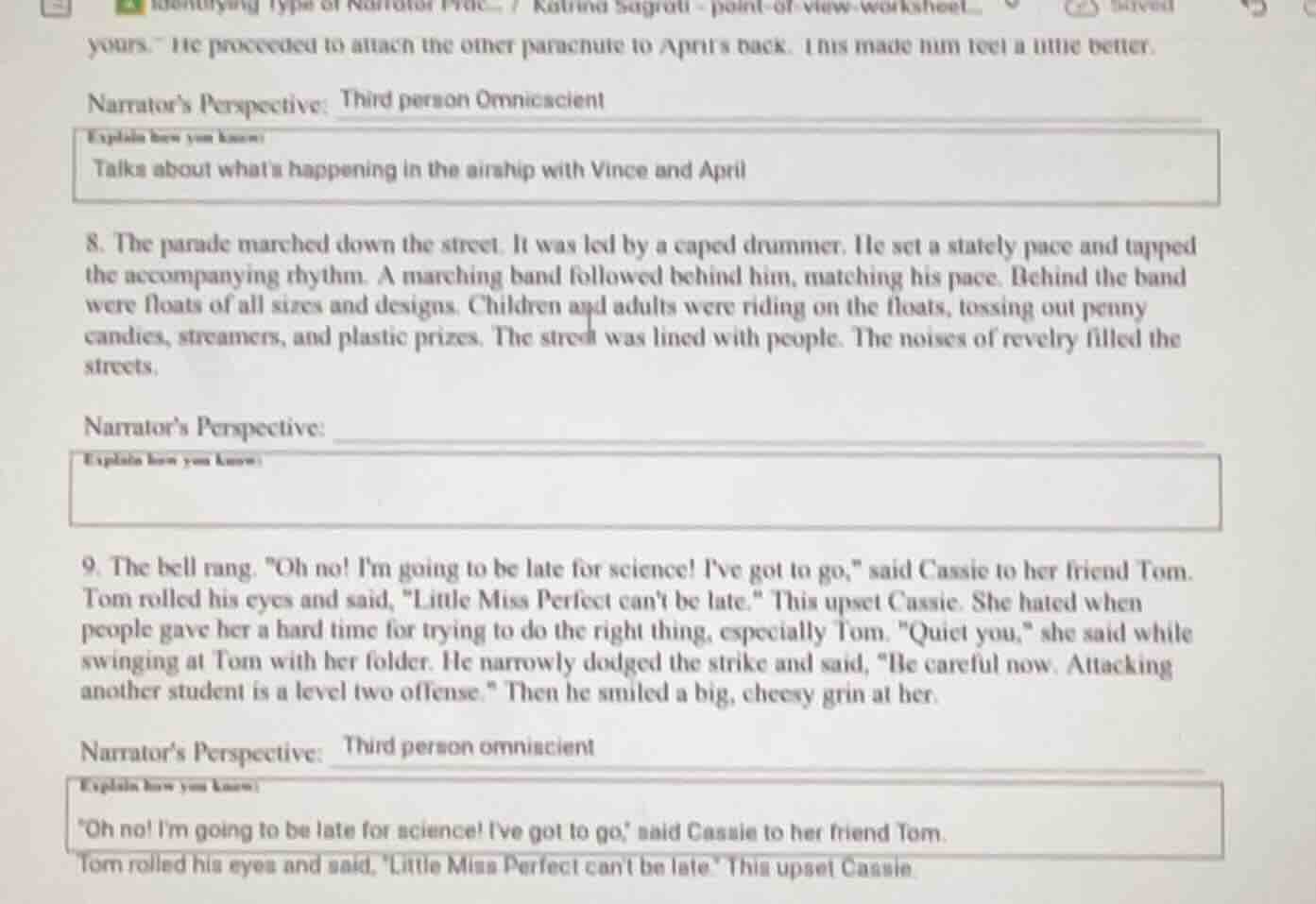
yours.\ he proceeded to attach the other parachute to aprils back. this made him feel a little better.
narrators perspective: third person omniscient
explain how you know:
talks about whats happening in the airship with vince and april
- the parade marched down the street. it was led by a caped drummer. he set a stately pace and tapped the accompanying rhythm. a marching band followed behind him, matching his pace. behind the band were floats of all sizes and designs. children and adults were riding on the floats, tossing out penny candies, streamers, and plastic prizes. the street was lined with people. the noises of revelry filled the streets.
narrators perspective:
explain how you know:
- the bell rang. \oh no! im going to be late for science! ive got to go,\ said cassie to her friend tom. tom rolled his eyes and said, \little miss perfect cant be late.\ this upset cassie. she hated when people gave her a hard time for trying to do the right thing, especially tom. \quiet you,\ she said while swinging at tom with her folder. he narrowly dodged the strike and said, \be careful now. attacking another student is a level two offense.\ then he smiled a big, cheesy grin at her.
narrators perspective: third person omniscient
explain how you know:
\oh no! im going to be late for science! ive got to go,\ said cassie to her friend tom.
tom rolled his eyes and said, \little miss perfect cant be late\ this upset cassie.
Question 8
To determine the narrator's perspective, we analyze the text. The narrator describes the events of the parade (the drummer, the band, the floats, the people on floats, and the crowd) using third - person pronouns like "he", "them", and "the street was lined...". There is no indication of being limited to one character's thoughts or feelings. The narrator has a broad view of the events, describing multiple elements of the parade from an external, all - seeing (but not revealing internal thoughts of characters) perspective, which is characteristic of third - person objective or third - person omniscient (in a more observational way here, but often for such descriptive scenes of events, third - person objective or a form of third - person omniscient that focuses on actions is used. However, since it's describing the events without delving into character thoughts, a common classification is third - person objective, but sometimes also considered third - person omniscient in a general narrative sense for such descriptive passages. But more accurately, for this passage, the narrator is using third - person and is able to describe all the events of the parade (the drummer's actions, the band, the floats, the people on floats, the crowd) without being restricted to one character's viewpoint. So the narrator's perspective is Third person objective (or Third person omniscient in a broad descriptive sense). To explain: The narrator describes the parade events (drummer, band, floats, people on floats, crowd) using third - person pronouns, and there's no focus on a single character's thoughts/feelings, just the actions and scenes.
The narrator's perspective is given as third - person omniscient. We know this because the narrator not only reports the dialogue between Cassie and Tom (e.g., Cassie's "Oh no! I'm going to be late for science! I've got to go," and Tom's "Little Miss Perfect can't be late") but also reveals Cassie's internal feeling: "This upset Cassie. She hated when people gave her a hard time...". A third - person omniscient narrator can access the internal thoughts and feelings of characters, which is what we see here (revealing Cassie's emotions).

Snap & solve any problem in the app
Get step-by-step solutions on Sovi AI
Photo-based solutions with guided steps
Explore more problems and detailed explanations
Narrator’s Perspective: Third person objective (or Third person omniscient)
Explain how you know: Describes parade events (drummer, band, floats, etc.) with third - person pronouns, no single - character thought focus, just actions/scenes.